Motivational gifts are the gifts the Holy Spirit places in every born-again believer, and in this fourth message of the series the pastor turns to the gift of serving. He teaches that each of the seven gifts in Romans 12 is a weapon against a cursed world system, that we must take ownership of our gift instead of treating it like something borrowed, and that God releases His own ability into the lives of those who serve with excellence.
This message continues from Motivational Gifts #3: Romans 12, the Recipe for Your Gift and the Gift of Prophecy. Below you will find the full video, a structured summary, the Scriptures behind each point (linked to the New King James Version on Bible Gateway), a timestamped outline and practical steps for putting your gift to work this week.
Sermon at a Glance
This message was posted on June 27, 2023, and preached at NTC Ministries with a Spanish interpreter at the pastor’s side for visiting believers. He later thanks everyone for giving God their full attention.
He frames the whole series with one idea. When people are born into this world, society shapes them into a personality. When they are born again, Jesus gives them motivational gifts by the Holy Spirit. These gifts are not just temperament; they are grace placed within us so God’s power can flow through us to others.
| Detail | Information |
|---|---|
| Speaker | The pastor of NTC Ministries |
| Series | Motivational Gifts (part 4) |
| Main text | Romans 12:1–8 and 1 Peter 4:9–11 |
| Key theme | The gift of serving and the power of God that follows excellence |
| Length | About 58 minutes |
Weapons Against a Cursed World
One of the series’ foundational passages is Psalm 46:1–5: God is our refuge and strength, a very present help in trouble, so we will not fear though the earth be removed and the mountains shake. There is a river whose streams make glad the city of God; God is in the midst of her, and she shall not be moved.
The pastor reads this as a picture of how God’s gifts work. God is our refuge in a cursed world, so He gifts us with weapons. Every gift He gives is a weapon against the earth curse system, and all of them flow into our lives by the river of the Holy Spirit. He then lays out three groups of gifts in the New Testament.
| Group of gifts | Where he finds it | Who receives it | Purpose as taught |
|---|---|---|---|
| Ascension (fivefold) gifts: apostle, prophet, evangelist, pastor, teacher | Ephesians 4:11–13 | Only some, by God’s preference, not because they are better | To teach the whole body how to do the work of the ministry until we all reach maturity |
| Nine spiritual gifts | 1 Corinthians 12:4–11 | Activated through baptism in the Holy Spirit | Supernatural gifts for warfare in this world |
| Seven motivational gifts: prophecy, serving, teaching, exhorting, giving, leading, mercy | Romans 12:3–8 | Everyone who is born again, each with one dominant gift | Weapons that bring God’s power to help us get up and over in life |
On the first group, he quotes Paul’s promise that these ministries are given “till we all come to the unity of the faith” (Ephesians 4:11–13). They have never been done away with and cannot be, he says, because we need them in this troubled world until Jesus comes. The nine gifts of 1 Corinthians 12:4–11 are supernatural tools for spiritual warfare.
The third group is for everyone. Romans 12:3–8 says we are many members in one body, with gifts differing according to the grace given us: prophecy, ministry, teaching, exhortation, giving, leading and mercy. Every believer has one of these as a dominant gift, even if they use several.
Opening the Door to Your Motivational Gifts
The pastor compares the motivational gifts to the gifts of the Spirit. When Jesus rose from the dead, He breathed on the apostles and said, “Receive the Holy Spirit” (John 20:22), yet He also told them to wait in Jerusalem for the Promise of the Father (Acts 1:4–5). When we are born again, the Spirit comes into us; when we are baptized in the Spirit, we are brought into Him, and His power becomes available.
In the same way, the motivational gifts are handed out to every believer at the new birth, but Romans 12:1–3 shows what we must do to open the door for them. Used well, he says, these gifts are literally weapons against this evil world. He draws four requirements from the passage.
First, from verse 1, we have to be willing to sacrifice our time and energy to work in His kingdom, using our physical abilities. People can sit at home and say, “I’m the church,” but they are not letting what God put in them come out. You have to come among the church and let your gift flow, and then God’s power comes against the evil around you.
Second, from verse 2, we keep our minds renewed in the Word so we can bring the flow of God’s power to the people we serve. Third, from verse 3, we remember these are grace gifts, not part of our natural makeup. We do not despise them or shy away from them; we embrace them as a personal gift from God.
Fourth, each gift is unique. 2 Corinthians 10:12 warns that those who measure and compare themselves among themselves are not wise. Do not decide someone else is so much better that you will not use your gift. Whether you are an organizer, an exhorter who loves to encourage, or a server, the more you use your gift, the more God’s power will flow, at work and on the job as well as at church.
He briefly reviews the previous message on prophecy. Romans 12 says to prophesy in proportion to our faith, which he explains means no one can prophesy beyond their knowledge of the Scriptures. In Peter’s day some boasted of spiritual words that were not scriptural. Peter answered that he had been on the Mount of Transfiguration and heard the Father’s voice, yet he pointed believers to the more sure prophetic word of Scripture (2 Peter 1:16–19). Our ability, the pastor concludes, comes from our knowledge of the Scriptures, not our experiences.

The Gift of Serving
Next comes the second of the motivational gifts. Romans 12:6–7 says, “or ministry, let us use it in our ministering.” The interpreter’s Spanish Bible uses the word serving, and the pastor explains that the Greek word behind ministry is diakonia, meaning to serve, to be in attendance, someone who waits on you.
That is why many countries call their government leaders ministers, he says: they are there to serve the people. Jesus saw rulers in His day who wanted to lord it over others, and Scripture tells leaders not to be lords over those entrusted to them but examples to the flock (1 Peter 5:3). He applies the same principle to the home: children are lent to parents by God, to be raised in the training and admonition of the Lord (Ephesians 6:4), and parents are to guard and protect them.
The gift of serving, the pastor says, is extremely important because it motivates those who have it to meet the practical needs of the church. They have an eye to see needs and meet them. He notes that when someone motivated as a server is called into the fivefold ministry, those churches seem to grow bigger and stronger than with any other motivational gift.
Even ministers whose dominant gift is not serving must take on servanthood, he adds, because a minister has to be more like Jesus than anybody. Leaders in the church are not there to lord over the people but to serve them and be an example.
He then turns to 1 Peter 4:9–11, where Peter writes about these same gifts: “Be hospitable to one another without grumbling. As each one has received a gift, minister it to one another, as good stewards of the manifold grace of God.” Nobody is left out. Whatever gift you have, God has lent it to you to use in the body of Christ.
Take Ownership of Your Gift
The pastor does a short word study on 1 Peter 4:10. The word received, he says, is the Greek lambano, which means to accept something, to personally take it and take ownership of it. If someone lends you a vehicle for a year, you should use it as if it were your own, checking the tires and changing the oil.
He tells a story about a brand new boat he had owned for a year and used only twice. He lent it to a man, and when it came back, the propeller and the lower shaft of the motor were broken, and both sides looked as if someone had pounded them with sledgehammers. No one even apologized.
The pastor believes the man would never have treated the boat that way if it had been his own; he had no investment in it, so it did not matter to him. When we do not use what God has given us, he imagines it looks to God the way that boat looked to him. God’s answer is to receive the gift as our own and use it with all our mind and strength.
The word gift, he continues, is charisma, something given by God. We were not born with it. And the word minister in this verse, he teaches, describes someone who serves in a very wealthy family or a royal court, where service has to be excellent and requires training.
That is why he is puzzled by people who want to serve in the church but refuse instruction and simply do things their own way. Peter’s point, he says, is that you may have a gift, but you still need to be trained so you are excellent in using it.
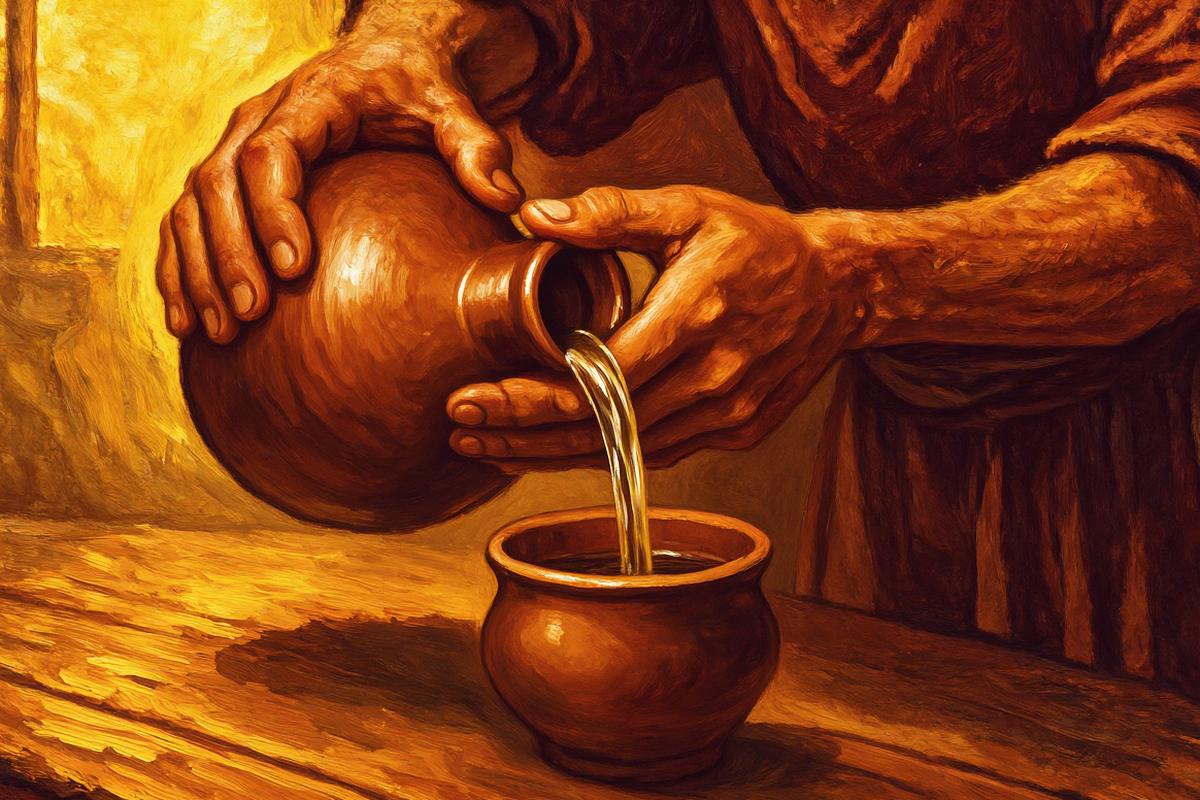
Serve With Excellence, Receive His Ability
To picture excellent service, the pastor describes a visit he and his wife Pam made to what he calls the oldest Mexican restaurant in the United States, in Tampa Bay, Florida, built in the 1830s. They had two servers. One took the order and the other made sure they had everything they needed. The moment their water glasses ran low, someone was there refilling them.
The servers stood out of sight but watched like hawks for whatever guests needed. He says he knows why that restaurant is still running after almost 200 years, and that is how the church should serve. Whatever gift is in your life, do it with all your might.
That is why he works so hard at whatever he does, and why he expects the people around the church to put real effort into whatever they are given or volunteer for. He does not like to hear “what does it matter anyway,” because the Lord says to do it with excellence. Excellence, he explains, means high-level service, giving the very best we can.
Then comes the promise in 1 Peter 4:11: “If anyone ministers, let him do it as with the ability which God supplies.” The pastor says the word ability is ischus, and he compares it to a bodybuilder who works hard to shape his body into a sculpture, listening to every trainer because there is a prize at the end. How much more with God. Whether your gift is giving, serving, exhorting or organizing, work hard at being the best at it, and God will come with supernatural ability.
He shares his own experience from working in the world. Companies never wanted to see him go. At one job at a paper mill in Escanaba, Michigan, for Rust Engineering, the work ended, yet the company kept paying him for six months with nothing to do because they wanted to keep him. He finally asked them to lay him off so he could work elsewhere. It was not because he was a great guy, he says, but because he gave his best.
He links the word ability to an echo. When you use your abilities to the best of your capacity, God’s power comes back to you many times over, like an echo bouncing back again and again. And do not look around asking why no one else works as hard. Just do what you are called to do with everything you have.
Stephen: A Server Full of Power
The pastor’s final example comes from the early church. The Grecian widows were not being fed regularly, and the apostles said they needed to stay focused on prayer and the Word. So they told the church to choose men from among them who were motivated by serving (Acts 6:1–8).
One of them, Stephen, was excellent at what he did. His job, as the pastor puts it, was simply to hand out bread and cheese, make sandwiches and pour milk. But because he put everything into it, the ability of God came on him. Acts 6:8 says, “And Stephen, full of faith and power, did great wonders and signs among the people.” He just wanted to meet the needs of people.
That, the pastor says, is what God wants to do in our lives. Ecclesiastes 9:10 says, “Whatever your hand finds to do, do it with your might; for there is no work or device or knowledge or wisdom in the grave where you are going.” Solomon’s point, as he teaches it, is that these gifts are given for this troubled world, so that the world can see a display of the kingdom of heaven.
We live in an evil world, he says, and there will be battles, stress and strain. But if you apply yourself as fully as you can, God’s ability will come and get you up and over in life, with blessings and empowerment you never imagined, because you used well what He gave you. A half-hearted job, on the other hand, leaves you on your own, no matter how much you pray or fast. Do what you are supposed to do with everything you have, and He serves through you with signs and wonders.
He closes by commending the visiting believers who, though they did not speak English, focused on the Word and gave their full attention. He recalls the people of Israel standing to listen attentively as the Word of God was read in Ezra’s day, and says God empowered them to rebuild Jerusalem’s walls despite their enemies. American Christians, he warns, can grow lazy when everything is handed to them. Be diligent in everything, he urges, even if your service today is just with your ears, and God will reward you.
Using Your Gift This Week
The pastor’s challenge is simple: whatever gift God has given you, receive it as your own and use it with excellence. These steps come straight from the message:
- Show up and serve. Give time and energy among the church instead of claiming to be the church from home.
- Look for practical needs. If serving is your gift, train your eye to see what is lacking and meet it quietly.
- Treat your gift as your own. Do not handle it like the borrowed boat; invest in it and care for it.
- Take instruction. Ask how things should be done and learn to do them well, as servers in a royal court must.
- Stop comparing. Do not measure yourself against others; do your part with everything you have.
- Expect His ability. Like Stephen, do ordinary service with all your might and trust God to add His power.
Timestamped Outline
- 0:00 Personality versus motivational gifts; Psalm 46
- 1:52 Reading Psalm 46 with the interpreter
- 4:13 Every gift is a weapon; the fivefold ministry
- 7:13 Nine spiritual gifts and seven motivational gifts
- 9:32 Reading Romans 12:3–8
- 12:14 Born again and baptized in the Spirit
- 14:26 Sacrifice your time and energy
- 16:31 Renewed minds, grace gifts and no comparing
- 18:42 Review: prophecy in proportion to faith
- 21:03 The gift of serving: diakonia
- 27:49 Servers meet practical needs
- 30:01 1 Peter 4:9–11 word study
- 32:49 Lambano and the borrowed boat
- 34:51 Charisma and royal-court service
- 36:58 The restaurant in Tampa
- 40:46 Doing everything with excellence
- 42:55 The ability God supplies: ischus
- 45:06 Paid to stay on the payroll
- 48:40 Stephen and the daily distribution
- 50:48 Whatever your hand finds to do
- 54:58 Diligent listening and closing charge
Motivational Gifts Series
This message is part of a ten-part teaching on the motivational gifts. Start from the beginning or continue with the next message:
- First message: Motivational Gifts #1: The River, the Streams and the 21 Gifts of God
- Previous: Motivational Gifts #3: Romans 12, the Recipe for Your Gift and the Gift of Prophecy
- You are here: Motivational Gifts #4: The Gift of Serving and the Ability God Supplies
- Next: Motivational Gifts #5 — Why Did You Call Me, Lord? The Gift of Serving and Martha’s Example
Frequently Asked Questions
Can someone have more than one motivational gift?
The pastor teaches that every born-again believer has one of the seven gifts in Romans 12 as a dominant gift, even though they may use several of them. The dominant gift shapes how you naturally see and respond to needs. A person motivated by serving, for example, has an eye to notice practical needs and meet them, while others may lean toward teaching, giving or mercy.
Do pastors need the gift of serving?
Not necessarily as their dominant gift, but the pastor says anyone called into the fivefold ministry must take on servanthood anyway, because ministers have to be more like Jesus than anybody. Leaders are not there to lord over the people but to serve them and be an example. He also observes that churches led by those whose motivational gift is serving often grow bigger and stronger.
Why does the pastor stress training and instruction?
Because, as he teaches from 1 Peter 4:10, the word for minister describes service in a wealthy household or royal court, where work must be excellent and servers must be trained. Having a gift is not enough. He finds it hard to understand volunteers who refuse instruction and do things their own way, and says Peter wants every gift trained so it is used with excellence.
Scripture References
All passages open in the New King James Version on Bible Gateway:
- Romans 12:3–8 — the seven motivational gifts
- Romans 12:1–3 — opening the door to your gift
- Psalm 46:1–5 — God our refuge and strength
- Ephesians 4:11–13 — the fivefold ministry gifts
- 1 Corinthians 12:4–11 — the nine spiritual gifts
- 1 Peter 4:9–11 — good stewards of God’s grace
- Acts 6:1–8 — Stephen, full of faith and power
- Ecclesiastes 9:10 — do it with your might
How this summary was made: written with AI assistance from the sermon’s own transcript and checked against the Scriptures listed above.
Watch More Messages
If this message stirred you to put your gift to work, there are hundreds more teachings from NTC Ministries waiting for you. Browse the full sermon archive and keep growing in the grace God has given you.