The Holy Spirit and power go together because the Holy Spirit is not a symbol or an impersonal force; He is a real Person of the Godhead who teaches, guides, comforts, intercedes, convicts and makes us new. In this fifth message of the series, Dr. William P. Hohman lays a Scripture-heavy foundation for the person of the Holy Spirit and His work within the believer. It follows Holy Spirit and Power #4: The Benefits of Speaking in Tongues.
The service opens with a short teaching on Psalm 1 and being doers of the Word. Below you will find the full video, a structured summary, every Scripture linked to the New King James Version on Bible Gateway, a timestamped outline and practical steps for the week ahead.
Sermon at a Glance
This service from the New Testament Church in Merrill, Wisconsin, was posted on August 24, 2020. It opens with worship, a short teaching on Psalm 1 during the offering, and an update on the church’s Christian academy. Dr. Hohman then returns from ministering at a camp meeting in northern Wisconsin and continues his series on the Holy Spirit.
The first four weeks covered the Holy Spirit and prayer, including the prayer language. This week he begins to separate the work of the Holy Spirit within us from His work upon us, starting with what He does inside the believer. He admits the message is “a little scripture heavy,” because his goal is simply to prove from the Bible that the Holy Spirit is truly a Person.
| Detail | Information |
|---|---|
| Speaker | Dr. William P. Hohman |
| Series | Holy Spirit and Power, part 5 |
| Main text | John 16:8–11 and John 3:3–8 |
| Key theme | The Holy Spirit is a Person and God, and He makes us new from within |
| Length | About 94 minutes, with the teaching beginning near the 30-minute mark |
Doers of the Word: The Tree by the Rivers of Water
Before the offering, the minister leading that part of the service reads from Psalm 1:1–3. Blessed is the man who does not walk in the counsel of the ungodly, but whose delight is in the law of the Lord. He asks how many have found that when you apply the Word to your life it produces fruit. When the Bible says do this and you do it, God takes what is natural and makes it supernatural.
The person who does the Word is like a tree planted by rivers of water, where the water never stops and the soil is always rich. That tree brings forth fruit in its season, its leaf does not wither, and whatever it does prospers. Being a doer, he says, is not religious activity on Sunday mornings; it is walking out the door as a Spirit-filled son or daughter of God.
He also announces that the church’s Christian academy will open the day after Labor Day, with a mission to train children in the way they should go (Proverbs 22:6), and asks for intercessors and volunteers.
Standing Against the Spirit of the World
Dr. Hohman says the spirit of the world has gotten into the church in a big way, and the only thing believers have to stand against it with is the Word of the living God. That is a biblical worldview, not just a worldview. Do not let the world tell you how to make your decisions or set your standards. But without the Holy Spirit, he warns, you will never be able to stand on the Word of God at all.
The Holy Spirit is the one who strengthens us, giving fortitude and stamina where people would normally have none. Dr. Hohman calls this grace, and grace is specific. Soon after leaving the military, the Lord told him to work for no pay for a man cutting wood, whom he found sitting on a stump crying as his marriage and business fell apart. He helped, but he admits it was not his grace.
The lesson he draws is that everybody is graced differently, and that is the Holy Spirit at work in our lives. So do not condemn yourself in areas where you are not graced, and do not boast about the areas where you are. Every grace comes from God, not from ourselves. This sets up the rest of the series: the Holy Spirit works within us and upon us, and each position brings its own attributes.
The Person of the Holy Spirit
Dr. Hohman cites a Barna Group survey reporting that six out of ten American Christians do not believe the Holy Spirit is a living force, with 58 percent strongly agreeing He is just a symbol of God’s power. Churches that believe this, he says, are powerless, without Holy Spirit and power, performing a religious duty they call worship.
Real worship, he teaches, is dying to yourself and doing what God wants done. In Romans 12:1–2 the same word can be translated service or worship, which is why a worship service is not a spectator’s service. If he is not serving people with the graces God has given him, he says, he is not really a worshiper.
He affirms the Trinity: the Father, the Son and the Holy Spirit are each a distinct Person of the Godhead, the same in essence and deity. His first proof is that Scripture describes the person of the Holy Spirit in personal terms, as the table below gathers.
| What the Holy Spirit does | Scripture he reads | What it shows |
|---|---|---|
| Comforts and teaches all things | John 14:26 | He brings to remembrance what Jesus said |
| Guides into all truth | John 16:13 | He is the Spirit of truth, a Person who leads |
| Intercedes with groanings | Romans 8:26 | He helps us in our weaknesses |
| Can be grieved | Ephesians 4:30 | He has emotions |
| Reveals what God has given | 1 Corinthians 2:12 | He has an intellect He shares |
| Distributes gifts as He wills | 1 Corinthians 12:11 | He has a will and takes responsibility |
From John 14:26 he notes that the academy teaches children to pray before a test, trusting the Holy Spirit to bring to remembrance what they learned. John 16:13 says He will guide you into all truth.
Romans 8:26 shows that the Holy Spirit helps in our weaknesses, and Ephesians 4:30 warns us not to grieve Him. Every born-again believer has grieved Him, he says, and the answer is to humble yourself and say, “Forgive me, Lord.”
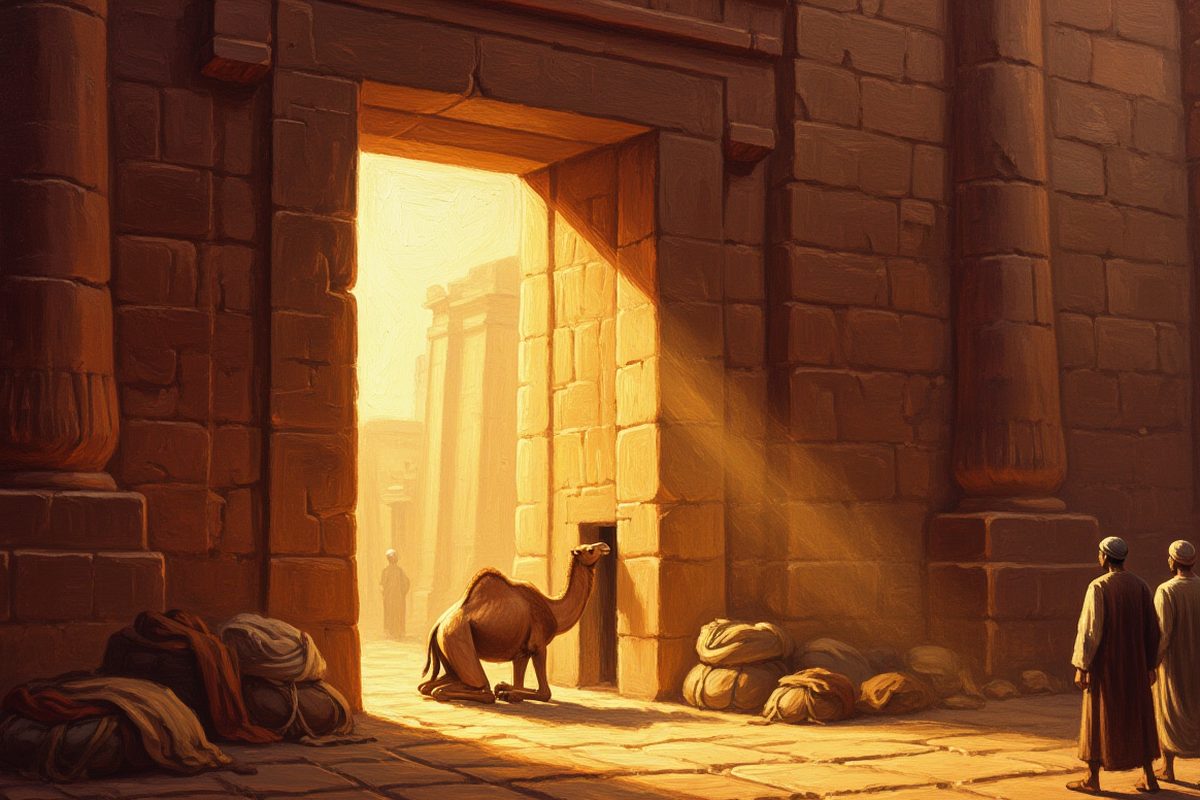
That humility leads him to Jesus’ words about a camel going through the eye of a needle (Matthew 19:24). He teaches that the eye of the needle was a small door in the city gate used at night, so a merchant had to unload his camel and have it crawl through on its knees. It is easier for a camel to bow, he says, than for a rich man who trusts his money and brilliance to bow to God. Every knee will bow (Philippians 2:10–11), and he would rather bow now, willingly.
Finally, 1 Corinthians 2:12 and 1 Corinthians 12:11 show that the Holy Spirit reveals what God has freely given and distributes gifts as He wills. If you think you have nothing, the Holy Spirit is responsible, and He will do His job.
The Holy Spirit Is God
The next proof is that Scripture calls the Holy Spirit God. In Acts 5:1–4, Ananias and Sapphira sold their property and claimed to give the whole price while keeping part back. Peter asked why Satan had filled Ananias’s heart to lie to the Holy Spirit, then said he had not lied to men but to God. Lying to the Holy Spirit, Dr. Hohman points out, is lying to God. They could have given part honestly; the lie was the problem.
Hebrews 10:15–17 says the Holy Spirit witnesses to us about the covenant the Lord makes: He will put His laws into our hearts and write them on our minds, and remember our sins no more. The Spirit speaks the covenant of the Lord, so He is God. In the Old Testament, he adds, the Holy Spirit came on people only for a task or season. Because of Jesus the Mediator, believers now receive the fullness of His ministry as a royal priesthood (1 Peter 2:9).
Dr. Hohman dwells on the word witness, giving the Greek as martureo, from which the word martyr comes. A martyr lays down his life for the glory of God, and the Holy Spirit is the one who strengthens us to lay our own lives down for Jesus. Israel promised to do everything the Lord said and broke that promise at once; our strength to obey is the Holy Spirit, the same Spirit who was upon Jesus. He points to Wurmbrand, author of Tortured for Christ, as proof of that strength.
The Holy Spirit also has the attributes of deity. Psalm 139:7–10 asks where we could go from His Spirit; if we ascend to heaven or make our bed in hell, He is there. That is omnipresence. In Hebrews 11:1–2 the elders obtained a good report by faith, and he ties that phrase to the same martyr word: by faith they laid their lives down. For us, he says, it usually means giving up our own preferences and saying, “Here am I.”
Conviction, Not Condemnation
The Holy Spirit plays a major role in the application of salvation. Without Him nobody can be saved, because salvation is an inward work and a heart transformation. In John 16:8–11 Jesus said the Spirit would convict the world of sin, of righteousness and of judgment. Dr. Hohman takes each in turn.
On sin, he recalls the comedian George Carlin mocking the idea of a loving God who gives ten commandments and sends people to hell for breaking one. That is not what God does, he says. The Spirit convinces us that we do not live up to God’s standard, so we need Him to be our standard. On righteousness, the Spirit shows that we have no righteousness of our own. Our righteousness is as filthy rags, so God offers us the gift of His righteousness. That, he says, is an all-loving God.
On judgment, those living under the god of this world, who is judged, will feel that judgment, but those living under the One who took all judgment are free from condemnation, because where the Spirit of the Lord is, there is liberty (2 Corinthians 3:17). Salvation is confessing Jesus as Lord, not only Savior (Romans 10:9); anything less, he says, is a doctrine of devils.
Conviction and condemnation can feel the same, a heaviness that says something is not right. The difference is where they lead:
| Condemnation says | Conviction says |
|---|---|
| You failed and there is no hope for you | You failed, but come to Me |
| You will never change | I will change you and help you |
| You are worthless | I will cleanse you, strengthen you and transform you |
Sin is sin whether the world or the church does it, he says, but a Christian can run to the One who cleanses. Even Jesus prayed, “Not My will, but Yours, be done” (Luke 22:42). We cannot perform God’s will in our lives, but He can.

Born of the Spirit and Made New
In John 3:3–8 Jesus told Nicodemus that unless one is born again he cannot see the kingdom of God, and unless he is born of water and the Spirit he cannot enter it. The wind blows where it wishes, and so is everyone born of the Spirit. People who only ask God to heal them or pay their debts, without giving Him their lives, never see what His kingdom really is.
Being born again, Dr. Hohman says, is not a polite request for Jesus to come into your life. It is asking God to forgive your sin and laying your life down, like the camel crawling through the gate. Then there is a breaking, a liberty and resurrection life. Without a real new birth, water baptism just sends a dry sinner down and brings a wet sinner up.
The absence of the Holy Spirit is a mark that someone is unsaved. Romans 8:9 says, “Now if anyone does not have the Spirit of Christ, he is not His.” Reading Jude 1:19 in the New Living Translation, he notes that those who cause divisions follow their natural instincts because they do not have God’s Spirit. Where the Spirit is, people build unity. Titus 3:5 adds that He washed away our sins and gave us new birth and new life through the Holy Spirit.
He then states the key distinction for the series. When the Holy Spirit is within us, His work is for us: He washes, cleanses and causes fruit such as joy, goodness and peace. When He is upon us, it is for others, as in Luke 4:18, where the Spirit anointed Jesus to preach the gospel to the poor and heal the brokenhearted. If you will not humble yourself to Him for your own life, he says, you will not humble yourself for others.
2 Corinthians 5:17 says, “If anyone is in Christ, he is a new creation.” David prayed for a clean heart and a right spirit (Psalm 51:10), and Ezekiel 36:25–27 promises a new heart, a new spirit and God’s Spirit within us. Giving your life to Jesus, he says, is not mainly about getting healed or prosperous; it is letting the Holy Spirit change you into His image.
He illustrates with his daughter Sarah at about four years old. She would hold his hand and lean back until her grip failed and she fell. He told her to let him hold her hand instead. Once she trusted his grip rather than hers, she leaned all the way back and he laid her gently on the floor. Christianity, he says, has nothing to do with our strength and everything to do with God’s strength.
Living in Holy Spirit and Power This Week
Dr. Hohman closes by leading the church in a prayer of repentance and surrender: asking forgiveness, making Jesus Lord and Savior, and inviting the Holy Spirit to give a new heart and empower a Christian life. Next week, he says, he will turn to the Holy Spirit upon us and the anointing. Here are practical steps from this message:
- Do the Word, not just hear it. Pick one instruction from Psalm 1 or this message and act on it this week.
- Talk to the Holy Spirit as a Person. Thank Him as Teacher, Guide, Comforter and Intercessor, and ask Him to bring to your remembrance what you have learned.
- Respond quickly to conviction. When you sense you have grieved Him, say, “Forgive me, Lord,” and let Him strengthen you instead of carrying condemnation.
- Serve with your grace. Ask where God has graced you and use it to serve people, without boasting or condemning yourself where you are not graced.
- Bow willingly. Like the camel at the gate, lay down whatever you are holding on to and make Jesus Lord, not only Savior.
- Lean on His strength. Like Sarah leaning back in her father’s grip, stop measuring God’s strength by your weakness.
Timestamped Outline
- 0:00 Opening prayer and worship
- 11:14 Psalm 1: delight in doing the Word
- 14:36 Christian academy announcement
- 30:15 Dr. Hohman returns from camp meeting
- 38:56 Working in the woods: everyone is graced differently
- 40:50 A survey on belief in the Holy Spirit
- 45:27 The Holy Spirit described in personal terms
- 47:48 John 14:26 and John 16:13
- 50:24 Romans 8:26 and Ephesians 4:30
- 51:37 The camel and the eye of the needle
- 55:05 Ananias and Sapphira: the Holy Spirit is God
- 58:29 Martureo: the witness and the martyr
- 1:03:03 Psalm 139: the attributes of deity
- 1:05:34 John 16: conviction of sin, righteousness and judgment
- 1:11:36 Conviction versus condemnation
- 1:15:36 John 3: you must be born again
- 1:23:10 The Spirit within us and upon us
- 1:29:24 Sarah leaning back on her father’s hand
- 1:31:43 Prayer of salvation and surrender
Holy Spirit and Power Series
This is the fifth message in the series. Start from the beginning or go back one step:
- First message: Holy Spirit and Power #1: The Importance of the Holy Spirit and Jesus the Baptizer
- Previous: Holy Spirit and Power #4: The Benefits of Speaking in Tongues
- You are here: Holy Spirit and Power #5 — The Person of the Holy Spirit Within Us
Frequently Asked Questions
Is the Holy Spirit the same as the Father and the Son?
Dr. Hohman teaches that the Holy Spirit is the same in essence and deity as the Father and the Son, yet He is a distinct Person of the Godhead with His own purpose. He affirms belief in the Trinity: the Father, Jesus and the Holy Spirit are each a separate Person. Jesus came as Redeemer, and after He ascended, the Holy Spirit was given to regenerate, renew and empower believers.
Why did the Holy Spirit stay on believers in the New Testament but not always in the Old?
According to this message, in the Old Testament the Holy Spirit came upon people only for a duty, a season or a particular moment, and seldom remained. Because Jesus came as the Mediator between God and man, the fullness of the Spirit’s ministry can now be applied to every believer. Believers are sealed with the Holy Spirit of promise as a royal priesthood called out of darkness into His light.
What will the next message in the series cover?
Dr. Hohman explains that this message dealt with the Holy Spirit within us so that the next one can turn to the Holy Spirit upon us and the anointing. He says everyone who knows Jesus Christ is anointed by God, and that believers will grow intimate with the Holy Spirit, become comfortable with the anointing and do greater things for God.
Scripture References
All passages open in the New King James Version on Bible Gateway:
- Psalm 1:1–3 — the tree planted by the rivers of water
- John 14:26 and John 16:13 — the Spirit teaches and guides
- Romans 8:26 — the Spirit intercedes for us
- Acts 5:1–4 — lying to the Holy Spirit is lying to God
- Hebrews 10:15–17 — the Spirit witnesses to the covenant
- Psalm 139:7–10 — where can I go from Your Spirit
- John 16:8–11 — conviction of sin, righteousness and judgment
- John 3:3–8 — born of water and the Spirit
- Ezekiel 36:25–27 — a new heart and a new spirit
How this summary was made: written with AI assistance from the sermon’s own transcript and checked against the Scriptures listed above.
Watch More Messages
If this teaching helped you know the Holy Spirit better, there are hundreds more messages from NTC Ministries to explore. Browse the full sermon archive and keep growing in His presence and power.