Entering your promise land, as this message is titled, starts with a change of mind: God has already delivered His people, but they must stop living like slaves, stop grumbling, and trust His word enough to obey it. The speaker walks through Israel’s exodus from Egypt, Psalm 34, the healing of the paralyzed man, Joshua’s commission and the fall of Jericho to show why so many believers stay stuck in the wilderness.
Below you will find the full video, a structured summary of the sermon, every Scripture used (linked to the New King James Version on Bible Gateway), a timestamped outline, and practical steps for walking into the blessings God has promised.
Sermon at a Glance
This message was preached at NTC Ministries and posted on April 25, 2022. The speaker is not named in the recording. He mentions that Dr. Hohman had read Joshua 1 in a message about a month earlier, and that studying that passage is where God gave him this sermon. It runs about an hour and ends in prayer.
His burden is simple. God wants His people blessed, healed and provided for, yet many Christians never walk in it. Like the Israelites, they were set free but kept the mindset of slavery, and that mindset kept them circling instead of entering their promise land.
| Detail | Information |
|---|---|
| Speaker | Not named in the recording (a pastor at NTC Ministries) |
| Series | Stand-alone message |
| Main text | Joshua 1:6–9 and Joshua 6 |
| Key theme | Trading a grumbling, fearful slave mentality for trust and obedience |
| Length | About 60 minutes, closing with prayer |
Basic Instructions Before Leaving Earth
The speaker begins with a slogan he has seen on t-shirts and bumper stickers: BIBLE stands for Basic Instructions Before Leaving Earth. God’s word does start with the basics, he says, but it goes into great detail, and it teaches not only how to get to heaven but how to live in this earth. Its stories are true, but they are also principles meant to be applied now.
He asks whether the church really believes God wants them blessed. God promises to do exceedingly abundantly above all we ask or think (Ephesians 3:20), and yet there are seasons when we wonder why we are not seeing it. He admits he feels the same pressures everyone else feels in this world.
Jesus felt them too. In the Garden of Gethsemane His soul was heavy, He sweated as it were great drops of blood, and He asked His disciples to pray with Him. Still He prayed, “Nevertheless not My will, but Yours, be done” (Luke 22:42–44). The speaker returns to that prayer again and again in this message. Trusting God when we cannot see or feel His work is how believers receive what He has for them.
Free, but Still Thinking Like Slaves
He recaps the exodus. The Israelites were not employees of Egypt; they were slaves, beaten, whipped and living in fear every day. That, he says, is a type and shadow of what Jesus came to do: bring us out of a slave mentality and fear and into the promises of God.
When the Israelites cried out, God sent Moses, and even Moses doubted he was the right person. The speaker points out that the God who made the heavens, calls the stars by name and numbers the hairs on our heads understands far more than we do, yet our flesh still resists Him. His ways and thoughts are higher than ours, so the right response is to surrender and obey.
Pharaoh refused again and again until the plagues ended with the loss of the firstborn. Put yourself in the slaves’ place, the speaker says. After the first refusal they likely concluded that God’s plan had failed and focused on everything going wrong. Then, after they finally left, Pharaoh’s army trapped them at the Red Sea, and instead of celebrating their freedom they assumed God had brought them out to die.
Moses cried out to God, struck the water with his staff, and the sea opened so they could cross on dry ground (Exodus 14:21–22). He notes that it was not muck; it was dry land. God can deliver you from all your troubles, he says, but you have to step into it with a new mindset. In Christ all things become new (2 Corinthians 5:17), and the only one who keeps bringing up your forgiven past is Satan.
Yet the Israelites murmured and bickered for forty years, and that generation never entered the promise land. God delivered them from bondage, but they never changed their mentality. The speaker contrasts that with the believer who wakes up saying today will be the best day ever, because it is a day God has made, and who expects God to bless his family, workplace and everyone he meets.
Taste and See: Lessons From Psalm 34
How does a believer change? Through the Word, he says. Read it, study it and memorize it. He mentions the confessions displayed in the church entryway, and the student confession recited in the church’s school, and urges people to memorize such confessions and declare them daily.
That way, when sickness tries to come, you can declare that by His stripes you are healed (Isaiah 53:5). When a bill comes due, you can stand on the kingdom economy Dr. Hohman recently taught: give, and it will be given to you, good measure, pressed down, shaken together and running over (Luke 6:38). God has not given us a spirit of fear, but of power, love and a sound mind (2 Timothy 1:7).
He then reads Psalm 34:8–16, where David teaches the happiness of those who trust God: “Oh, taste and see that the LORD is good; blessed is the man who trusts in Him!” Fearing the Lord does not mean being scared of a deity waiting with lightning bolts. It means reverence for His holiness, submission, respect and love in return for His unconditional love.
Those who seek the Lord shall not lack any good thing, so he seeks Him first thing every morning: good morning, Heavenly Father; good morning, Holy Spirit; good morning, King Jesus. He thanks God for the day and asks for eyes to see His goodness and to look to Him as the source of strength, wisdom and peace.
The psalm then asks who desires life and wants to see good days, and the answer is to keep your tongue from evil and your lips from speaking deceit. He cannot imagine spending forty years bickering and questioning leadership. There is a simple test for any thought, he says: God wants to prosper, bless, increase and heal us, so why entertain any thought that says otherwise? Believers are called to be doers of the word, not hearers only (James 1:22).

Faith That Jesus Can See
Depart from evil and do good, the psalm continues. We are not to be conformed to this world but transformed by renewing the mind (Romans 12:2). He has stopped feeding on negative headlines and chooses to think on whatever is true, pure and good (Philippians 4:8). God has given thousands of promises, and the word of God works.
The eyes of the Lord are on the righteous. David marvels that God is mindful of man (Psalm 8:4), and the speaker says God’s mind is filled with you. By my God I can leap over a wall (Psalm 18:29), and greater is He who is in you than he who is in the world (1 John 4:4).
On friendships he is balanced. Love and care for unbelieving friends and show them the way, but remember that evil company corrupts good habits (1 Corinthians 15:33). If they are not changing, check whether you are. Seek first the kingdom of God (Matthew 6:33), and remember that we love the sinner, because we were all sinners once. Believers are salt and light in this world (Matthew 5:13–14).
In Matthew 9:1–7, friends carried a paralyzed man on a mat to Jesus, and Jesus saw their faith. Faith, the speaker says, is not wondering whether you can fit Jesus in between gardening and fishing. It is knowing that all you need is His word. Jesus forgave the man’s sins, and the teachers of the law accused Him of blasphemy.
Jesus knew their thoughts, just as God knew where Adam was hiding in the garden. He asked why they entertained evil thoughts, then told the man to take up his mat and go home, and he did. The teachers were focused on the wrong thing: not that a man was healed, but whether Jesus was allowed to do it.
That is why we stay in the Word, he says, so that signs and wonders feel normal. He shares his testimony of seeing people prayed for whose later x-rays showed nothing, and of a man in Africa whose skull was crushed when a truck hit his motorcycle. The man went to church anyway, pressed in during loud worship, and declared that if God could heal one, He could heal him. The speaker reports that the next day’s x-rays showed no trace of a fracture.
Entering Your Promise Land: Joshua and Jericho
Before turning to Joshua, he reminds the church how blessed they are: closets to choose clothes from and food to choose each day, while he has visited places where people carry their shoes over their shoulders as a sign of prosperity. Yet we still grumble. He does not want to be like the teachers of the law, or like the Israelites who complained for forty years while seeing God’s blessings.
After Moses endured forty years of complaints from the Israelites, God gave Joshua a pep talk in Joshua 1:6–9. Three times He says to be strong and of good courage, once adding very courageous, as if Joshua needed extra for the people he was leading. Joshua was not to turn to the right or the left, but to do what God said.
The book of the law was not to depart from his mouth, the speaker explains, meaning the Word would keep flowing from him and never run dry. He was to meditate on it day and night and do it, and then he would make his way prosperous and have good success. “Have I not commanded you? Be strong and of good courage; do not be afraid, nor be dismayed, for the LORD your God is with you wherever you go.”
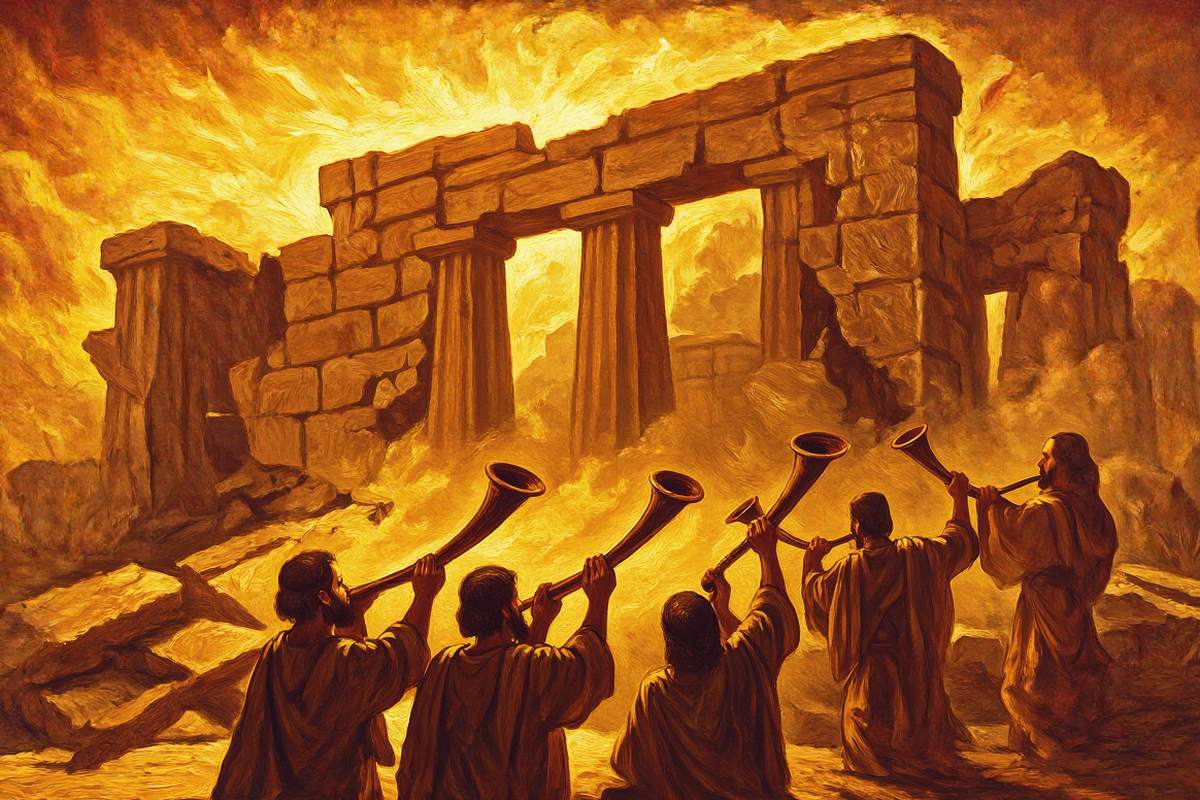
Joshua’s first test was Jericho, described in Joshua 6:1–20. The city was securely shut up, with walls so thick, the speaker says, that chariot races were held on top. Joshua was a mighty man of valor, yet God told him to march around the city once a day for six days, seven times on the seventh, then have the priests blow the ram’s horns and the people shout.
The table below follows the speaker’s comparison between the generation that wandered and the people who took Jericho.
| In the wilderness | At Jericho |
|---|---|
| Freed, but kept a slave mentality | Followed God’s instruction without understanding it |
| Murmured and complained for forty years | Were told not to say a word until the shout |
| Questioned the leaders God gave them | Listened when the ram’s horns sounded |
| Saw provision but chose not to see it | Saw the wall fall down flat |
| Never entered the promise | Went straight in before them |
Joshua commanded silence: “You shall not shout or make any noise with your voice, nor shall a word proceed out of your mouth, until the day I say to you, ‘Shout!'” The speaker believes Joshua knew exactly what forty years of grumbling sounded like and would not let it start again. When the people shouted at the long blast of the ram’s horn, the wall fell down flat and they went straight in. That, the speaker says, is what entering your promise land looks like: obedience without grumbling.
Guarding Your Mouth and Asking in Faith
Everyone has a human nature that raises questions, the speaker admits, which is why we must be built up in our most holy faith. Jesus said that in Him we may have peace, though in the world we will have tribulation; be of good cheer (John 16:33). “Many are the afflictions of the righteous, but the LORD delivers him out of them all” (Psalm 34:19).
So stay in the joy of the Lord. “A merry heart does good, like medicine, but a broken spirit dries the bones” (Proverbs 17:22). Even when he does not feel it, he declares that the joy of the Lord is his strength (Nehemiah 8:10). He who guards his mouth preserves his life (Proverbs 13:3), which is why he does not need to read everyone’s venting on social media.
David himself prayed for help: “Set a guard, O LORD, over my mouth; keep watch over the door of my lips” (Psalm 141:3), and asked that the words of his mouth and the meditation of his heart be acceptable to God (Psalm 19:14). In the kingdom, words build up and let our light shine.
In James 1:4–8, let patience have its perfect work so that you may be perfect and complete, lacking nothing. He asks the church to read it personally, in me. Ask God for wisdom, but ask in faith without doubting, because the one who doubts is like a wave of the sea, a double-minded man unstable in all his ways.
Did God ever promise an okay life? No, Jesus came to give life more abundantly; it is the thief who steals, kills and destroys (John 10:10). So get angry at Satan, not at God. Background, age and upbringing do not matter, he says. You are fearfully and wonderfully made (Psalm 139:13–14), not a mistake, and you only have to choose to walk in it.
Walking Into the Promise This Week
Here are the practical steps drawn from this message:
- Pray the Gethsemane prayer. When you feel caught between a rock and a hard place, say, not my will but Yours be done.
- Start the day with God. Greet the Father, the Holy Spirit and King Jesus each morning and ask for eyes to see His goodness.
- Memorize and declare the promises. Learn confessions from the Word so you can answer fear, sickness and lack with Scripture.
- Put a guard on your mouth. Refuse grumbling, complaining and negative venting, at home, at work and online.
- Test every thought. If a thought does not line up with a God who wants to bless, heal and increase you, do not entertain it.
- Obey before you understand. Like Joshua and the Israelites at Jericho, follow what God has told you even when the plan makes no natural sense.
Timestamped Outline
- 0:00 Basic Instructions Before Leaving Earth
- 0:52 Does God really want you blessed?
- 1:39 Gethsemane: not my will but Yours
- 3:29 The Israelites’ slavery in Egypt
- 4:24 God sends a reluctant Moses
- 8:23 Trapped at the Red Sea
- 10:24 Forty years of complaining
- 13:21 How do I change? Memorize the Word
- 15:06 Psalm 34: taste and see
- 17:15 Seeking the Lord every morning
- 18:58 Keep your tongue from evil
- 24:46 Unsaved friends and priorities
- 26:45 Matthew 9: the paralyzed man
- 31:04 The healing testimony from Africa
- 35:05 Joshua 1: be strong and of good courage
- 37:55 Jericho, the fortified city
- 40:52 Why Joshua commanded silence
- 43:03 The wall falls down flat
- 45:28 John 16:33 and Psalm 34:19
- 47:25 A merry heart and a guarded mouth
- 50:30 James 1: ask in faith
- 56:46 Fearfully and wonderfully made
- 59:12 Closing prayer
Frequently Asked Questions
Is it wrong to feel doubt or frustration as a Christian?
The speaker does not pretend believers never feel pressure. He says he feels the same things everyone feels, and he points to Jesus in Gethsemane, whose soul was heavy. The difference is what you do next. Jesus still prayed for the Father’s will, and the speaker encourages believers to answer those feelings with the Word instead of entertaining them or voicing them as complaints.
Does this message mean I should cut off unbelieving friends?
No. He says it is fine to have friends who do not know Jesus and that we should love them, care for them and show them the way. His caution is about influence: if you are not seeing a change in their lives, check whether they are changing yours. Keep God first, pray for them, and remember that you were once a sinner too.
What does “the fear of the Lord” mean in Psalm 34?
He teaches that it is not being afraid of God as if He were waiting to strike you for every mistake. It is reverence for His holiness, respect, submission and a love that answers His unconditional love. In Psalm 34, those who fear the Lord in this way lack nothing, and those who seek Him lack no good thing.
Scripture References
All passages open in the New King James Version on Bible Gateway:
- Joshua 1:6–9 — be strong and of good courage
- Joshua 6:1–20 — the walls of Jericho fall
- Exodus 14:21–22 — crossing the Red Sea on dry ground
- Psalm 34:8–16 — taste and see that the Lord is good
- Matthew 9:1–7 — Jesus heals the paralyzed man
- Luke 22:42–44 — not My will, but Yours
- Psalm 141:3 — set a guard over my mouth
- James 1:4–8 — ask in faith without doubting
How this summary was made: written with AI assistance from the sermon’s own transcript and checked against the Scriptures listed above.
Watch More Messages
If this message encouraged you to trust God’s promises, there are hundreds more teachings from NTC Ministries to explore. Browse the full sermon archive and keep walking in the blessing God has for you.