Crazy faith is ordinary faith with courage added: the willingness to step out in the very areas where you feel weakest, trusting God to do what you cannot. In this third message of the series, Dr. William P. Hohman reviews the first two keys, caring for other people and not despising small beginnings, and then adds the third: faith takes courage. He builds the message on Paul’s discovery that God’s power finds its full expression through our weakness.
The series began with Crazy Faith, Part 1 — Thinking of Others Before Yourself. Below you will find the full video, a structured summary of this crazy faith message, the Scriptures he uses (linked to the New King James Version on Bible Gateway), a timestamped outline, and practical steps for this week.
Sermon at a Glance
This service was streamed from the New Testament Church in Merrill, Wisconsin, during the stay-at-home season of spring 2020, and posted on April 20, 2020. Pastor Paul opens with prayer, worship and a short teaching on tithes and offerings from Malachi 3:8–11, where God invites His people to try Him and see whether He will not open the windows of heaven. He presents giving as obedience, not as the church asking for money.
Dr. Hohman then takes the pulpit. He reminds listeners that Isaac sowed in a time of famine and reaped a hundredfold in the same year (Genesis 26:12), and that the Lord is searching for people through whom He can show Himself strong (2 Chronicles 16:9). A hard season, he says, does not mean God has forsaken His people.
| Detail | Information |
|---|---|
| Speaker | Dr. William P. Hohman |
| Series | Crazy Faith, message 3 |
| Main text | 2 Corinthians 12:9–10 and Joshua 1:5–7 |
| Key theme | Faith takes courage: God’s power works through our weakness |
| Length | About 84 minutes, including worship; the sermon begins near 25:00 |
Crazy Faith Starts With Other People
Dr. Hohman explains where the series name came from. A friend and mentor in ministry listened to some of the good, the bad and the ugly of his years of ministry and told him, “you got crazy faith.” He answered that it was just faith. His friend replied that most people do not recognize real faith, so to them it looks crazy. That conversation sent him to prayer, and these messages are the result.
The first key, taught the week before, is to focus your attention on other people. He reads Philippians 2:4: we are not to be interested only in our own lives but in the lives of others too. Galatians 6:10 adds that we should do good to all people, especially those of the household of faith.
He illustrates this with the church’s food pantry, which now serves over 900 people a month. There was a season when twenty thousand pounds of food would run out within two weeks, and he sensed something was wrong. After months of prayer, he says, the Lord told him, “you’re doing it wrong,” and pointed him to Galatians 6:10: the household of God first.
So one Sunday the staff filled the school cafeteria with food and invited the congregation, who had been paying for everything, to help themselves. Within a few weeks, Dr. Hohman reports, doors opened from seven different cities and fifteen streams of supply. Today the pantry also gives away clothing and household goods. He credits obedience and a heart for blessing others.
Do Not Despise Small Beginnings
The second key is small beginnings. You do not have to be perfectly skilled or educated before God can use you. God tells us not to lean on our own understanding but to acknowledge Him in all our ways (Proverbs 3:5–6), because He wants our faith in Him rather than in our talent or charisma. Reading Zechariah 4:10 from the New Living Translation, he notes that the Lord rejoices to see the work begin.
He admits he has made plenty of mistakes in ministry. Once, he says, the Lord told him, “William, do something even if it’s wrong.” He understood it to mean imperfect, not sinful. So he started, stumbling and fumbling down the field like a cheerleader who somehow got the ball in the Super Bowl. It was not pretty, he says, but God moved mightily.
The story that proves it began almost forty years ago in Michigan. He and his wife had two small children and took them to a park in summer. The Lord laid it on his heart to share Jesus with the children and parents there, but his efforts went nowhere. While praying, he sensed the Lord tell him to put on a puppet show, and he saw a vision of an old van with a puppet stage built into the back doors.
Two ladies from the church helped make eight puppets, but there was no van. Driving through northern Wisconsin, he spotted an old van sitting in tall grass beside a mobile home. The owner said he had no water because of a failing well. He offered the van in exchange for water. It took three weeks of driving a well point by hand before about six feet of water stood in the pipe, and the van was his.
He recorded short puppet shows on cassette tapes, promised children a small prize if they stayed, and used carnival trinkets in an object lesson about Jesus. The majority of the children and parents, he says, prayed to receive Jesus, and the toys reminded them of the message long after the show ended.
Soon a pastor invited him to a Vacation Bible School at a Catholic church in Niagara, Wisconsin. He reports that all 92 people there were born again and baptized in the Holy Spirit, with the priest jumping for joy at the back. Denominational camp meetings, travel and a Christian television station in Milwaukee followed.
Like Moses, who protested that he could not speak until God asked who made man’s mouth (Exodus 4:10–12), he simply took a step and God backed him. Today he serves as principal of a K–12 Christian academy and superintendent of a network of schools. He ties it to Proverbs 22:4: humble surrender before the Lord brings life, prosperity and honor.

Faith Takes Courage: Crazy Faith in Your Weak Areas
Then comes the new teaching. “Faith takes courage,” Dr. Hohman says, and he defines the word carefully: “courage means that you’re doing something even though you’re weak in that area.” If it’s a strong area in my life, he explains, I don’t need courage; if it’s a weak area, I need courage, and so I go to God. That is where crazy faith lives.
David is his first example. Sent with food for his brothers, he heard Goliath defy the armies of the living God and offered to fight. Everyone told him he was just a boy facing a trained warrior. But David answered that the Lord who delivered him from the paw of the lion and the bear would deliver him from this Philistine (1 Samuel 17:37). Earlier small victories gave him courage for the giant.
Dr. Hohman tells how, when he started a business for his wife, the Lord told him to call it Big Kingdom Business, and that has been his mindset ever since. Whatever your hand finds to do, do it with all your might (Ecclesiastes 9:10), because God has big kingdom business in store.
The foundational passage is 2 Corinthians 12:9–10. Reading from the Passion Translation, he quotes Jesus telling Paul, “my grace is always more than enough for you and my power finds its full expression through your weakness.” We are not relying on our skill, education or talent, but totally on God. Paul could even celebrate his weaknesses, because, in Dr. Hohman’s words, “our weakness becomes a portal for God’s power.”
He applies this in the church’s school, where every boy plays basketball, baseball and football, even those who are not good at it. Because each one eventually faces something they cannot do well, nobody mocks anyone.
He adds 1 Corinthians 2:3–5 from the New King James Version, where Paul came “in weakness, in fear, and in much trembling” so that “your faith should not be in the wisdom of men but in the power of God.” When God asks you to do something outside your gifts and you answer that it is not your calling, he warns, you cripple yourself and lose the portal of power God has given you.
You Do the Natural, God Does the Supernatural
Satan is the god of this world (2 Corinthians 4:4), and Dr. Hohman says he tries to intimidate believers by exploiting their weaknesses. God answers by using the very thing the enemy uses for fear to bring His power. He then runs through a series of Bible stories with one pattern: “if you do the small natural thing God will do the large supernatural thing.” The table below follows his examples.
| Person | The small natural step | What God did |
|---|---|---|
| Noah | Built an ark against all opposition before it had ever rained | God brought the flood |
| Moses | Struck the Red Sea with his rod | God parted the waters |
| Elijah | Struck the Jordan River | God parted the river |
| The prophet and the student | Threw a stick into the water after a borrowed axe head | God made the iron swim |
| The widow of Zarephath | Made her last meal for Elijah first | God kept the oil and flour from running out |
The passages are Genesis 6:13–22, Exodus 14:21–22, 2 Kings 2:8, 2 Kings 6:5–7 and 1 Kings 17:12–16. No matter how skilled you are as a physician, attorney or minister, he says, if you only do what is comfortable it will never be big kingdom business.
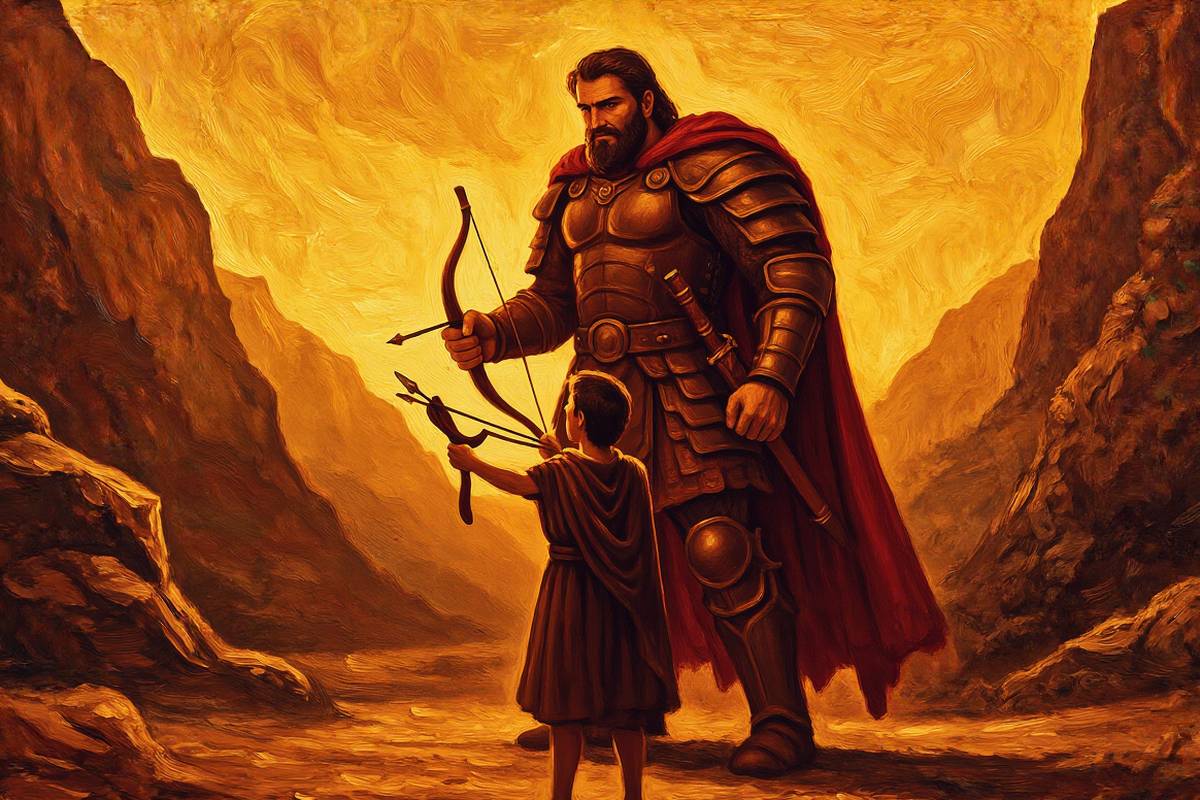
Faith is not the only ingredient; it must be mixed with courage. In Joshua 1:5–7, Joshua was taking over from Moses and was afraid. God told him, “Be strong and of good courage,” and again, “Only be strong and very courageous.” Dr. Hohman draws three focal points from the passage.
First, focus on God’s presence: as He was with Moses, He would be with Joshua. Jesus promised to be with us always (Matthew 28:20) and never to leave or forsake us (Hebrews 13:5). Second, focus on His promises, the inheritance He swore to give. Third, focus on what He commanded. God is not only in us, he says, but for us and with us, active on our behalf.
Listening to the Right Voice
Dr. Hohman tells a story from when he was three or four years old. His mother took him Christmas shopping at a Montgomery Ward store and told him to stay right where he was while she stepped away. Time passed, and the thought came that she had forgotten him. He started calling for her, and nearby shoppers laughed and said the poor boy was lost, which only made him more certain he was.
He ran outside, crying, and then found his way back to the car, while a voice in his head told him it would not be there. It was. Half an hour later his furious mother arrived. She had been on the other side of the clothes rack the whole time and asked why he had not done what she said. That, he says, is the lesson of Joshua: he listened to another voice instead of what he had been told.
He notes that Christians have often reinforced what the devil was saying rather than what God said, which is why he wants to be an encourager to people of faith who have a vision.
Joseph is the next example. When he shared his dream that his family would bow to him, his brothers resented it, but he held on to what God said (Genesis 37:5–11). Years later he told them that what was meant for harm, God turned to good (Genesis 50:20). Dr. Hohman offers a gem to write down: “whenever God tells you to do something it’s a gift to you, it’s not a burden on you.”
He closes this section with a story from the 1940s. A middle-aged man walked into a church in Brooklyn simply to pray for courage, knowing his decision could cost him his job and reputation. A couple of weeks later, Branch Rickey signed Jackie Robinson, the first African American to play in the major leagues. Robinson went on to win Rookie of the Year in 1947 and Most Valuable Player in 1949. It took massive courage on both their parts, Dr. Hohman says, and courage is what turns faith into crazy faith.
The Courage of the Paralyzed Man
In Mark 11:22, Jesus told His disciples to have faith in God, which Dr. Hohman reads from Young’s Literal Translation as “have the faith of God.” To have that faith, he says, we must change the way we think, because corrupt thinking always holds us back. God’s thoughts and ways are higher than ours (Isaiah 55:8–9). “You’ll always be where you’ve been if you’re only willing to do what you’ve always done.”
Many Christians say they have faith in God, he observes, yet trust other voices before God. His answer is Romans 3:4: let God be true. People who lose the fire of God, he says, are people without courage, and those who step out to share the goodness of God will see fire they never imagined.
His final example is the paralyzed man in Luke 5:17–26. It took courage to be strapped to a stretcher and lowered through a roof. But Dr. Hohman points to verse 17: Pharisees and teachers of the law from every village had come. Their doctrine said any infirmity was the result of terrible sin, so this man had to face the people who looked down on him.
Jesus said, “your sins are forgiven,” and when the Pharisees objected, told the man to get up and walk. That simple step of faith dealt with two mentalities at once: the man’s belief that he was no good, and the religious leaders’ belief about why people suffer. Dr. Hohman asks, “do you know what’s worse than being physically paralyzed? That’s paralyzed in your mind.”
That is why Jesus said to repent, to change the way you think, for the kingdom of heaven is at hand (Matthew 4:17). He encourages anyone holding a grudge to find the courage to forgive. Crazy faith, he concludes, does not have to be spectacular; it is simply taking steps in an area where you are normally weak.
He ends with an invitation to receive Jesus, noting that Jesus asks us to confess Him before others (Matthew 10:32–33), which itself takes courage. He leads a prayer of salvation, then prays for a listener named Jim, declaring healing over his back as he senses the Lord leading.
Living Out Crazy Faith This Week
Here are practical steps drawn from this crazy faith message:
- Start with someone else. Look for one person you can bless this week, beginning with the household of faith.
- Take the small first step. Do not wait until you feel qualified; begin imperfectly and let God direct your path.
- Name your weak area. Identify where you feel least capable and ask God for courage there, since that is where His power shows up.
- Feed your courage. Like Joshua, think on God’s presence, His promises and His commands before you act.
- Choose your voices. Stand close to people of faith and become an encourager to others who are stepping out.
- Forgive someone. Let go of the grudge you are holding; it is one of the bravest steps of faith you can take.
Timestamped Outline
- 0:01 Welcome and opening prayer
- 6:48 Tithes and offerings: Malachi 3
- 12:24 Worship
- 25:00 Dr. Hohman continues the series
- 27:17 Where the name crazy faith came from
- 28:29 Key one: think of other people
- 30:45 The food pantry and Galatians 6:10
- 33:54 Key two: small beginnings
- 36:03 The puppet show vision
- 37:55 Trading a well for a van
- 42:31 Ninety-two saved at a Bible school
- 45:42 Key three: faith takes courage
- 46:42 David and Goliath
- 48:49 Power made perfect in weakness
- 52:17 1 Corinthians 2: faith in the power of God
- 54:24 You do the natural, God does the supernatural
- 56:35 Joshua: be strong and of good courage
- 59:44 Lost in the department store
- 1:04:46 Joseph holds on to his dream
- 1:07:08 Branch Rickey prays for courage
- 1:10:59 The paralyzed man and the Pharisees
- 1:15:42 Prayer of salvation
- 1:18:13 Prayer for healing
Crazy Faith Series
This message is part of a series at NTC Ministries. Go back or continue where this one leaves off:
- Previous: Crazy Faith, Part 1 — Thinking of Others Before Yourself
- You are here: Crazy Faith #3: Faith Takes Courage in Your Weakest Areas
- Next: Crazy Faith #4: It Takes Desire to Follow Jesus
Frequently Asked Questions
Is crazy faith the same as recklessness?
No. Dr. Hohman says crazy faith is simply real faith that most people do not recognize. When the Lord told him to do something even if it was wrong, he understood it to mean imperfect, not bad. His examples all involve a step God had asked for: a puppet ministry to reach children, a pantry to feed families, David answering a giant who defied God. The step may look foolish to others, but it follows what God has said.
What if my weakness is real and not just a feeling?
That is exactly where this message applies. Dr. Hohman does not deny weakness; he says it becomes a portal for God’s power. Paul admitted he came in weakness, fear and much trembling, and Moses said he stuttered. In both cases God worked through the limitation rather than waiting for it to disappear. You supply the small natural step, and God supplies what is beyond you.
Why does Dr. Hohman connect forgiveness with courage?
Because holding on to an offense keeps you mentally paralyzed, which he calls worse than physical paralysis. He urges listeners to forgive whether or not the other person ever comes to them. Like the paralyzed man facing the Pharisees, forgiving someone means stepping past what you have been told about yourself and others, and that step opens the door for Jesus to work.
Scripture References
All passages open in the New King James Version on Bible Gateway:
- 2 Corinthians 12:9–10 — power made perfect in weakness
- Joshua 1:5–7 — be strong and of good courage
- 1 Corinthians 2:3–5 — faith in the power of God
- Zechariah 4:10 — the day of small things
- Galatians 6:10 — do good to all, especially the household of faith
- 1 Samuel 17:37 — the Lord who delivered David
- Isaiah 55:8–9 — His thoughts are higher
- Luke 5:17–26 — the paralyzed man lowered through the roof
How this summary was made: written with AI assistance from the sermon’s own transcript and checked against the Scriptures listed above.
Watch More Messages
If this message stirred your courage, there are hundreds more teachings from NTC Ministries waiting for you. Browse the full sermon archive and keep stepping out in faith.