The blood covenant makes Jesus Christ not a redeemer but the Redeemer, and in Isaiah 48:17 that Redeemer says He teaches His people to profit. In this message, Dr. William P. Hohman closes the prosperity portion of his blood covenant series with a simple theme: only our best will do. He shows that God takes pleasure in the prosperity of His servants, but that He watches whether what He gives us becomes more important than He is. This message continues from The Blood Covenant #22: Good News to the Poor and the Blessing of Abraham.
Below you will find the full video, a structured summary of the sermon, the Scripture behind each point (linked to the New King James Version on Bible Gateway), a timestamped outline, and practical steps you can take this week.
Sermon at a Glance
This message was preached at NTC Ministries and posted on June 8, 2021. It runs about 77 minutes and ends with communion. Pastor Hohman describes it as the fifth and final message in the prosperity portion of the blood covenant teaching, following earlier weeks on redemption from the curse, Deuteronomy 28 and Psalm 35:27.
He begins by praying, as Paul prayed for the church at Ephesus, that the eyes of the congregation’s understanding would be enlightened. Without the Holy Spirit, he says, the brilliance of what Jesus did could never be understood, and even when people hear it they tend to doubt it, just as many in Jesus’ day had eyes to see but refused to see.
| Detail | Information |
|---|---|
| Speaker | Dr. William P. Hohman |
| Series | The Blood Covenant (#23, final prosperity message) |
| Main text | Isaiah 48:17 and Malachi 3:8–12 |
| Key theme | Our Redeemer teaches us to profit, and only our best will do |
| Length | About 77 minutes, ending in communion |
The Redeemer Who Teaches You to Profit
Pastor Hohman opens with a foundational claim of the blood covenant: Jesus is not a redeemer, He is the Redeemer. There is no co-redeemer and no other go-between. There is one mediator between God and man, the man Christ Jesus, and only His blood redeems. Everything else in the message rests on that.
He recalls the starting point of the prosperity teaching in Galatians 3:13–14: Christ has redeemed us from the curse of the law so that the blessing of Abraham might come upon the Gentiles. He summarizes the curse as poverty, sickness and spiritual death. For poverty God has given wealth, for sickness health, and for death eternal life.
Faith in these truths grows the same way saving faith does. The Word of God is a living seed, he says. You may hear about Jesus many times before the seed comes up and you finally act on it. That is why faith comes by hearing, and hearing, and hearing (Romans 10:17). The more understanding we gain, the easier it becomes to step out.
The text for the day is Isaiah 48:17, where the Lord, “your Redeemer, the Holy One of Israel,” says He is the one “who teaches you to profit.” Pastor Hohman teaches that the Hebrew word translated profit, ya’al, means to become successful, to be benefited, to ascend and to prosper. If we are really taught by God, he says, we should be profiting in life, not just hanging on.
That is why he cannot separate prosperity from redemption. Teaching us to profit is part of who the Redeemer is. The benefits of the blood covenant come with the Redeemer Himself.
In the World but Not of It
Pastor Hohman explains that the earth has run on a curse system since Adam, and everyone is born into it. But redemption changes our position. Drawing on Deuteronomy 28:13, he says believers are the head and not the tail, above only and not beneath. You are in this world, but the system is not crushing you or oppressing you.
He is careful to add that this does not make anyone better than anyone else. We are all fearfully and wonderfully made. The difference is that some people, even some who go to church, are not paying attention or humbling themselves. The Holy Spirit leads and guides believers into all truth, so they are not to live in fear. But he insists this takes partnership: walking side by side with God, not merely quoting verses.
That partnership includes work. Quoting Proverbs 10:4, he says the hands of the diligent are made rich. You cannot be lazy and expect favor, and simply collecting a paycheck without working is stealing from your employer. We have to work in harmony with God, he says, in symphony with Him.
He also warns that people who are not applying themselves to a part of the covenant often criticize those who are. He shares that his own mother was once very vocal against his message, until she gave her life to Jesus, was baptized in the Holy Spirit, and began driving more than two hours each week to church. He testifies that she was healed of multiple myeloma and that their lives were greatly blessed. His counsel: stand in the truth and do not back away.

The Best Test: Only Our Best Will Do
From Psalm 35:27, Pastor Hohman reminds the church that the Lord “has pleasure in the prosperity of His servant.” God is pleased when you pray and receive, and when you get the desire of your heart. His question is never whether your desires are good. His question is whether what He gives you will become more important to you than who He is to you.
He calls this the best test. When God told Abraham to sacrifice Isaac, his only son whom he loved (Genesis 22:1–12), Abraham was willing, and God stayed his hand. Now the Lord knew Abraham would give his best. Pastor Hohman teaches that this act gave God the legal right to bring Jesus Christ into the earth as Redeemer.
So his theme for the day is that only our best will do. Athletes have a saying: “leave it all on the court.” Win or lose, you can hold your head high because you did your best and have nothing to regret. That is what God wants. Whatever you do, at work or at church, do it as unto the Lord and with all your might (Colossians 3:23).
The book of Malachi shows what happens when people stop giving their best. After Nehemiah’s generation rebuilt the walls of Jerusalem, Israel grew apathetic, and their understanding of God became skewed.
In Malachi 1:2–3, God says, “I have loved you,” and Israel answers, “In what way have You loved us?” God points to Jacob and Esau. Esau sold his birthright, his future, for a bowl of lentil soup (Genesis 25:29–34). Jacob, for all his scheming, finally wrestled with God all night and would not let go until God blessed him (Genesis 32:24–29). He wanted his blessing from God, not from the world’s system, and that is what God loved.
Malachi’s generation, by contrast, brought God their seconds: the broken, the blemished, the calf they could not eat anyway. Give God the best.
Bring All the Tithes into the Storehouse
Malachi then asks, “Will a man rob God?” The answer is in tithes and offerings (Malachi 3:8–12). Pastor Hohman calls this the best test in life: are you worshiping what you have more than you are worshiping God? The word tithe means a tenth, a tenth of all your increase, and Proverbs 3:9–10 promises filled barns and overflowing vats to those who honor the Lord with their firstfruits.
He stresses that the blessing is both natural and spiritual. God has given us all things that pertain to life and godliness (2 Peter 1:3), not godliness alone. The storehouse, he teaches, is the local church, the house of God where believers come to receive instruction from the King of kings.
Then comes the striking invitation: “Try Me now in this.” Pastor Hohman teaches that the Hebrew word, bachan, means try me, test me, prove me, and he calls it the only place in the Bible where God invites us to test Him. If we do, He will open the windows of heaven and pour out a blessing so great there is not room enough to receive it.
He has the congregation say it with him: God never wants to withhold from me. If God did not withhold His only begotten Son, how will He not freely give us all things (Romans 8:32)? Yet there is also a purpose: that people would see how great a God He is.
How God Rebuked the Devourer
In Malachi 3:11, God promises to rebuke the devourer for your sake. Pastor Hohman explains that what you have will last longer and will not break right away. He also points back to Isaac in Genesis 26:12–14, who sowed in a time of famine, reaped a hundredfold in the same year, and kept prospering until the Philistines envied him.
He then tells his own story. In 1982, he and his wife Pam decided to live in radical obedience to God. Late that winter both sensed in their hearts that they should give ten percent of their income. They did not think they could afford it, and they had never heard tithing taught in their mainline church. Months later, at a Spirit-filled church, they heard a message on tithing and looked at each other: that is what we are doing.
Before that message, his construction company took an excavation job at an airport in Ironwood, Michigan, under union terms the company was not structured for. Equipment was abused, and they went more than a hundred thousand dollars into debt. Three bank officers told him to go bankrupt. He refused, saying he could not in good conscience put the burden of his debt on someone else. All he had to offer, he told them, was his name and his word.
He and Pam asked the Lord what to do. They went to each creditor, promised to pay something every month, sometimes ten or twenty dollars, and worked from sunrise to late at night, with Pam holding the flashlight while he repaired machinery. When he went to pay a fuel bill of about seventeen thousand dollars, the owner told him an unknown woman had already paid it in full.
Then Cummins Diesel, whose faulty repair had cost him a couple of thousand dollars, asked him to bring in his bills. He had carefully circled only the parts tied to their error. Instead, the company marked every bill paid in full. Within about two months, he says, they went from the bankers urging bankruptcy to owing nothing, and that year was the best financial year of his life. “He rebukes the devourer for your sake,” he says, “and I’m here to testify that is a fact.”
Giving First Changes Kingdoms
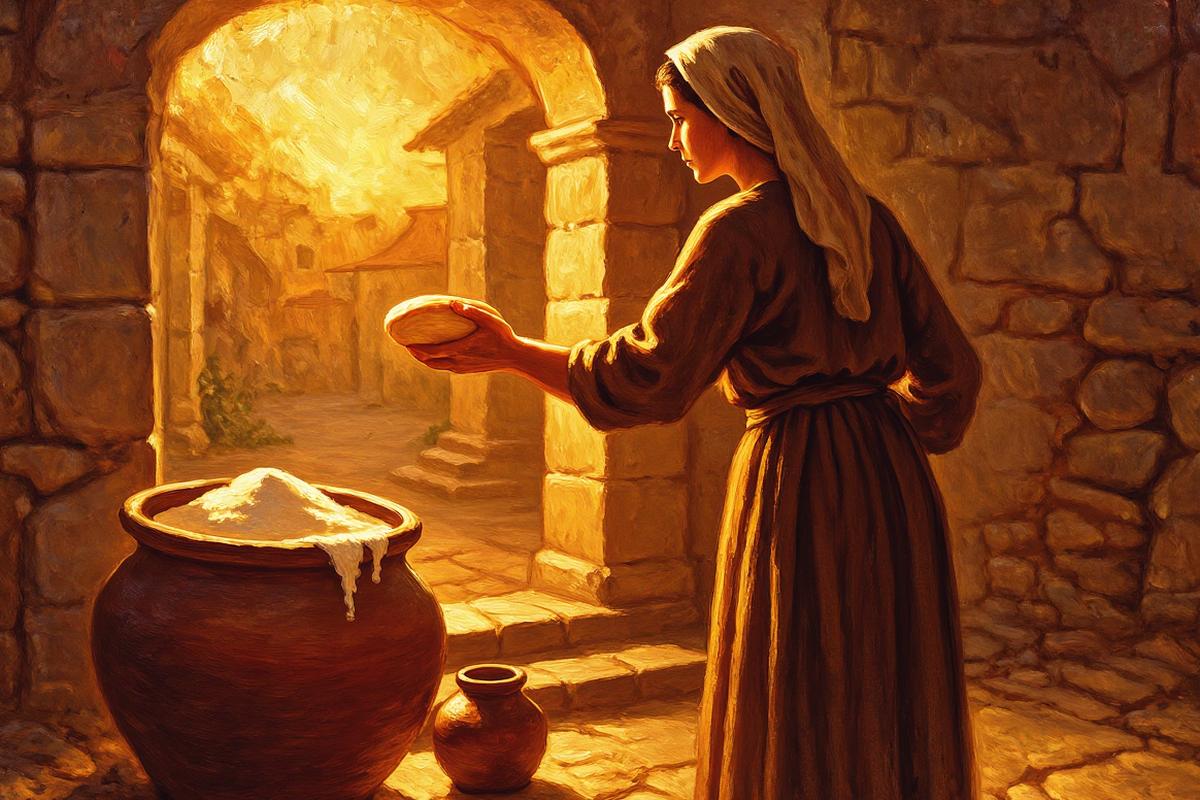
Pastor Hohman turns to 1 Kings 17:8–16. The widow of Zarephath had only a handful of flour and a little oil, enough for one last meal for herself and her son. Elijah told her not to fear, but to make him a small cake first. She did, and the bin of flour was not used up nor did the jar of oil run dry for many days.
When she gave first, he teaches, she changed kingdoms. What she held moved from the jurisdiction of this world, where there is never enough, into God’s hand, where my God shall supply all your need according to His riches in glory (Philippians 4:19). The fear of giving is the fear of not having enough. Giving God the first part answers that fear, and God will not be in debt to anyone.
The pattern runs through the Bible stories he cites. The table below gathers them as he teaches them.
| Person | What they gave or did | Outcome as taught |
|---|---|---|
| Abraham | Was willing to offer Isaac, his best | God knew he would give his best and opened the way for the Redeemer |
| Abraham | Tithed to Melchizedek before taking any spoils | Grew so wealthy the land could not hold him |
| Isaac | Sowed seed in a time of famine | Reaped a hundredfold the same year |
| Jacob | Wrestled with God for His blessing | God said, “Jacob I loved” |
| Esau | Traded his birthright for one meal | Lost his future for what he wanted right now |
| Widow of Zarephath | Fed Elijah first from her last flour and oil | Flour and oil lasted for many days |
He saw the same pattern in a hard winter that followed. Self-employed, with no work and no unemployment, he was siphoning fuel oil from his trucks to heat his house. A nurse hired him to paint two rooms, then asked him to remove an old oil tank from her basement. What looked like ten or fifteen gallons yielded about 150 gallons of fuel oil, enough for the rest of the winter.
He links it to Jesus’ first miracle at the wedding in Cana (John 2:1–11), where Mary told the servants to do whatever He said, and the best wine came last. Tithing did not start with the law, he adds: Abraham tithed to Melchizedek (Genesis 14:18–20) long before Moses. Offerings go beyond the tithe, and 2 Corinthians 9:6–11 says God is able to make all grace abound so that you have an abundance for every good work. He and Pam, he says, have given away five or six cars, and shortly after giving one away, a man offered them another.
Living the Blood Covenant This Week
Pastor Hohman insists that no one can buy a miracle. Giving purchases nothing; it is obedience that transfers what we have into another kingdom where God can work with it. He closes with communion from 1 Corinthians 11:23–26, taken not to stay saved but as a point of contact, in remembrance of the Redeemer who became poor so that we might be made rich (2 Corinthians 8:9).
Here are the practical steps drawn from this blood covenant message:
- Give God your best, not your leftovers. At work, at home and at church, do everything with all your might, as unto the Lord.
- Put the tithe first. Like the widow who fed Elijah first, give God the first tenth of your increase before anything else.
- Ask what your part is. Instead of looking for a way out of giving, ask the Lord to show you what to do as a covenant partner.
- Work diligently. Favor follows diligent hands. Do honest work for the pay you receive.
- Purpose your offerings. Beyond the tithe, decide in your heart what to give, and give cheerfully, not grudgingly.
- Tell what God has done. When He provides, share it so that He is glorified, not you.
He prays that God will teach the church to profit and to sow only into fertile soil. As he puts it, “He’s not El Chipo, He’s El Shaddai”: not a stingy God, but the all-sufficient One who is good and does good.
Timestamped Outline
- 0:01 Jesus is not a redeemer, He is the Redeemer
- 2:09 Prayer for the eyes of understanding
- 3:14 Galatians 3: redeemed from the curse
- 5:12 The Word is a living seed
- 7:18 Why people criticize the covenant blessings
- 9:24 Isaiah 48:17: He teaches you to profit
- 11:38 The head and not the tail
- 13:47 What the word profit means
- 16:14 Psalm 35:27 and the best test
- 18:24 Only our best will do
- 21:32 Malachi 1: Jacob and Esau
- 26:31 Will a man rob God?
- 29:48 Try Me now in this
- 34:57 Rebuking the devourer and Isaac’s hundredfold
- 36:01 1982: starting to tithe
- 38:28 Deep in debt and told to go bankrupt
- 45:10 A fuel bill paid in full
- 46:05 Every bill marked paid
- 48:01 Elijah and the widow of Zarephath
- 53:12 The hard winter and the oil tank
- 58:39 Water into wine at Cana
- 1:01:44 Abraham tithes to Melchizedek
- 1:03:50 2 Corinthians 9: sowing bountifully
- 1:08:08 Communion as a point of contact
Blood Covenant Series
This message is part of a long teaching series at NTC Ministries. Start from the beginning or continue where this one leaves off:
- First message: The Blood Covenant
- Previous: The Blood Covenant #22: Good News to the Poor and the Blessing of Abraham
- You are here: The Blood Covenant #23: The Redeemer Who Teaches You to Profit — Only Our Best Will Do
- Next: The Blood Covenant: Heaven’s Protection, Part 1 — From Strangers to Kingdom Citizens
Frequently Asked Questions
Isn’t the tithe just part of the Old Testament law?
Pastor Hohman teaches that the principle came before the law. He sees it first in the garden of Eden, where all of the garden was given to Adam except one tree God kept as His own. He then points to Abel, Noah and Abraham, and especially to Abraham tithing to Melchizedek, all before the law was given. In his view the tithe is part of covenant partnership, not a rule that ended with Moses.
Can giving buy a healing or a miracle?
No. Pastor Hohman is clear that you cannot take money and purchase a healing or a miracle from God. Giving is not a transaction. It is obedience, and in that obedience we transfer what we have out of a world under the curse and into the kingdom of heaven, where God can work with it. The heart behind it matters, which is why he links giving so closely to faith and thanksgiving.
Where should a believer give beyond the tithe?
He teaches that the tithe goes to the storehouse, the local church where you are fed. Offerings are different: they are what you purpose in your own heart. He and Pam give the tithe immediately, then pray together about what else to give. He asks God to show which works are good soil, because he does not want to sow on a rocky path or on the pavement.
Scripture References
All passages open in the New King James Version on Bible Gateway:
- Isaiah 48:17 — the Redeemer who teaches you to profit
- Galatians 3:13–14 — redeemed from the curse
- Psalm 35:27 — God’s pleasure in our prosperity
- Genesis 22:1–12 — Abraham’s best test
- Malachi 1:2–3 — Jacob I loved
- Malachi 3:8–12 — tithes, offerings and the windows of heaven
- Genesis 26:12–14 — Isaac’s hundredfold harvest
- 1 Kings 17:8–16 — the widow of Zarephath
- 2 Corinthians 9:6–11 — sowing bountifully
How this summary was made: written with AI assistance from the sermon’s own transcript and checked against the Scriptures listed above.
Watch More Messages
If this message strengthened your faith, there are hundreds more teachings from NTC Ministries waiting for you. Browse the full sermon archive and keep growing in the covenant God has made with you.