Pastor Dennis Toyne teaches that the purpose of the church is to be a place where the presence of God dwells and where people can meet Him, and he draws that pattern from King David’s desire to build God a house. In this guest message at NTC Ministries, he and his wife Sandy share what they have seen in churches across the country, why worship surrounded the ark day and night, and why every believer is a light set on a hill.
Below you will find the full video, a structured summary of the message, each Scripture used (linked to the New King James Version on Bible Gateway), a timestamped outline and practical steps for living out what Pastor Toyne teaches about the church and worship.
Sermon at a Glance
This message was preached at NTC Ministries in Merrill, Wisconsin, and posted on November 28, 2022. Pastor Dennis Toyne and his wife Sandy are longtime friends of Dr. Bill and Pam Hohman, for about 25 years by his count. The Toynes have pastored for 43 years and have been married 51. Sandy opens with a few words, and Pastor Toyne then preaches on the purpose of the church.
His main text is 2 Samuel 7, which he uses as a type and a shadow: an Old Testament pattern, revealed to David, that is happening in the church now. He closes by praying for the church’s leaders, its worship team, its children and youth, and for revival in the surrounding region.
| Detail | Information |
|---|---|
| Speaker | Pastor Dennis Toyne, with opening words from Sandy Toyne |
| Series | Stand-alone guest message |
| Main text | 2 Samuel 7:1–3; 1 Chronicles 15–16 and 25 |
| Key theme | The church as a place where God’s presence dwells and people meet Him |
| Length | About 43 minutes |
What Visitors Notice First
Sandy Toyne starts with some warmth and humor. Every Monday, she says, her husband believed he had to make her laugh, and she would tell him he already made her laugh every day. He is known for corny Iowa jokes that some people appreciate and others miss entirely.
Then she turns serious. Since she and Dennis became semi-retired, they have traveled a lot and always gone to church wherever they were, often large churches. Even before retirement, she took notes on every visit, because as a pastor she wanted to learn anything another church did well that her own church was not doing.
What she found was sobering. They attended churches with a thousand people in each service, and not once did anyone ask her name, tell her she was welcome or say “God bless you.” Sometimes they did not feel the presence of God, did not feel the anointing on the Word, and did not sense that the church took time for His presence.
Sandy says a church must have the presence of God and the freedom of the Word of God. Many believers are actually starving, she says, because people want to change what the Word says, and they cannot. She tells NTC that it has the presence of God and the Word of God, with no apologizing for what the Word says.
Being semi-retired, she adds, does not mean she will quit reading the Word, stop believing in the Holy Spirit or stop praying in tongues. Even after seeing and hearing almost everything, she still needs a fresh anointing, the Word to convict and encourage her, and the Holy Spirit moving in her. She thanks God that Brother Bill and Pam have kept the Word and the Holy Spirit as a mandate for the area and the world.
Pastor Dennis Toyne on the Purpose of the Church
Pastor Dennis Toyne picks up from his wife’s words, saying that what she shared is central to his own message on the purpose of the church. He notes that NTC is approaching its 37th year in January. He recalls Dr. Bill’s story of arriving in Merrill to hate mail and rocks thrown through a window, with people telling him to leave town. But they stayed, God blessed them, and years later the church received a certificate of appreciation from the city. That, he says, is quite a change.
His text is 2 Samuel 7:1–3. When the Lord had given King David rest from his enemies, David said to Nathan the prophet, “See now, I dwell in a house of cedar, but the ark of God dwells inside tent curtains.” Nathan told him to do all that was in his heart, for the Lord was with him.
David later had to set his building plans aside, and the temple was built by Solomon. But Pastor Toyne points out that the rest of the chapter shows how impressed God was with David’s heart. David looked at his own beautiful home and could not accept that the Creator of heaven and earth was living in a tent of animal skins. If his palace looked like that, God’s house should look far better.
Pastor Toyne sees two desires in David. First, David wanted to give God a place. God has always looked for a place in people’s hearts and lives; He designed each person with a space only He can fill, so that He could be the center of their life. Second, David wanted to give the people a position to meet with God. He wanted to bring God to his capital and his country, and to let God’s presence be the government of society, so that what God says goes and His Word remains.
David’s Tabernacle of Worship
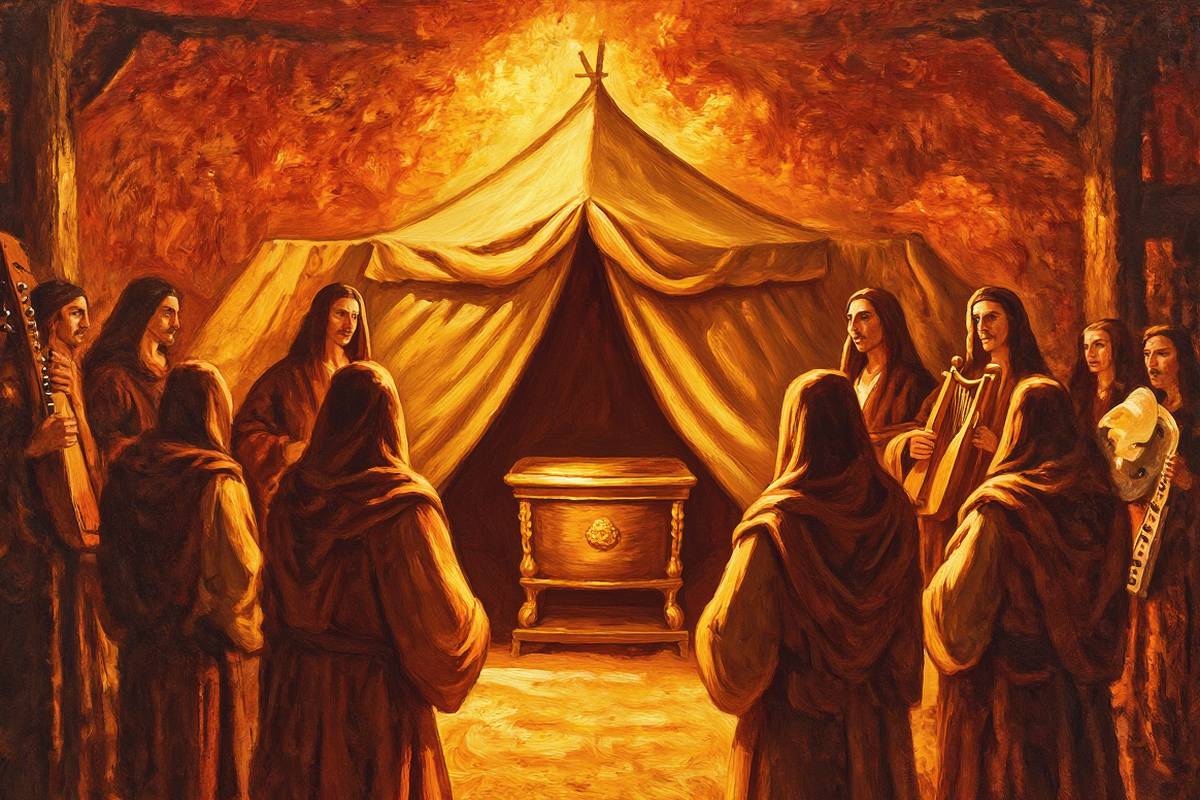
What made David’s tent unusual, Pastor Toyne explains, was that it became a place of worship day and night. He points the church to 1 Chronicles 15 and 1 Chronicles 16, and to 1 Chronicles 25:1–7. The table below sets out the details he gives and what he draws from each:
| What David set up | As Pastor Toyne describes it | What he draws from it |
|---|---|---|
| 288 singers and musicians | Their sole job was to worship the Lord before the ark | Worship is the centerpiece, not an extra |
| 24 worship teams | Led by family elders, 12 members in each team | Families coming in by turn: “it’s our turn, let’s go worship God” |
| Up to 4,000 singers | About half the population of Merrill, he jokes | A worshiping people makes God’s presence visible |
| New instruments | Many designed by David himself | Something that had never existed on earth before |
| Worship day and night | Something Moses never did | On earth as it is in heaven |
He invites the church to picture several hundred worshipers around a tent perhaps no bigger than the auditorium. He mentions the evangelist Tommy Tenney, who wrote of the presence of the Lord as a blue flame, and admits he does not know where that image came from. But he does know that in Moses’ day there was a pillar of cloud by day and a pillar of fire by night (Exodus 13:21–22).
When people saw David’s tabernacle even from far off, he says, something would hit them inside: this is where the God of the Hebrews is. This is the God who split the Red Sea (Exodus 14:21–22) and healed them of snake bites in the wilderness (Numbers 21:8–9). Other gods had nothing like it, no church like this, because it was surrounded by praisers and the glory of God.
Each day, a visitor might hear worshipers singing about God’s goodness, the next day about His healing, the next about His victory over every enemy. “God didn’t call you to be usual,” Pastor Toyne tells the church. “God called you to be unique and unusual,” a light in the darkness. He thanks God for a loud worship team and quotes the call to shout to God with the voice of triumph (Psalm 47:1).
David, he believes, caught a revelation of what worship looks, sounds and feels like in heaven, and wanted that on earth, as Jesus taught us to pray, “Your kingdom come. Your will be done on earth as it is in heaven” (Matthew 6:9–10). That is why, when we come to church, we should be radical praisers and worshipers who create an atmosphere where God’s glory can dwell.
A Footprint of God’s Presence
In Psalm 145:5 David says he will meditate on the glorious splendor of God’s majesty and His wondrous works. Pastor Toyne believes David would sit before the ark in that tabernacle, close enough to sense prophetic revelation, and that many of the Psalms came from those times. Some even name the instrument David played them on.
When God’s presence comes, Pastor Toyne says, it is a tremendous blessing, because He comes with everything He is. A church with property, like NTC with its several acres, has a footprint on the earth: a footprint of authority and possession that allows God’s government and glory to come down in that place.
He compares it to a radio station. The tower and studio sit on a small base, but the broadcast reaches twenty or twenty-five miles in every direction. A church that prays, worships, shares the gospel, shares testimonies and loves one another, rather than backstabbing, gossiping and complaining, works the same way. Its building is small, but its light goes out like a city set on a hill, because Jesus called His people the light of the world (Matthew 5:14–16). He even leads the congregation in “This Little Light of Mine.”
He reads more of Psalm 145 and David’s promise to bless God’s name every day and speak of His mighty acts to the next generation (Psalm 145:1–7), adding that where the Spirit of the Lord is, there is liberty (2 Corinthians 3:17). In Psalm 26:6–8 David washes his hands in innocence, goes about God’s altar proclaiming His wondrous works, and loves the place where God’s glory dwells.
That psalm describes what the Toynes did as pastors. They walked back and forth around the altar and the chairs, praying over the places where families usually sat, and listening for what the Lord would say. When they built a new building in Suamico, the first services felt dead. Minister friends told them to keep praying until the anointing saturated the house. They kept praying, shouting and singing, and within a few weeks the atmosphere changed as people pressed into God’s presence.
When God comes, Pastor Toyne says, He cannot help Himself. He comes with healing, and He comes as love. The worst tormented sinner can walk in, and the church does not criticize or judge but invites them to draw close to the Father and be cleansed by the blood of Jesus. God arrives with the gifts of the Spirit, the word of knowledge, word of wisdom, tongues, interpretation, prophecy and miracles (1 Corinthians 12:8–10). He “comes with a fruit basket” too: love, joy, peace, longsuffering and all the fruit of the Spirit (Galatians 5:22–23).
You Are the Church
Pastor Toyne recalls how often people in Suamico told him they had driven past the church for years, watched it being built, and then one day found themselves inside. He would tell them the Lord brought them in, because it was time for them to receive something. God, he jokes, is into accidents, “accidentally on purpose” for good things.
But the building is not the whole story. He calls 1 Corinthians 3:16 a verse that blows his mind: do you not know that you are the temple of God and that the Spirit of God dwells in you? When believers go out, they carry God’s presence and invite people to church. He encourages sitting with a guest and coaching them through the service, pointing out the worship team and the smiling ushers.
Every church should have testimonies, he says, and if not from the pulpit, then in everyday conversation. At a men’s ministry, he had the men pair off and tell one another how they came to Jesus. It built friendships, and it reminded each man how lost and hopeless he had been before Jesus changed everything. “Sharing your testimony,” he says, “is how you do church outside of church.”
On the day of Pentecost, the fire of God fell on the 120 in the upper room, and they went out praising God in languages the crowds understood (Acts 2:1–11). Thousands were added to the church because of that testimony (Acts 2:41). The church is also a place of healing: anyone sick should call for the elders to pray and anoint them with oil, and the prayer of faith will save the sick (James 5:14–15).
Wherever Paul went, Pastor Toyne says, there was either a revival or a riot, and sometimes both. In Acts 17:6 the believers were accused of turning the world upside down, and he tells NTC that they are turning Merrill right side up for Jesus.
He urges them to keep being living stones connected to the cornerstone (1 Peter 2:5–6), and to serve as an integral part of the body. Echoing Sandy, he asks them never to let a visitor go unwelcomed. Greet people and share your life; in a few moments you might meet the best friend you will ever have.
Being a Church That Shines
Pastor Toyne closes by praying for the pastors, that the windows of heaven would open and revelation would come to every person, and that the fire of God would fall on the whole region. He prays for more musicians and singers, for a Holy Spirit move among the children and youth, and that hands would be anointed to heal. Here are the practical steps from his message:
- Greet every visitor. Learn their name and tell them they are welcome, so no one leaves your church feeling invisible.
- Make room for God’s presence. Treat worship as the centerpiece of the service, as David did, not as a warm-up.
- Pray over your church. Walk the room and pray over the seats where families sit, as the Toynes did.
- Share your testimony. Tell someone this week how you came to Jesus; it builds friendship and stirs your own faith.
- Bring and coach a guest. Invite someone, sit with them and help them understand what is happening in the service.
- Keep seeking a fresh anointing. However long you have walked with God, keep reading the Word and yielding to the Holy Spirit.
He ends by leading the congregation to ask the Lord to anoint their hands to heal, their mouths to speak healing words, their eyes to be filled with His love, and their hearts to love like His.
Timestamped Outline
- 0:00 Friends of Dr. Bill and Pam; 43 years pastoring
- 1:13 Sandy on visiting churches
- 2:22 No one said “God bless you”
- 3:32 Starving for the Word
- 4:55 Still needing a fresh anointing
- 6:15 The purpose of the church; NTC’s 37th year
- 7:25 2 Samuel 7: David’s house and God’s tent
- 9:47 A place for God, a position for people
- 11:09 Worship day and night
- 12:23 288 singers and 24 worship teams
- 14:27 The pillar of cloud and fire
- 16:46 Called to be an unusual church
- 18:08 On earth as it is in heaven
- 19:22 Psalm 145: meditating on His splendor
- 20:34 A footprint of authority, like a radio tower
- 23:12 This little light of mine
- 25:11 Psalm 26: walking around the altar
- 27:21 Praying the anointing into a new building
- 28:27 He comes with gifts and a fruit basket
- 31:44 You are the temple of the Holy Spirit
- 34:19 Sharing your testimony
- 36:35 James 5 and Acts 17: revival or riot
- 38:58 Welcome people; closing prayer
- 41:11 Praying for worship, children and youth
Frequently Asked Questions
Who are Dennis and Sandy Toyne?
From what they share in this service, the Toynes are longtime friends of Dr. Bill and Pam Hohman, about 25 years by their count. They have pastored for 43 years, have been married 51 years, and describe themselves as semi-retired. Pastor Toyne also refers to the church they pastored in Suamico, where they built a new building and prayed until the anointing filled it. Since retiring they have traveled widely, visiting many churches.
Why does David’s worship matter for churches today?
Pastor Toyne uses David’s tabernacle as a type and a shadow of the New Testament church. David surrounded the ark with worship day and night, something Moses had never done, and the result was a place where people could sense God’s glory even from far off. He teaches that churches today follow the same pattern when they become radical praisers and worshipers, creating an atmosphere where God’s presence can dwell and people can meet Him.
What did the Toynes do when their new church building felt lifeless?
Pastor Toyne admits the first few services in their new building in Suamico felt dead, as people missed the old place. Minister friends told them it was normal: keep praying, shouting and singing until the anointing saturates the house. They did, and within a few weeks the anointing of the Holy Spirit increased and the atmosphere changed, as the congregation pressed into praying in the presence of God.
Scripture References
All passages open in the New King James Version on Bible Gateway:
- 2 Samuel 7:1–3 — David’s desire to build God a house
- 1 Chronicles 16 — worship before the ark
- 1 Chronicles 25:1–7 — the 288 singers and musicians
- Psalm 145:1–7 — meditating on His glorious splendor
- Psalm 26:6–8 — the place where Your glory dwells
- Matthew 5:14–16 — a city set on a hill
- 1 Corinthians 3:16 — you are the temple of God
- Acts 2:1–11 — the testimony at Pentecost
- James 5:14–15 — the church as a place of healing
- Acts 17:6 — turning the world upside down
How this summary was made: written with AI assistance from the sermon’s own transcript and checked against the Scriptures listed above.
Watch More Messages
If this message stirred your love for God’s house, there are hundreds more teachings from NTC Ministries waiting for you. Browse the full sermon archive and find your next message.