The motivational gifts of Romans 12 are investments God has already placed in you, not something you have to beg Him for. In this tenth and final message of the series, the pastor shows from creation and Colossians 2 that believers are already complete in Christ, then gives the full teaching on the seventh gift, mercy: what mercy-motivated people are like, how John the Beloved and the Good Samaritan model it, and the pitfalls mercy must avoid. His closing word is simple: show mercy with cheerfulness. This message follows Motivational Gifts #9: God Expects a Return and the Gift of Leadership.
Below you will find the full video, a structured summary, the Scripture behind each point (NKJV on Bible Gateway), a timestamped outline, and practical steps for using your motivational gifts this week.
Sermon at a Glance
This message was preached at NTC Ministries and posted on October 4, 2023, as the tenth and last teaching in the Motivational Gifts series. The pastor, who says he has been in ministry 42 years, notes that he had been away for a while and that the Lord was leading him into new teaching after this. He opens in prayer, thanking God that His Word is sharper than any two-edged sword (Hebrews 4:12) and asking for edification, comfort and, where needed, correction.
The first part of the sermon lays the foundation for all seven gifts: everything we receive is a gift, and every gift is meant to bless others. The second part completes the series with mercy, the seventh gift of Romans 12, and closes with a prayer of salvation and a blessing.
| Detail | Information |
|---|---|
| Speaker | The pastor of NTC Ministries (not named in the recording) |
| Series | Motivational Gifts, #10 (final) |
| Main text | Romans 12:4–8 and Colossians 2:9–10 |
| Key theme | You are complete in Christ; use your gifts, and show mercy with cheerfulness |
| Length | About 58 minutes |
Complete in Christ Before You Ask
“Everything that we get in life is a gift from God,” the pastor begins. Three chapters of the Bible deal specifically with spiritual gifts, but God has given far more than that: everything that pertains to life and godliness. Those gifts are not a patch for something we just discovered we lack. He has already provided them.
Creation, he says, is the standard for how God does everything. God did not create man on the first day, when there would have been no light and no ground. He made everything first, even planting the Garden of Eden, and only then created Adam and gave him dominion over it all. Scripture never records Adam asking God for anything; his time with God was fellowship, not a list of requests.
Yet many Christians spend most of their prayer time asking God for things. The pastor is clear that asking is not wrong, and the Lord knows what we need before we ask (Matthew 6:8). But if our relationship with God is nothing but “God, I need,” something is off in how we understand it.
When we are born again, God removes the heart of stone and gives a heart of flesh (Ezekiel 36:26). We become a new creation; old things pass away and all things become new (2 Corinthians 5:17). The “all things” are already there, he says; we just have to receive them, which is why Scripture calls us to enter His rest.
He explains that God resting on the seventh day (Genesis 2:2) did not mean He was tired. It was like an attorney who says, “I rest my case”: everything has been presented. Jesus said the same on the cross, “It is finished!” (John 19:30). Then he has the church read Colossians 2:9–10: in Him dwells all the fullness of the Godhead bodily, “and you are complete in Him.”
Gifts Are Investments for Serving Others
Because we are complete, the pastor says, God expects us to partake of His gifts and use them. Each one is an investment, and He wants a return. That is what He told Adam: be fruitful and multiply (Genesis 1:28). He has the congregation turn to one another and say, “I’m going to multiply and increase.”
How do we multiply? 1 Peter 4:10 says each one should use whatever gift he has received to serve others, as good stewards of God’s grace. God did not give us gifts for ourselves but for others, which is why the church’s motto is “I serve.” Jesus Himself came not to be served but to serve and give His life a ransom for many (Mark 10:45).
In more than four decades of ministry, he says, the biggest obstacle he sees is reluctance: people do not step out because they might be wrong. He asks parents whether they strapped their children into a chair so they could never make a mistake. Children have to be exposed to failure so they want to learn and do better. No virtuoso pianist started that way; they practiced and hit wrong notes along the way.
He shares his own mistakes. Evangelizing at fairs, sharing the Lord fourteen times a day, he once accidentally burned a lady’s hair, and she still gave her life to Jesus. At a building dedication in the Upper Peninsula, he spilled red food coloring all over the brand-new altar area in front of about five hundred people and preached long hoping everyone would leave. Instead, every one of them gave their life to Christ that night.
His conclusion: never fear making mistakes, because God will back you. If God turns what the devil meant for harm into good (Genesis 50:20), He can turn our blunders around too. Christianity, he says, is not a set of rules with God waiting to punish. It is “a king, a kingdom and a royal family,” and the Father treats His family like family. What He desires is not sacrifice but a broken spirit and a contrite heart (Psalm 51:16–17).
The Seven Motivational Gifts of Romans 12
Romans 12 opens by calling us not to be conformed to this world but transformed by the renewing of our minds, so we can prove God’s good and perfect will. Then Romans 12:4–8 lists the gifts: as we have many members in one body, all with different functions, we have “gifts differing according to the grace that is given to us.” The pastor reads it from the New American Standard Bible and from The Message, which he summarizes as being what we are made to be without comparing ourselves.
He calls them motivational gifts because they shape what drives us. Every believer should be able to function in all seven at some level, but most have one, two or three that are dominant. Because the gifts help form our personality, we should not despise how God made us. Comparing ourselves among ourselves is not wise (2 Corinthians 10:12). Among believers, love is the bond, for God is love (1 John 4:7–8).
To show how the gifts differ, he imagines a woman dropping a stack of papers outside the church while seven people walk by, each with a different dominant gift. He voices the responses of the server, prophet, teacher and exhorter; the table pairs those with his definition of each gift:
| Gift | How he defines it | Response to the dropped papers |
|---|---|---|
| Prophecy | Perceiving; quickly discerning good and evil and revealing truth | If you did this differently, it wouldn’t have happened |
| Serving | Meeting practical needs | Here, let me help you pick them up. Oh, I do that too, everyone does that |
| Teaching | Instructing, clarifying and illustrating; loves accurate study | Let me show you how to keep that from happening |
| Exhortation | Encouraging others to keep going | That looked great; it belonged on a funny-video show |
| Giving | Giving from all their resources to further God’s work | — |
| Leading | Standing in front by example; organizing long projects into steps | — |
| Mercy | Sensing and identifying with the emotions of others | — |
He adds a few notes along the way. Prophecy in this sense is not being the judge of the church; it is the elder who senses something is wrong and asks, “Is everything okay?” A teacher knows there is only one interpretation of a verse, but thousands of applications. The exhorter must keep encouraging even when it is discouraging. And the organizer can break a long project, like building the church’s facility, into short-term goals that servers can carry out.

The Gift of Mercy: John and the Good Samaritan
The last gift is in Romans 12:8: “he who shows mercy, with cheerfulness.” Why cheerfulness? Because mercy-motivated people often walk around as if wearing a sign that says, “I love you; it’s okay to kick me.” They get stepped on and hurt, and others think they are soft. They are the heart of the body, quick to sense joy or distress, and good at counseling and discipling, but they tend to avoid firmness.
His example is John the Beloved. Matthew, Mark and Luke, the synoptic Gospels, tell many of the same stories from different angles, like witnesses on different corners of an intersection. John focuses instead on what Jesus said about loving and caring for people. He records the new commandment of John 13:34–35, love one another as I have loved you, and in John 13:23–25 he is the disciple leaning on Jesus’ breast, the one Peter asked to find out who the betrayer was.
Mercy is tied to Romans 12:15: rejoice with those who rejoice, and weep with those who weep. The pastor says the Greek word for mercy means human or divine compassion, tender mercy, shown in word or deed. Luke 1:50 says His mercy is on those who fear Him, and he explains that this fear means awe and reverence, not terror. He links it to 1 Peter 3:10: whoever would love life and see good days must keep his tongue from evil and his lips from deceit.
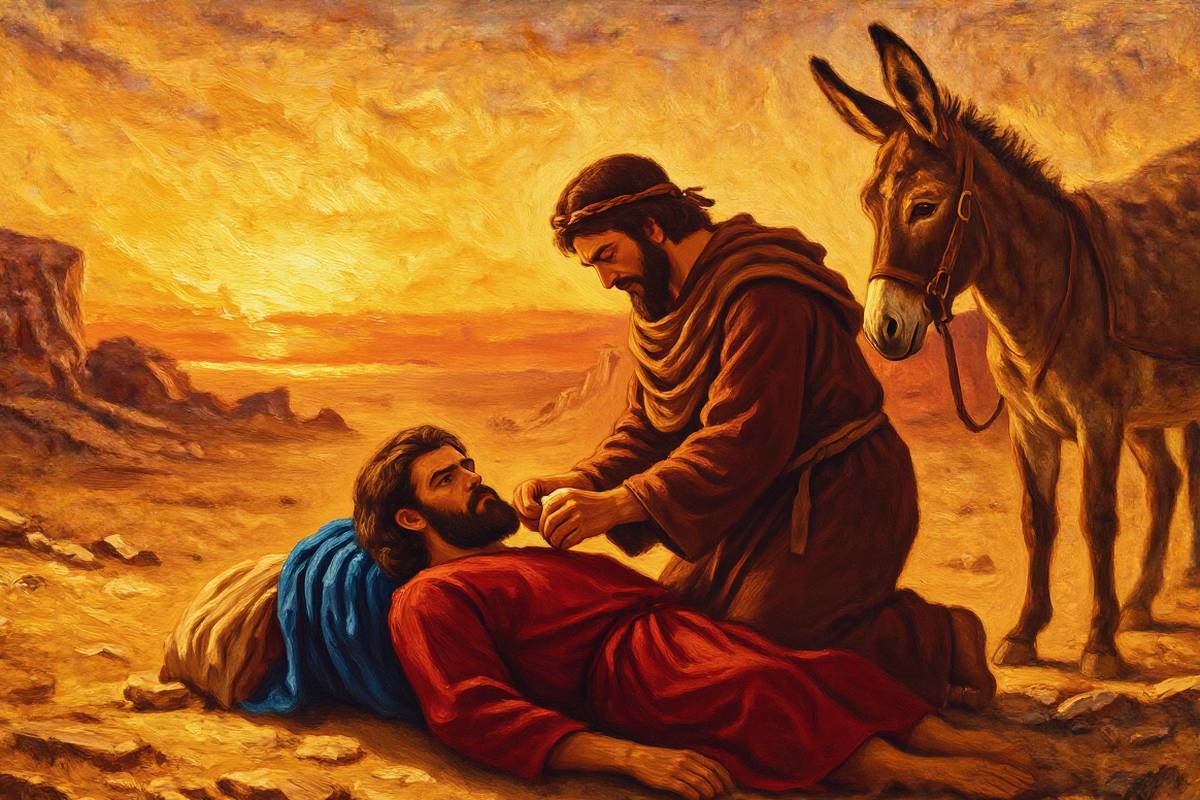
The greatest picture of mercy is the Good Samaritan in Luke 10:25–37. A lawyer tested Jesus about eternal life and quoted Deuteronomy 6:5 and Leviticus 19:18. Wanting to justify himself, he asked, “And who is my neighbor?” A priest and a Levite passed by a wounded man, unwilling to get involved. A Samaritan, from a people at odds with the Jews over where to worship, had compassion, bandaged him, brought him to an inn and paid for his care.
Jesus’ verdict: “Go and do likewise.” The pastor observes that the religious men who did everything by the law showed no mercy. He contrasts rigid law with justice and tells of a woman from Merrill driving her husband to the hospital in Wausau who stopped at a broken red light to avoid a ticket; by the time they arrived, her husband had died. God wants justice and mercy, he says, not the coldness of the letter.
He also reminds the church that Christianity is a family, not a rulebook. Give yourself some slack, he says. Jesus was more than good enough, paid everything, and invites the weary and heavy laden to come to Him and find rest (Matthew 11:28–30).
Strengths and Pitfalls of Mercy
The pastor then lists the characteristics of a mercy-motivated person. They are optimistic and look for the good in people, even when someone’s life has tanked. They are intuitive and sense the mood of a room. They are drawn to the hurting, uncomfortable with pain, and want to bring healing, often more at ease with emotional needs than physical ones. They love to be needed and gladly share people’s joys and sorrows.
Mercy and prophecy, he notes, often complement each other once the mercy-motivated person matures. The leader, however, may clash with mercy, because the leader says, “Let’s get off this chair and do something.” That is why we have to understand one another. John the Beloved, he points out, wrote books of the Bible that fit perfectly with everyone else’s.
He names several pitfalls. Mercy-motivated people can avoid confrontation so much that they cut off anyone who suggests change. Their decisions can look emotional or weak, as if they lack conviction. They can be offended when loved ones are hurt, though Psalm 119:165 says great peace have those who love God’s law, and nothing causes them to stumble. He also tells of a person who saw a marriage counselor for two years, a counselor who had been divorced eight times.
Their affectionate nature can be misread, especially with the opposite sex. That is why, he says, NTC staff and ministers never counsel someone of the opposite sex alone behind closed doors. He mentions Billy Graham refusing to travel alone with a woman who was not his wife, even when mocked, in keeping with abstaining from every form of evil (1 Thessalonians 5:22).
Two more pitfalls: mercy can interfere with God’s plan by rescuing people from a trial they need. Sometimes, like the prodigal son, a person has to come to himself (Luke 15:17) before his heart is open to God. And mercy can suffer empathy overload, carrying burdens instead of releasing them to God until it turns cynical. The answer is Romans 12:8: show mercy with cheerfulness, because optimism is essential in the body of Christ, especially when so many people are filled with the world’s negative news.
Using Your Motivational Gifts This Week
The pastor returns to Romans 12:1–3, where Paul appeals “by the mercies of God” for us to present our bodies as living sacrifices and be transformed, like a caterpillar becoming a butterfly, because God has dealt each one a measure of faith. You are fearfully and wonderfully made (Psalm 139:14). Here are practical steps from the message:
- Thank before you ask. Spend part of your prayer time thanking God for what He has already given, since you are complete in Him.
- Name your dominant gifts. Review the seven gifts and identify the one to three that most motivate you.
- Serve someone with your gift. Use it this week to bless one person, as 1 Peter 4:10 instructs.
- Step out despite mistakes. Do the thing you have held back from because you might be wrong, and trust God to back you.
- Show mercy cheerfully. If you are mercy-motivated, release burdens to God and stay optimistic instead of becoming cynical.
- Value the other gifts. Thank someone whose gift is different from yours instead of expecting them to function like you.
Timestamped Outline
- 0:00 The final message in the series, and prayer
- 1:02 Everything is a gift from God
- 2:26 Creation: everything ready before Adam
- 3:48 A new creation in Christ
- 4:54 God rested; Jesus said it is finished
- 6:08 Colossians 2:9–10: complete in Him
- 7:26 1 Peter 4:10: gifts to serve others
- 8:38 Don’t fear being wrong
- 10:01 A king, a kingdom and a royal family
- 11:28 Stories of mistakes God turned around
- 13:55 Romans 12: the motivational gifts
- 16:05 The seven gifts listed
- 18:24 Prophecy as perception
- 19:41 Serving and the dropped papers
- 21:50 Teaching and exhortation
- 24:05 Giving and leading
- 26:12 Mercy with cheerfulness
- 29:45 John the Beloved and the new commandment
- 34:37 Fear means awe
- 38:11 The Good Samaritan
- 44:52 Characteristics of mercy
- 49:45 Pitfalls of mercy
- 53:16 Romans 12: be transformed
- 55:38 Prayer and blessing
Motivational Gifts Series
This is the final message in the Motivational Gifts series at NTC Ministries. Start from the beginning or go back one message:
- First message: Motivational Gifts #1: The River, the Streams and the 21 Gifts of God
- Previous: Motivational Gifts #9: God Expects a Return and the Gift of Leadership
- You are here: Motivational Gifts #10: Complete in Christ and the Gift of Mercy (Romans 12)
Frequently Asked Questions
Can a person have more than one motivational gift?
Yes. The pastor teaches that every believer should be able to operate in all seven gifts to some degree, though not always skillfully. Most people have one, two or even three that are dominant and shape their personality. He told the congregation that during the series some of them may have raised their hands three different times, recognizing themselves in several gifts, and he encouraged them to keep using all of them cheerfully.
Is it wrong to ask God for things in prayer?
No. The pastor says God will never scold anyone for asking, and He knows what we need before we ask. His concern is a prayer life that is only “God, I need.” Because believers are complete in Christ and everything pertaining to life and godliness has already been given, he encourages prayer that receives and gives thanks, the way Adam simply walked with God in the garden.
How does the pastor explain different accounts in the Gospels?
He compares Matthew, Mark and Luke to witnesses standing on different corners of an intersection where an accident happened. Each tells the same event from a different angle, so the Bible does not contradict itself. John, he says, wrote fewer of those shared stories and focused instead on what Jesus said about love and mercy, which fits his mercy-motivated heart.
Scripture References
All passages open in the New King James Version on Bible Gateway:
- Romans 12:4–8 — gifts differing according to grace
- Colossians 2:9–10 — complete in Him
- 1 Peter 4:10 — use your gift to serve others
- 2 Corinthians 5:17 — a new creation
- Romans 12:15 — rejoice and weep with others
- John 13:34–35 — the new commandment
- Luke 10:25–37 — the Good Samaritan
- Psalm 51:16–17 — a broken and contrite heart
- Romans 12:1–3 — be transformed
How this summary was made: written with AI assistance from the sermon’s own transcript and checked against the Scriptures listed above.
Watch More Messages
If this series helped you discover how God made you, there are hundreds more teachings from NTC Ministries waiting for you. Browse the full sermon archive and keep putting your gifts to work.