Matters of the heart come down to one question in this fifth message of the series: where is your treasure? The speaker teaches from Matthew 6:19–21 that whatever you treasure is where your heart will go, and that heart treasures are built by keeping your word to God, even when something else looks more attractive. He calls this worship as “worth ship”: showing God with your actions that He is worth more than anything this world offers. The message follows Matters of the Heart #4: A Heart That Remembers.
Below you will find the full video, a structured summary of the sermon, the Scripture behind each point (linked to the New King James Version on Bible Gateway), a timestamped outline, and practical steps for laying up treasures in heaven this week.
Sermon at a Glance
This message was preached at NTC Ministries in Merrill, Wisconsin, in the winter and posted on December 13, 2021. It runs about 66 minutes and ends with the church standing to thank God for His Word and to ask Him to fill every heart. The speaker is the pastor who began the series and who planted the church some 35 years earlier, though he is not named in the recording.
After reviewing the series so far, he announces the subject for the day, heart treasures, and spends the hour on what Jesus meant by laying up treasures in heaven rather than on earth.
| Detail | Information |
|---|---|
| Speaker | Not named in the recording (the founding pastor of the church) |
| Series | Matters of the Heart, part 5 of 8 |
| Main text | Matthew 6:19–21 and Luke 14:15–33 |
| Key theme | Heart treasures: where your treasure is, your heart will be also |
| Length | About 66 minutes, ending in prayer |
A Heart That Remembers: Why the Disciples Missed the Miracle
The speaker begins with the new heart God gives at salvation. When we accept Jesus Christ, God takes out the stony heart and gives a heart of flesh with His Spirit inside (Ezekiel 36:26–27). That new heart is soft, which is why new believers can feel things more deeply. The answer is not to take offense but to keep bringing the heart back to God so He can strengthen it.
A new heart is meant to need God constantly. That is why he points to Psalm 119:165: great peace have those who love God’s law, and nothing causes them to stumble. Nothing can offend the person who keeps handing his heart to God.
He then recaps the previous message. Jesus fed the five thousand with five loaves and two fish and twelve baskets were left over (Matthew 14:13–21). That night He walked on the sea through a storm (Matthew 14:22–33). Soon after, He fed four thousand men, plus women and children, with seven loaves and a few fish (Matthew 15:32–39).
Yet when Jesus warned the disciples about the leaven of the Pharisees and of Herod, they thought He was upset that they had brought only one loaf (Mark 8:14–21). He asked why their hearts were hardened. They had seen and handed out the miracle with their own hands, but they did not remember. Growing in the miraculous, the speaker says, starts with paying enough attention to remember what God has already done.
Matters of the Heart: Where Your Treasure Is
To introduce heart treasures, he tells of a man who asked a physician what it takes to become a doctor. He expected to hear about cost and years of schooling. Instead the doctor answered, “You have to have a heart for medicine.” Without a heart for it, the debt and the long internship nights will make you quit.
He reads Matthew 6:19–21: do not lay up treasures on earth, where moth and rust destroy and thieves break in and steal, but lay up treasures in heaven, “for where your treasure is, there your heart will be also.” It is not wrong to have things on earth; to lay up means to store and guard them.
A wealthy brother-in-law, gripped after 9/11 by the fear of losing his money, stopped flying to Europe for business. It was his money, not his life, he feared for. Do not be that protective of anything on earth, the speaker says; be protective of your treasures in heaven, and endure to the end so you actually receive them.
He takes the point back to Adam. God gave Adam dominion over the works of His hands (Genesis 1:26–28), and Adam handed it to Satan through disobedience. Corruption entered and the ground began to produce thorns and thistles (Genesis 3:17–19). We live in that earth curse system and face constant opposition, but Jesus said to be of good cheer because He has overcome the world (John 16:33).
When we cave in and give up, he says, it shows our heart was never really there. In matters of the heart, quitting reveals that our heart treasures lay somewhere else all along.
Worship Is Worth-Ship: Heart Treasures Grow When You Keep Your Word
The speaker reminds the church that worship is a compound word, worth and ship: what is it worth to you? If something else seems worthier of your time, you will stop worshiping God and give that worship to it. He pictures one woman with a thousand suitors. The one man she chooses knows he is valued, because she had a thousand other choices. God wants to be chosen like that, with our actions and our time.
Gordy Yeager, who helped establish the church, once worked construction with him. A coworker said he really wanted to come to the Thursday Bible study, then did not show up. The next day Gordy told him plainly, “If you really wanted to go, you’d have went.” He had wanted to do something else. That, the speaker says, is worship and worth-ship in action.
Jesus taught us to let our yes be yes and our no be no (Matthew 5:37), and to keep our word even when it costs us (Psalm 15:4). Keeping your word to God is worship, and when that happens the heart grows stronger. Since Proverbs 4:23 says the issues of life flow from the heart, a bigger heart produces more.
He points to the church itself. It began in a living room, then a garage, and now reaches 37 nations with radio, television, publishing, schools and colleges. Every time problems came, he chose to keep obeying, and that was worship. As the heart grows, heart treasures grow with it, like a bigger paycheck from God. By contrast, people who leave when they hear something they dislike, such as teaching that life and death are in the power of the tongue (Proverbs 18:21), are often still producing nothing years later.
His own story makes the point. The Lord told him and his wife to give away everything they owned. They arrived in Merrill with two mattresses and lived in a broken-down motor home behind a barn, powered by a 300-foot extension cord, with no running water. Soon he was offered a pastorate across the state at five times the pay, and later churches in Florida, the Bahamas and even Hawaii. Each time he said no, because God was worth more to him than earthly gain. Those choices, he says, were heart treasures laid up in heaven.
Heart treasures from God, he explains, rarely come as rubies, diamonds or gold. It comes as directives, things He asks us to do. During hard seasons he went to God daily and prayed, “Lord, you gotta strengthen my heart.” He says it felt like dying a thousand deaths, but the fruit is a family that walks with the Lord.
Excuses at the Great Supper
Two short stories illustrate heart treasures. A young woman found a borrowed book tiresome until she learned its author was the man she secretly had a heart for; then it was the best book she had ever read. And nobody would want to be the wife of a man who still had a heart for another woman. God is no different. He wants your heart.
The church at Ephesus worked hard but had left its first love (Revelation 2:4–5). Their hearts were in the work rather than in Jesus. You can serve God and keep giving Him your heart at the same time, he says. Remember, “it isn’t the hardest times that are the greatest challenges to man; it’s the greatest times that are the greatest challenges to man.”
Jesus was tempted after forty days with nothing (Luke 4:1–13), and again when crowds were praising Him. Israel was warned that it is God who gives the power to get wealth (Deuteronomy 8:17–18).
In Luke 14:15–24, a guest at a meal says, “Blessed is he who shall eat bread in the kingdom of God.” The speaker notes the irony: he was eating with the King right then. Jesus answers with the parable of the great supper. He applies it to church: a pastor prepares a meal to feed God’s flock, says all things are ready, and the invited begin to make excuses. The table follows his reading.
| Excuse in Luke 14 | What the speaker draws from it |
|---|---|
| I bought a piece of ground and must go see it | Nobody buys land without looking at it first; excuses lack common sense |
| I bought five yoke of oxen and must test them | Ten oxen means a plowing business; he bought first and tested after |
| I married a wife, so I cannot come | A relationship became the reason to stop showing up |
| The master fills the house with the poor, lame and blind | God turns to those who will keep the commitment; He wants His house filled |
He then makes it personal. You can come to church physically while your heart is out ice fishing or at the ball game. If your heart wanders there, your treasure is there, not in heaven, and the message will not benefit you. We have to cast down every imagination that exalts itself against the knowledge of God (2 Corinthians 10:5), and nobody can do that for us. Some Sundays he would rather stay home, but he comes, because “I can’t live on yesterday’s life and expect tomorrow’s promises to come.”
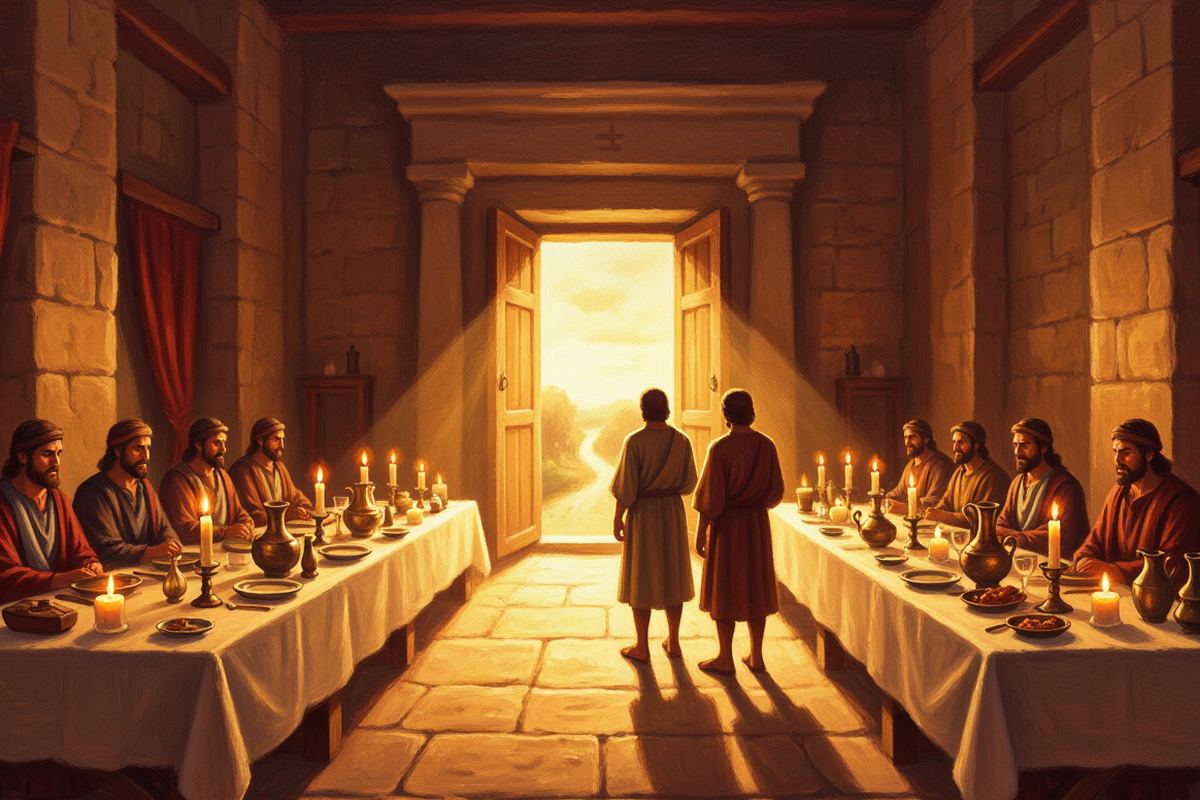
Counting the Cost of Discipleship
Next he reads Luke 14:25–33. Whoever does not hate father, mother, wife, children and even his own life cannot be Christ’s disciple. First he stops on discipleship itself. Pride says, “I don’t want you to tell me.” Arrogance says, “I know everything.” Both destroy people, families and churches. Jesus said to make disciples of all nations (Matthew 28:19), and the speaker says he still keeps people around him who can speak into his life.
The word hate here, he teaches, does not mean despising your family or your own life. He explains the Greek word as meaning to love less: a relative disregard for everything else compared with your devotion to God. God does not mind you having a camp, but if tending it means skipping what He asked of you, you are laying up treasure on earth instead of treasures in heaven.
Carrying the cross has one meaning: when the crowds saw Jesus carry His cross to Golgotha, they knew He was going to die. To pick up our cross is to die to ourselves, and when we do, our hearts grow and more heart treasures are deposited in them, making us bolder in faith.
Jesus then gives two pictures: the man who sits down to count the cost before building a tower, and the king who considers whether ten thousand can meet twenty thousand. One is work and the other is a fight. He says many times he did not have enough to finish, so he had to go to God for greater deposits of treasure. Our fight is not against flesh and blood but against principalities and powers (Ephesians 6:12).
He calls Israel’s promise to do everything God asked (Exodus 19:8), soon followed by a golden calf, one of the worst verses in the Bible. Even with a new heart, our sufficiency is in Christ alone.
Whoever does not forsake all he has cannot be His disciple. The speaker does not tell everyone to give everything away. The point is a process in which your desire for God grows greater than your desire for anyone or anything, until He is not just talking with you but instructing, supporting and counseling you.
Moses and the Treasures of the Invisible Realm
The final example is Moses. Drawn from the Nile by Pharaoh’s daughter, whose name for him, he explains, means drawn out (Exodus 2:1–10), Moses was trained in Pharaoh’s courts and in line for the throne. Yet Hebrews 11:24–29 says he refused to be called the son of Pharaoh’s daughter and esteemed the reproach of Christ greater riches than the treasures in Egypt, because he looked to the reward.
Israel crossed the Red Sea on dry land, but the Egyptians drowned. In the visible realm Egypt had everything and Israel had nothing. But, he says, “in the invisible realm Israel had everything and Egypt had nothing.” If you take nothing else from the message, he urges, remember that this world has nothing in the invisible realm, whatever government you live under and whoever seems richer than you.
He reads Philemon 1:4–6, where the sharing of faith becomes effective by acknowledging every good thing in us in Christ Jesus. Then he lists what we have in Christ: love that cannot be fathomed, righteousness that cannot be tarnished, hope that cannot be disappointed, strength that cannot be enfeebled, and resources that cannot be exhausted. These are the real treasures in heaven, and they are heart treasures no thief can steal.
All of God’s promises are yes in Christ (2 Corinthians 1:20), and His divine power has already given us all things that pertain to life and godliness (2 Peter 1:2–4). “Has given” is past tense, he notes, so stop trying to get from God and simply take. If we cherish the godliness part, the life part will follow, because God knows it will not drag us away.
Building Heart Treasures This Week
The speaker closes by calling the church to stand and thank God that His Word will not return void, praying that their hearts would be stronger for Him than ever. Here are practical steps drawn from this message on matters of the heart:
- Remember what God has done. Like the disciples after the feedings, review the miracles you have already seen before you worry about one loaf.
- Keep your word to God. When you said you would be there, go, even when something else feels better. That is worship.
- Check where your heart wanders. Notice what your mind drifts to in church or prayer; that is where your treasure is.
- Treat His directives as treasure. God’s treasure usually comes as something He asks you to do. Stick with it.
- Ask Him daily to strengthen your heart. When the cost feels higher than what you have, go to God for a greater deposit.
- Declare the invisible riches. Acknowledge every good thing that is yours in Christ, as Philemon 1:6 teaches.
Timestamped Outline
- 0:02 Series recap: two hearts and a new heart
- 3:14 A heart that remembers: the feeding of the 5,000
- 5:09 The 4,000 and the one loaf in the boat
- 7:04 Heart treasures: a heart for medicine
- 9:12 Matthew 6:19–21 and the fearful brother-in-law
- 11:45 Adam’s dominion and the earth curse system
- 13:50 Worship as worth-ship
- 15:05 Gordy Yeager and the start of the church
- 19:05 From a garage to 37 nations
- 22:56 Working to increase your employer
- 26:14 Giving everything away and the motor home
- 30:07 The book and its author
- 32:06 Ephesus and the first love
- 34:13 Luke 14: the parable of the great supper
- 40:16 Present in body, absent in heart
- 43:36 Everyone needs to be discipled
- 45:42 What “hate” means: to love less
- 47:54 Counting the cost of the tower
- 52:04 The king at war and forsaking all
- 54:14 Moses refuses the treasures of Egypt
- 56:30 The invisible realm and the Red Sea
- 58:52 What we have in Christ
- 1:01:18 All things pertaining to life and godliness
- 1:03:31 Closing prayer
Matters of the Heart Series
This message is part of an eight-part series at NTC Ministries. Start from the beginning or continue where this one leaves off:
- First message: Matters of the Heart #1: Guarding the Spiritual Heart and the Principle of the Seed
- Previous: Matters of the Heart #4: A Heart That Remembers
- You are here: Matters of the Heart #5: Heart Treasures — Where Your Treasure Is, Your Heart Will Be
- Next: Matters of the Heart #6 — Building Tender Hearts Toward God
Frequently Asked Questions
Is it wrong for a Christian to own things on earth?
No. The speaker says plainly that God does not mind you having treasures on earth, and that the Lord can give both earthly and heavenly riches. The problem is laying them up: storing, guarding and working to hold on to them until they take the attention that belongs to God. He uses a camp as an example. Owning it is fine; skipping what God asked of you to tend it is laying up treasure on earth.
How do I know if I really want to follow through on something for God?
The test in this sermon is action. When a coworker said he really wanted to come to Bible study and then did not, Gordy Yeager told him that if he had really wanted to go, he would have gone. The speaker teaches that what we actually do with our time shows what we treasure. Desire that never turns into obedience was never the heart’s treasure in the first place.
Why does the speaker call good times the greatest challenge?
He observes that Jesus faced temptation in the wilderness when He had nothing, and again in a season when crowds were hailing Him. Prosperity tempts us to think our own power produced the blessing, which is why Deuteronomy 8 warns Israel to remember that God gives the power to get wealth. Working hard is right, he says, but the heart must stay given to God.
Scripture References
All passages open in the New King James Version on Bible Gateway:
- Matthew 6:19–21 — treasures on earth and in heaven
- Mark 8:14–21 — do you not remember?
- Ezekiel 36:26–27 — a new heart
- Proverbs 4:23 — keep your heart with all diligence
- Revelation 2:4–5 — returning to your first love
- Luke 14:15–24 — the parable of the great supper
- Luke 14:25–33 — counting the cost
- Hebrews 11:24–29 — Moses and the treasures of Egypt
- 2 Peter 1:2–4 — all things for life and godliness
How this summary was made: written with AI assistance from the sermon’s own transcript and checked against the Scriptures listed above.
Watch More Messages
If this message helped you think about where your heart is, there are hundreds more teachings from NTC Ministries waiting for you. Browse the full sermon archive and keep laying up treasures in heaven.