

The kingdom economy is the way heaven works, and every believer lives between two systems at once: the toil-driven economy of a fallen world and the economy of heaven that God opens to His children when they are born again. In this first message of the series, Dr. William P. Hohman lays the foundation, showing that God wants to teach His people to profit, to lead them in the way they should go, and to give them power to get wealth so His covenant is established.
Below you will find the full video, a structured summary of the sermon, the Scripture behind each point (linked to the New King James Version on Bible Gateway), a timestamped outline, and practical steps for learning the economy of heaven this week.
Sermon at a Glance
This message opens a ten-part series at NTC Ministries and was posted on March 1, 2022. Pastor Hohman calls it a foundational teaching titled “the two economies.” It runs about 80 minutes and closes with an invitation to receive Jesus Christ.
Before he came into full-time ministry, he worked as a contractor, and he uses that experience to frame the series. A building needs a foundation matched to its weight, and a believer who wants to carry what God has planned needs a foundation in how the kingdom of heaven actually operates.
| Detail | Information |
|---|---|
| Speaker | Dr. William P. Hohman |
| Series | Kingdom Economy (part 1, the two economies) |
| Main text | Isaiah 48:17 and Deuteronomy 8:11–18 |
| Key theme | Learning the economy of heaven alongside the economy of this world |
| Length | About 80 minutes, ending with a salvation prayer |
Two Parallel Kingdoms Need a Proper Foundation
You could never set the Sears Tower on the foundation of a small church building. In a fallen world every structure faces stress, and the greatest stress from a roof is outward, not downward. He mentions a new arch in the Carolinas that collapsed sideways under ice because its supports were too weak.
The walls of the church building, by contrast, have bond beams and rebar-filled pylons going deep into the ground, hidden supports that keep the walls from bellying out. God works the same way. He holds the sun, moon and stars within their boundaries, and Paul teaches that God is a God of order who wants all things done decently and in order (1 Corinthians 14:40). When we stay in our place, we function best.
Since Adam’s fall, he explains, two kingdoms run parallel to one another: the fallen kingdom of darkness and the kingdom of heaven. When Nicodemus came by night, Jesus told him that unless a man is born again he cannot see the kingdom of God (John 3:3). Seeing here means perceiving. The kingdom is present, but only the born-again can understand it and become intertwined with it.
The darkness is real: a real devil, real sickness and real poverty. Yet the greater reality is the kingdom of the Son of God’s love. Colossians 1:12–13 says the Father has qualified us to be partakers of the inheritance of the saints in the light and has conveyed us into that kingdom. Christianity, he says, is not merely believing facts about Jesus; it is living by the kingdom economy and its rules.
Your Inheritance in the Kingdom Economy
To make the point personal, Pastor Hohman tells how an attorney contacted his wife Pam a few years back. A cousin she had not thought about in sixty years had died with no other relatives and left her an inheritance they were not even looking for.
Receiving it was not a matter of a phone call. They had to prove who she was, the attorney had to take it to the courts, and the courts had to verify everything. It took almost a year. Many Christians, he says, never learn what they have to do to receive their inheritance from God. They stop at “God said,” but God has also put certain things in order for us to apply.
Before Christ, most people work hard to learn the economy of this world so they can get ahead. Once we are born from heaven, we need the same diligence toward the kingdom economy, the system of the kingdom that created everything else. That is not greed. Jesus said to ask and receive so that our joy may be full (John 16:24), and the Father receives glory when we accept what He has done.
Refusing it is false humility. Had Pam told the attorney she did not deserve the money, he says, “that’s not humility that’s stupidity.” We are heirs of God and joint heirs with Christ (Romans 8:17), not joint heirs with our own abilities, cunning or education. Jesus finished the work, and grace gives it to us.
Receiving the inheritance is an empowerment, like the sudden sense people feel after an unexpected windfall that they can now accomplish things they never could before. God planned good works for each of us before the foundation of the world (Ephesians 2:8–10), and we cannot do them in our own strength. Saying “I don’t want that” is really saying, “I don’t want to do what You want me to do,” which is why Jesus asked why people call Him Lord and do not do what He says (Luke 6:46).

God Teaches You to Profit
The key verse of the message is Isaiah 48:17: “I am the LORD your God, who teaches you to profit, who leads you by the way you should go.” Pastor Hohman hears God saying that He needs this relationship with us and we need it with Him, because He leads from a kingdom we cannot see, hear, smell, taste or touch.
That is why Psalm 24:7–10 says, “Lift up your heads, O you gates!” He reads the gates as the five physical senses that humanity became enslaved to at the fall. As we lift up holy hands in worship or prayer, we surrender those senses to the King of glory, the Lord of hosts, and He comes in to aid, guide and help, so that life no longer runs on our own effort.
He teaches that the Hebrew word behind profit carries the sense of ascending, of being above and not beneath (Deuteronomy 28:13), and of your life growing in value: to your employer or company, in your home and marriage, to your children and to the church. Profit benefits others first and then benefits you. That is the kingdom economy he wants believers to learn.
He then reads the dictionary meanings of economy:
| Meaning of economy | How Pastor Hohman applies it |
|---|---|
| The structure or conditions of economic life | There are two systems, and believers must learn both |
| Thrifty, efficient use of material resources | Everything we have is God’s; we are stewards of it |
| Frugality and economizing | Jesus had the fragments gathered after feeding the five thousand |
| Efficient use of effort, language and emotions | Plan the job first; do not waste your words or your energy |
| A system of interaction and exchange | Producing anything, even a family, takes more than one person |
| Management of a household | God’s people are a household with its own order |
| The plan behind providence | God gives economies to meet human need and bring increase |
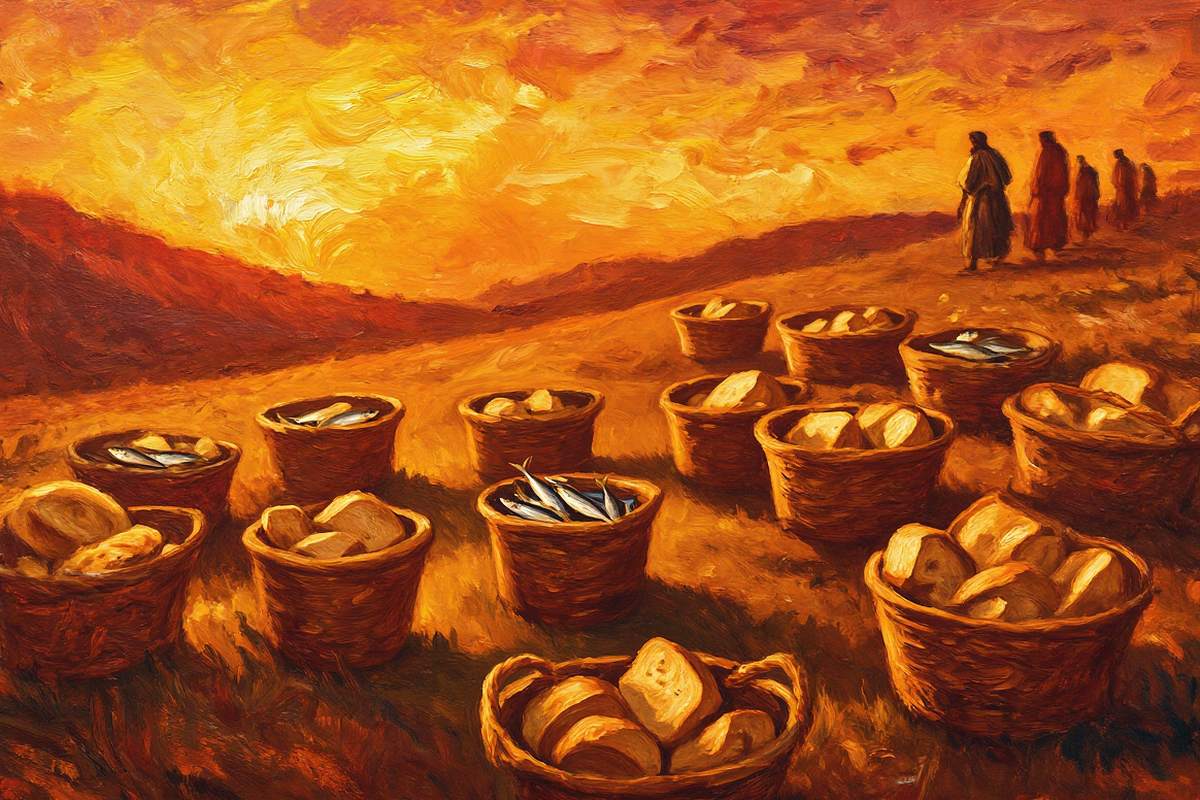
The fragments story shows the kingdom economy in action. After the miracle of the loaves and fish, Jesus told His disciples to gather up what was left so nothing would be lost (John 6:12–13), and twelve baskets were filled. He was working by another economy, yet He did not treat the miracle lightly. Pastor Hohman adds that a worker who walks half a mile across a site for one item at a time, without planning the job first, is stealing time.
The Economy of a Fallen World
Pastor Hohman then goes back to Genesis. Even before the fall there was an economy: God planted the garden, told Adam to keep it, and gave him Eve because one person could not do it alone. They went out to replenish the earth and returned to walk with God in the cool of the day.
After the fall, Genesis 3:17–19 describes the economy of this world: cursed ground, thorns and thistles, and bread eaten in the sweat of your face until you return to dust. God was not doing this to Adam, he says; Adam sowed the seeds, and whatever a man sows he also reaps (Galatians 6:7). The sweat is not only physical. It is the mental and emotional labor of trying to get ahead.
The world’s economy goes up and down like the stock market. In the economy of heaven there is only rising up, though believers still feel spiritual gravity from a real kingdom of darkness. Jesus said to render to Caesar what is Caesar’s and to God what is God’s (Matthew 22:21), so we work in both systems, but the economy of heaven has the greater effect. As you work, it kicks in alongside like a supercharger.
When his staff says something must be done now, Pastor Hohman often waits to see what heaven is saying, because through faith and patience we inherit the promises (Hebrews 6:12).
In Ephesians 2:19–22, believers are fellow citizens with the saints and members of the household of God. Joining a new household means setting aside the old household’s system. Then in Ephesians 3:1–6 Paul speaks of the dispensation of the grace of God. Pastor Hohman explains that dispensation translates the Greek word from which we get “economy,” meaning the administration of a household. Paul is speaking of the economy of grace.
Every part of life, he says, has a natural side and a spiritual side, and things happen in the spiritual realm before they appear here. Like a kick returner flattened by a lineman he never saw, believers who ignore that get blindsided. Do not give place to the devil (Ephesians 4:27): someone living by the economy of heaven can walk through what should have knocked him down.
Health shows both sides. Naturally, Proverbs 23:1–3 warns against desiring delicacies. Spiritually, people who do everything right still get sick, so we also need the faith that overcomes the world (1 John 5:4) and the promise that by His stripes we were healed (1 Peter 2:24).
Wealth, Blessing and Three Camps of Christians
Finances in the kingdom economy work the same way. Pastor Hohman teaches that in Christ we have been redeemed from poverty, sickness and spiritual death (Galatians 3:13–14). Naturally, Proverbs 6:6–11 sends the sluggard to the ant, which gathers in summer without any overseer; a little sleep and a little folding of the hands, and poverty comes like a prowler. You must work. But Jesus also came to give abundant life, and the Holy Spirit comes alongside to teach us to profit.
Proverbs 10:22 says, “The blessing of the LORD makes one rich, and He adds no sorrow with it.” Riches destroy people in the corrupted system, he says, but not through the economy of heaven. God’s only caution is in Deuteronomy 8:11–18: when your houses, herds, silver and gold multiply, do not forget the Lord or say that your own power gained this wealth, because it is He who gives you power to get wealth, that He may establish His covenant.
He tells business people he counsels never to think they are wrong for prospering, but to give God glory and let Him increase them. God is no respecter of persons, so that inheritance is for every believer, and kingdom people let God elevate them so they can give where it truly benefits those in need.
Many Christians, though, still live only by the world’s system. He describes three camps when it comes to money:
| Camp | How they live | The result |
|---|---|---|
| Sweat of the brow only | Everything comes by their own labor, so they hold it tightly | They seldom give, even to family, and refuse when God says give |
| Lazy toward work | They expect God to drop everything from heaven | Paul had to write that whoever will not work should not eat |
| Both systems | Diligent naturally, and trusting God’s promises and leading | A breakthrough of the economy of heaven into daily life |
The second camp is why Paul wrote that if anyone will not work, neither shall he eat (2 Thessalonians 3:10); money does not fall from heaven. Others give generously but never have anything; Pastor Hohman says a Christian who has an inheritance in Christ should not live always wishing for more to give.
Isaac Sowed in a Famine: The Kingdom Economy at Work
The closing illustration is Isaac. In Genesis 26:1–3 there was a famine in the land, and the Lord told Isaac not to go down to Egypt but to dwell where He would show him. Then Genesis 26:12–14 says Isaac sowed in that land and reaped in the same year a hundredfold, and the Lord blessed him. He kept prospering until he became very prosperous, and the Philistines envied him.
By the economy of this world, sowing seed in a drought is throwing it away, and Pastor Hohman imagines Isaac’s knees knocking. Yet Isaac worked in the heat, believed God would produce for him, and became a source of grain for people who might otherwise have starved. Through the kingdom economy, God gives power to get wealth to bless a region, not to hoard it.
Believing it can be done matters. Pastor Hohman points to Sir Edmund Hillary and Tenzing Norgay reaching the summit of Everest in May 1953, and to Roger Bannister running the four-minute mile in 1954 after being told it was impossible. Once someone did it, many others followed. The kingdom economy works the same way for those who believe their covenant.
From his own life, he recalls a winter in the Upper Peninsula with about a week of fuel oil left. He and Pam prayed, a call came to paint a kitchen, and the homeowner gave him an old tank with what looked like ten gallons in it. He drew out about a hundred gallons. Since God did not spare His own Son, how much more will He freely give us all things (Romans 8:32).
Jesus is the mediator of a better covenant, established on better promises (Hebrews 8:6), so the church should expect better results. That, he says, is how a handful of people in Merrill, Wisconsin, now serve in 38 nations with churches, schools, free clinics and radio stations.
Living the Kingdom Economy This Week
Pastor Hohman closes by inviting anyone who does not yet know Jesus to begin there, because the economy of heaven starts with a living relationship with Him (Romans 10:9–10). From that start, here are practical steps drawn from the message:
- Receive without false humility. Thank God for your inheritance in Christ instead of telling Him you do not deserve it.
- Lift up your gates. In worship and prayer, surrender what you see, hear, taste, touch and smell, and ask Him to lead you in the way you should go.
- Work diligently and trust Him. Do your part like the ant, and believe God to add His blessing beyond your effort.
- Steward the fragments. Plan your work first and waste nothing, whether money, time, words or energy.
- Wait for heaven’s direction. Before reacting to pressure, ask what the economy of heaven is saying and watch Him move.
- Remember who gives the power. When increase comes, give God the glory and use it to bless others and build His kingdom.
Timestamped Outline
- 0:00 A new series and the need for a proper foundation
- 2:04 Foundational teaching: the two economies
- 3:15 God of order and two parallel kingdoms
- 5:24 Colossians 1: the kingdom of light
- 6:26 Pam’s unexpected inheritance
- 10:30 Learning another economy is not greed
- 15:18 Isaiah 48:17: God teaches you to profit
- 16:24 Psalm 24: lift up your heads, O you gates
- 19:33 What the word economy means
- 20:49 Gathering the fragments
- 28:02 Genesis 3: the sweat of your face
- 30:56 Heaven’s economy only goes up
- 33:16 Ephesians 2: members of God’s household
- 35:18 Dispensation and the economy of grace
- 39:44 Do not get blindsided
- 45:11 Proverbs 6: go to the ant
- 47:14 Deuteronomy 8: power to get wealth
- 56:14 Three camps of Christians and money
- 59:26 Isaac sows in a famine
- 1:06:05 Everest and the four-minute mile
- 1:12:44 The fuel oil that kept flowing
- 1:15:27 Hebrews 8:6: a better covenant
- 1:19:10 Prayer of salvation
Kingdom Economy Series
This is the first message in a ten-part teaching series at NTC Ministries. Continue with the next message:
- You are here: Kingdom Economy #1: The Two Economies — Learning How Heaven Works
- Next: Kingdom Economy Part 2: Optimism Is Vital to Your Success
Frequently Asked Questions
Does learning the economy of heaven mean I can stop working?
No. Pastor Hohman says believers work in both systems. He sends the lazy to the ant in Proverbs 6 and reminds them of Paul’s rule that whoever will not work should not eat. The difference is what you trust. He works from the sweat of his brow, but he trusts that as he does what God asks, heaven’s economy comes alongside and produces blessing beyond his effort.
Why does Pastor Hohman wait instead of acting right away?
He describes watching what he calls the stock market of heaven. When pressure says something must be done immediately, he waits to hear what God is saying. More than once, he says, a week or two later the situation resolved without them having to do anything. He ties this to inheriting the promises through faith and patience, while noting that faith still includes work.
Is it wrong for a Christian to want to prosper?
In this message the answer is no. Pastor Hohman teaches that God’s only warning in Deuteronomy 8 is against forgetting Him and saying your own power produced the wealth. God gives power to get wealth to establish His covenant, build His kingdom, spread His goodness and share the gospel. The danger is a lifted-up heart and hoarding, not the blessing itself.
Scripture References
All passages open in the New King James Version on Bible Gateway:
- Isaiah 48:17 — the Lord who teaches you to profit
- Deuteronomy 8:11–18 — power to get wealth
- Colossians 1:12–13 — conveyed into the kingdom of the Son
- John 3:3 — born again to see the kingdom
- Psalm 24:7–10 — lift up your heads, O you gates
- Genesis 3:17–19 — the sweat of your face
- Ephesians 3:1–6 — the dispensation of grace
- Proverbs 10:22 — the blessing that makes rich
- Genesis 26:12–14 — Isaac reaps a hundredfold
- Hebrews 8:6 — a better covenant
How this summary was made: written with AI assistance from the sermon’s own transcript and checked against the Scriptures listed above.
Watch More Messages
If this message strengthened you, there are hundreds more teachings from NTC Ministries waiting for you. Browse the full sermon archive and keep learning how the kingdom of heaven works in your everyday life.


