Help God I Want Change is the opening message of a new series, and its point is simple: you were created to change. The pastor teaches that God made people from fertile soil, so that even after sin corrupted the whole earth, the human heart can still be worked, planted and made new. Real change does not come from new fashions, new circumstances or human effort, but from the incorruptible seed of God’s Word growing in the fertile soil of a willing heart.
Below you will find the full video, a structured summary of the sermon, the Scripture behind each point (linked to the New King James Version on Bible Gateway), a word study table, a timestamped outline, and practical steps for becoming fertile soil for God’s Word this week.
Sermon at a Glance
This message was posted on July 21, 2021, at NTC Ministries. The pastor explains that the church had just finished 27 weeks on the blood covenant and that this was the first session of a new series. He says the Lord gave him the message about two years earlier and that he had been meditating on it ever since.
The sermon moves from creation, through the fall and the corruption of the whole earth, to the new birth. Its thread is the contrast between corruptible and incorruptible: what decays in this world, and what God plants in us that cannot decay. It ends with an invitation to receive Christ or to come back to Him.
| Detail | Information |
|---|---|
| Speaker | The pastor (not named in the recording) |
| Series | Help God! I Want Change (session 1: created to change) |
| Main texts | Genesis 1–2; Romans 3:9–18; 1 Peter 1:23 |
| Key theme | Humanity was made as fertile soil so that the heart can be changed by God’s incorruptible Word |
| Length | About 70 minutes, ending with a prayer of salvation |
Created to Change, Not Conformed
The pastor opens with what he calls an identity crisis in the world. People run from one fad, trend, style and hairdo to another, trying to find who they are from the outside. They group together like cattle, he says, and then grow aggressive toward anyone who will not join the herd.
Scripture puts change somewhere else. 1 Peter 3:3–4 says true beauty is not the hair or clothing but the hidden person of the heart, which is incorruptible, unlike anything worn on the outside. Romans 12:2 tells believers not to be conformed to this world. When we find our place in God, he says, other people’s opinions lose their weight; the value of our life has to come from God’s Word.
He is honest that Christians need change too. Every believer has areas of life he is dissatisfied with. He should see a difference from last year to this year, and from thirty years ago to now. Too many believers are the same people they were decades ago and simply tell others to deal with it. That is not the right attitude, because we were created to be changed, made as fertile soil, and God did this knowing we would all need to change from the corruption of the fall.
The Lord also makes the way. Education, counseling or a doctor cannot change the heart; Jesus is the way, the truth and the life (John 14:6). David, attacked on every side, said he would have lost heart unless he believed he would see the goodness of the Lord in the land of the living (Psalm 27:13–14). The pastor stresses that this means now, in this present life.
His key application: God can change your circumstances, but He can also change who you are, and when He changes you, the circumstances do not have to change. We lose sleep wanting the system to change, he says, but the only person I can change is me.
Very Good, Then Corrupted: God’s Rest Interrupted
He goes back to the beginning. At the end of the sixth day God saw everything He had made, and it was very good (Genesis 1:31). On the seventh day God rested from all His work and blessed that day (Genesis 2:1–3). The pastor points out that every other day ends with “the evening and the morning,” but the seventh does not, because God’s rest has no beginning or end. That eternal rest is what He wants us to enter.
Then Adam and Eve sinned and disrupted that rest. By Noah’s day the earth was corrupt before God and filled with violence, because all flesh had corrupted its way (Genesis 6:9–12). If God rested on the seventh day, he asks, why did Jesus have to cry “It is finished” on the cross? Because corruption came in and God went back to work.
He calls it the work of redemption, not only of people but of all creation. With the Lord a day is as a thousand years (2 Peter 3:8), so God created in six days and then worked six thousand years to redeem. It took that long because He is not willing that any should perish. Only in the presence of God can lives be changed, he says, and all creation is waiting for the manifestation of the sons of God (Romans 8:19).
That is why Hebrews 4:11 says to labor to enter that rest. Many believers get born again and think there is nothing left to do. But being saved by grace brings us into the family, and from there we labor to enter God’s rest.
He explains that the Hebrew word translated corrupt means to decay or ruin, and that the King James Version renders it batter, cast off, destroy, lose, mar, perish, spoil and waste. His picture is iron rusting as oxygen bonds with it. Corruption works the same way in the world, which is why Adam eventually died at 930 years. One day this corruptible will put on incorruption (1 Corinthians 15:53).

Why Human Effort Cannot Fix Corruption
The pastor reads two passages side by side. Psalm 14:1–3 says the Lord looked down to see if any sought God, and all had turned aside and become corrupt; there is none who does good. Romans 3:9–18 repeats it: there is none righteous, no, not one, and there is no fear of God before their eyes. Coming into this world, he says, means instant corruption.
He compares it to a new car. The oxidation begins the moment it rolls off the assembly line, though it still looks sparkly. One day a bubble appears in the paint, and the problem is not the paint but the metal underneath. That is why changing clothes or styles cannot make anyone good. God wants to bring the incorruptible out of the hidden person of the heart, and he says that is where miracles come from.
He tells of a classic car a man offered to paint cheaply. The man sanded it to bare metal and painted it but never sealed it, and five months later there was more rust than before. That, he says, is human effort. People deep in debt get a little money and feel free, and three months later they are worse off, because the way of the world is corrupted and cannot produce anything else.
He offers a thought experiment. Put two nine-year-olds on an island with every provision and no danger, and they would build a society. But born into corruption, it would produce corruption, and without God’s intervention they would end up biting and devouring one another.
God, by contrast, does not create junk. In the beginning He created the heavens and the earth, and every good and perfect gift comes down from the Father of lights, with whom there is no variation (James 1:17).
Help God I Want Change: Made from Fertile Soil
This is the heart of the message. In Genesis 1:1, the word for earth means the whole globe. But in Genesis 1:25, where God makes the beasts and everything that creeps on the earth, the pastor points to a different Hebrew word, adamah, meaning the soil, the red ground we walk on. Then in Genesis 1:26, God says, Let Us make man, and the word for man is adam, sharing the same root.
He reminds the church of pioneers moving west to farm. They did not stop on sand and silt; they looked for red, rich soil full of nutrients. God took mankind not from the rock or the water of the earth but from its soil. You were created as fertile soil, he says, and that is why change is possible. Without it, people bound in corruption would be hopeless.
Believers have every hope. God wants to bless, increase and empower His people, and those who know their God will be strong and do great exploits (Daniel 11:32). But there is a choice. We can live like animals crouched on the ground, or we can let seed be sown into the ground.
He calls animal life nephesh, going to and fro. As a boy in upper Michigan he watched a caged bear in a city park pace a cement ledge until it wore a groove in it. That, he says, is the soul without God. David asked why his soul was cast down and told it to hope in God (Psalm 42:5). You do not have to stay down or feel the whole world is against you. The table below follows the words he draws from Genesis.
| Word, as taught | Meaning he gives | What it says about change |
|---|---|---|
| Eretz (earth) | The globe, the whole planet | The whole world became corrupt |
| Adamah (ground) | Soil, red earth | Soil can be worked and planted |
| Adam (man) | Man, from the same root as soil | People were made as fertile soil |
| Nephesh (animal life) | Going to and fro | The soul without God paces in place |
He adds the picture of a vacant lot full of brush, weeds and garbage. Because it is soil, it can be cleared, tilled and planted until it feeds a neighborhood. Animals and trees cannot change on the inside, but people can. That fertile soil can be fertilized, watered and planted, and it can bring a different future to many lives.
The Spirit of Incorruption
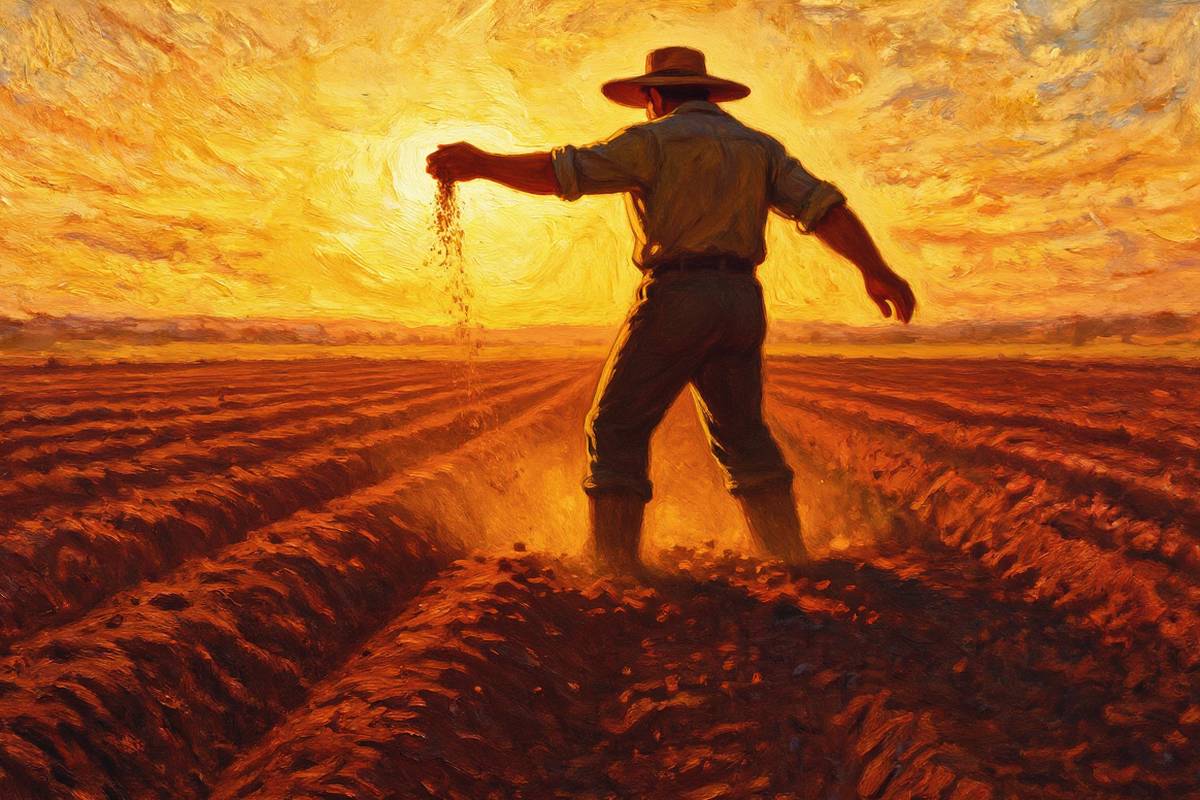
Jesus described the kingdom of heaven as a man sowing seed (Matthew 13:3–8). Some fell on the hard path, some on rocks, some among thorns, but some fell on good, fertile soil: the heart that says, here is my life, God, take out what needs to go. That heart produces thirty, sixty or a hundredfold. He wants believers to produce here, not just ask to be taken to heaven.
On the day of Pentecost, Peter preached from David’s psalm that God would not allow His Holy One to see corruption (Acts 2:22–33). Jesus was raised, exalted to the Father’s right hand, and poured out the promised Holy Spirit. The pastor calls Him the Spirit of incorruption. God worked six thousand years until Jesus cried “It is finished,” then sat down again in rest, and poured out that Spirit so believers could live above the beggarly elements of this world.
He gives two pictures. When five thousand needed food, Jesus did not send for supplies; He blessed what He had, and there was more left over than at the start (John 6:9–13). At the wedding in Cana, He turned water pots into the best wine (John 2:1–10). Neither came by natural means; both came from the incorruptible realm.
He applies this to the ministry itself: a handful of people in Merrill, Wisconsin, with a facility of almost 40,000 square feet holding a radio station, school, daycare, college and church, plus feeding programs in 37 nations. They did not do it by being wealthy. They did what God said, and God intervened. Our minds, he says, keep running back to the corrupted earth-curse system, but God wants us living from the incorruptible realm.
Born Again of Incorruptible Seed
The new birth is the doorway. Believers have been born again not of corruptible seed but incorruptible, through the Word of God which lives and abides forever (1 Peter 1:23). From the New Living Translation of James 1:18, he reads that God chose to give birth to us by His true word and made us His prized possession. Jesus told Nicodemus the same: unless you are born again of the Spirit, you cannot see the kingdom (John 3:3–6).
We are God’s prized possession, he says, because of what we are capable of: bringing heaven into people’s lives. That does not mean sitting idle, like a man leaning on a shovel praying for a hole. Believers are sojourners here, but they are meant to make the world better for others instead of complaining about it.
That takes leaving the herd. Some will not be born again because they fear losing friends or family. The pastor says Jesus’ words about leaving house and family mean leaving the pack mentality. If you are willing and obedient, you will eat the good of the land (Isaiah 1:19–20). Anyone in Christ is a new creation (2 Corinthians 5:17), the only creation that can change from corruptible into incorruptible.
He says he and his wife Pam very seldom pray for things, and needs are often met within a day or two. Jesus said the Father feeds the birds and clothes the lilies, so how much more will He care for you (Matthew 6:26–30). God made us alive with Christ and seated us with Him in heavenly places (Ephesians 2:4–7), and from that place of rest all He has done can flow.
Our labor, then, is coming to church, encouraging one another, turning off the bad news and getting the Word planted inside. If you abide in His word, you will know the truth, and the truth will make you free (John 8:31–32). He warns that people can receive healing and lose it if they keep planting trash. He shares that he gave his life to Christ at 11, stopped going to church, drifted into drugs and alcohol, and only changed when he recommitted his life and did what God told him. If he lived to please people, he says, he would not be a servant of Christ (Galatians 1:10).
Becoming Good Soil This Week
The pastor’s practical application comes down to planting the incorruptible seed in a willing heart:
- Stop waiting for circumstances. Ask God to change you first, knowing that a changed heart does not need changed circumstances.
- Leave the herd. Let God’s Word, not trends or other people’s opinions, define your identity.
- Plant the Word daily. Read it, apply it and do what He tells you, because the incorruptible seed sown in fertile soil is the only thing that changes the heart.
- Guard the soil. Turn off the play-by-play of bad news and step away from what keeps choking the seed.
- Labor to enter His rest. Stay in church, encourage others and keep coming into God’s presence.
- Make the world better. Bless and serve the people around you instead of complaining about how things are.
Change may take time. The pastor says one area of his own life took two years, but he looked back and knew that was not him anymore.
Timestamped Outline
- 0:00 A new series: we’re created to change
- 2:15 The hidden person of the heart
- 4:22 Every Christian needs to keep changing
- 6:25 Psalm 27: the goodness of the Lord now
- 8:38 Genesis 1:31: very good
- 10:53 The seventh day has no evening
- 11:55 Sin interrupts God’s rest: Genesis 6
- 14:46 Six days to create, six thousand years to redeem
- 17:28 Labor to enter rest; what corrupt means
- 20:27 Psalm 14 and Romans 3: none good
- 24:08 The paint job that made the rust worse
- 26:16 Children on an island
- 28:37 Eretz and adamah
- 31:08 Made from the soil: Genesis 1:26
- 35:10 Nephesh and the pacing bear
- 38:41 The vacant lot that can be changed
- 41:20 The sower and the good soil
- 42:26 Acts 2: no corruption for His Holy One
- 45:57 Loaves, fish and wine at Cana
- 49:40 1 Peter 1:23: incorruptible seed
- 52:07 James 1:18 and Nicodemus
- 56:50 2 Corinthians 5:17: a new creation
- 59:38 Ephesians 2 and John 8
- 1:07:06 Invitation and prayer
Frequently Asked Questions
If I am already saved, why do I still need to change?
The pastor teaches that being saved by grace brings you into God’s family, but it is not the finish line. Hebrews tells believers to labor to enter God’s rest. He says every Christian has areas of life to grow in and should see a difference from year to year. Christians who are the same people they were thirty years ago, he says, have not taken hold of the fact that they were created to change.
Why does the pastor say to turn off the news?
His point is about what you plant. He says you already know the news is bad and will get worse, so you do not need a play-by-play description. That time is better spent in the Word, getting what is eternal planted in you. He connects this to people who receive healing but keep feeding on fear and trash and then lose what God gave them.
How long does real change take?
He does not promise instant results. He says change will come, and he admits that one area of his own life took two years. Looking back afterward, he could see that the old pattern was not him anymore. The key is to keep allowing the incorruptible Word into your life and doing what it says, even when you do not feel you are doing it perfectly.
Scripture References
All passages open in the New King James Version on Bible Gateway:
- Genesis 1:26 — man made from the soil
- Genesis 2:1–3 — God rested on the seventh day
- Genesis 6:9–12 — the earth corrupt before God
- Romans 3:9–18 — none righteous, no, not one
- Hebrews 4:11 — labor to enter that rest
- Matthew 13:3–8 — the sower and the good soil
- Acts 2:22–33 — His Holy One saw no corruption
- 1 Peter 1:23 — born of incorruptible seed
- 2 Corinthians 5:17 — a new creation
How this summary was made: written with AI assistance from the sermon’s own transcript and checked against the Scriptures listed above.
Watch More Messages
If this message stirred a desire for change in you, there are many more teachings from NTC Ministries waiting for you. Browse the full sermon archive and keep planting God’s Word in good soil.