Freedom in praise and worship comes from drawing near to God, because when you draw near to Him, He draws near to you. In this second message of the teaching, Pastor Paul shows that God did not create worship because He needs our applause. He created it because He is love, and praise is the avenue He gave His children to receive more of His presence, strength and deliverance.
Pastor Paul walks through James 4, Psalm 22, Ephesians 6, Zephaniah 3, 2 Corinthians 10 and the fall of Jericho in Joshua 6. Below you will find the full video, a structured summary of the sermon, every Scripture linked to the New King James Version on Bible Gateway, a timestamped outline, answers to common questions and practical steps you can take this week.
Sermon at a Glance
This message was preached at NTC Ministries during Holy Week and posted on March 26, 2024. It runs about 62 minutes and ends with communion and a prayer of blessing over the church. Pastor Paul, who leads worship at the church, picks up where he left off the week before and reminds the congregation that the more we understand why we worship, the more confident we can be in taking the step of faith God asks of us.
Without faith it is impossible to please God (Hebrews 11:6), and he says pleasing and honoring his Father in heaven is exactly what he was created for. Even when we are not confident in ourselves, we can be confident in Him.
| Detail | Information |
|---|---|
| Speaker | Pastor Paul |
| Series | Freedom in Praise and Worship, Part 2 |
| Main text | James 4:8–10 and Psalm 22:3–4 |
| Key theme | Drawing near to God in praise opens us to His presence and breaks strongholds |
| Length | About 62 minutes, ending in communion |
Why God Created Praise and Worship
Pastor Paul begins with a simple question: do you believe God loves you? The Creator of the sun, moon and stars, who designed every intricate detail of creation, is, in his words, crazy madly in love with us. Nobody asked to wake up this morning. God breathed His breath into us because He loves us, and every person has been created with great purpose and great value.
He points to the song “Counting My Blessings,” whose writer said he set out to list the blessings God had given him and soon realized he could not count that high. God’s love goes beyond our comprehension. Pastor Paul lists his own blessings: healing, deliverance, freedom, his family, his parents, his church family, his work and his abilities. Then he adds that there is still more.
That leads to an objection he has read online. Why would God need His creation’s worship? Is He narcissistic, so shallow that He needs praise? Pastor Paul answers that this is not it at all. God is love, and we are the object of His affection. He is always looking for ways to bless, increase and show us His love.
So praise and worship are not a tax we pay to a needy God. They are a gift He created for us, a way to open ourselves up to a greater measure of the love He already has for us. That is the foundation of everything else in the sermon, and it is why he calls this teaching freedom in praise and worship.
Draw Near to God and He Will Draw Near to You
The first passage is James 4:8–10: “Draw near to God and He will draw near to you.” Pastor Paul compares it to the law of reciprocity, give and it shall be given. Some will ask how they can draw near to a God who is already everywhere. He answers that knowing God is everywhere is different from knowing He is right here, right now, with a tangible presence and anointing.
When the church sings about how great He is and gives Him gratitude, His presence fills the room. Sometimes people feel goosebumps, a love that blankets them or a strength that rises up. Anxieties they carried into church melt away. Verse 10 adds the condition: humble yourselves in the sight of the Lord, and He will lift you up.
Humility, he explains, is not about talent. Some say they cannot sing or play an instrument. Pastor Paul admits his own voice cracks and he misses beats. God wants excellence, but He is not looking for perfection; He is looking for the heart. As soon as worship becomes “look at me and how good I am,” it is just singing songs.
He contrasts this with what he calls a drive-thru McDonald’s type mentality: people who come to God only in a crisis, receive a miracle and disappear. God wants relationship and growth, like any good parent. He corrects whom He loves (Hebrews 12:6), and He also claps and rejoices over His children when they do well.
Drawing near also requires vulnerability. Pastor Paul compares it to telling someone you love them or asking them to marry you, when you cannot control their answer. The difference with God is that we never have to fear rejection. If we draw near to Him, He will draw near to us, whether we are in a congregation, lying in bed, driving to work or quietly worshiping under our breath at a family function.
Enthroned in Our Praise: Freedom From Strongholds
Next he turns to Psalm 22:3–4, reading the New King James: “But You are holy, enthroned in the praises of Israel. Our fathers trusted in You; they trusted, and You delivered them.” The King James says God inhabits the praises of His people. Pastor Paul draws a simple sequence from the passage: we praise, we trust, and God delivers.
Delivers from what, if life seems fine? Strongholds and ties to this world. Finances can be a stronghold, as good as they are. So can relationships, work and hobbies, even good ones like hunting, fishing, golf or tennis. God does not want any soul ties to this world. He wants us open and vulnerable for His blessings, even when we think we know better.
Praise is also a weapon against real spiritual enemies. In Ephesians 6:10–13 we are told to be strong in the Lord and in the power of His might, and to put on the whole armor of God, because we do not wrestle against flesh and blood. Pastor Paul stresses that this is not our own strength, talent or goodness; it is His ability, grace, wisdom, joy and peace.
Putting on the armor, he says, means getting into His Word and getting into worship. Satan knows how to get to people, reminding them of past failures to load them with fear and shame. But a child of God can say that no weapon formed against him will prosper (Isaiah 54:17), not because he says it once, but because he keeps pressing in and building relationship through praise.
He pictures a baseball player in his batting stance, feet firmly planted so a push will not move him. That is how believers need to stand when the enemy tries to knock them down from the high places God has lifted them to. As he puts it, they are the head and not the tail (Deuteronomy 28:13). When we praise, anxiety, aches and defeated thinking have to leave, because His holy presence fills the place.
He Rejoices Over You With Singing
To show how to battle through praise, Pastor Paul reads Zephaniah 3:14–17: sing, shout, be glad and rejoice with all your heart, because the Lord has cast out your enemy. The Lord your God in your midst will rejoice over you with gladness, quiet you with His love and rejoice over you with singing. Do not go halfway with God, he urges; He is not going halfway for you.
If He sings over us, we should sing to Him, and if He dances over us, we should dance with Him. He likens it to a wedding celebration, where everyone dances differently and that is fine. He recalls from the previous week’s teaching that God rides on the heavens by His name Yah (Psalm 68:4), rejoicing like a father whose children are coming to visit.
Then he tells his own story. At fourteen he liked to sing but was afraid of what his friends would think. After one service a bass player told him God had given him a vision of Paul playing guitar and leading worship. Paul had never once considered it. He took lessons for about six months and learned to worship in his bedroom as loudly as he could.
At fifteen or sixteen his father asked him to lead worship at the school chapel. Paul protested that he only sang in his bedroom. His father replied that the whole house heard him, and that what he did in his bedroom was what he should do out there, because he was not performing; he was worshiping. Paul agreed only if he could first teach on praise and worship. His mouth was dry, but he did it.
The lesson is that the step of faith pleases the Father. Practice worship at home, in the shower, in the car and at work. He answers the excuse that you cannot play an instrument with Psalm 47:1: “Oh, clap your hands, all you peoples! Shout to God with the voice of triumph!” Your hands and feet are instruments God built into you. That, he says, is real freedom in praise and worship.
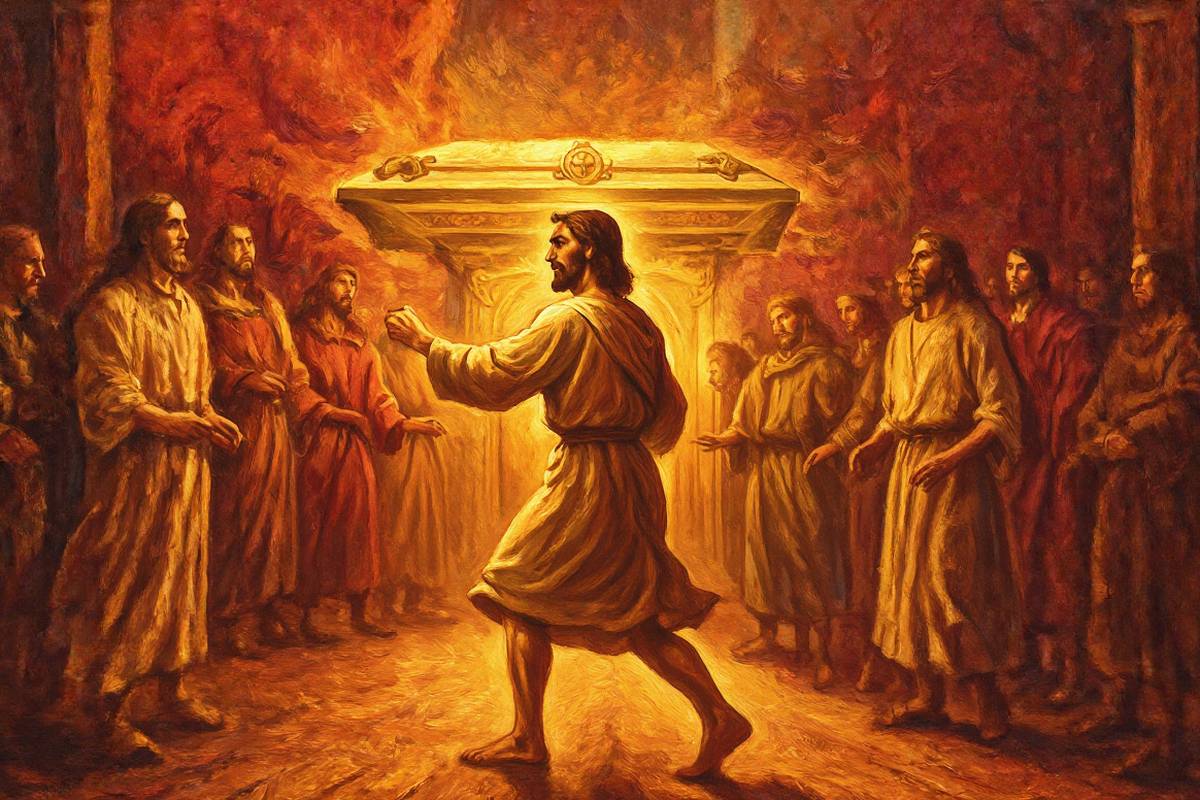
He ties this to Isaiah 61:1–3, which promises beauty for ashes and the garment of praise for the spirit of heaviness, and to Jeremiah 29:11–13, where God promises that those who seek Him with all their heart will find Him. David understood this when he danced before the ark and told his wife he would become even more undignified (2 Samuel 6:14–22).
Praise Is a Weapon That Pulls Down Strongholds
The next passage is 2 Corinthians 10:4–6: the weapons of our warfare are not carnal but mighty in God for pulling down strongholds, casting down arguments and every high thing that exalts itself against the knowledge of God, and bringing every thought into captivity to the obedience of Christ.
Pastor Paul defines a stronghold as anything that holds us back from the potential God has for us. It keeps us from becoming vulnerable before the Father because Satan whispers that we will get hurt, or that God’s promises are only for someone else. His response is to ask whether his Father in heaven would really be saying that. If not, he tells Satan to get behind him, knowing the devil seeks someone to devour (1 Peter 5:8).
Natural weapons are useless against spiritual forces of darkness. God has given believers His Word, the name of Jesus, and praise and worship. When He inhabits our praise, His favor surrounds us as a shield (Psalm 5:12). Worry, fear, stress and what he calls stinking thinking have to go when we give the Lord our heart.
The arguments Paul mentions, he explains, are the rebellious ideas that rise in our own minds. If you find yourself arguing with what the Word of God says, you are setting yourself up for failure. The high thing is often pride. He has the church practice saying “I’m wrong,” “I’m sorry” and “please forgive me,” and jokes that nobody’s lips fell off.
The goal is that every thought lines up with God’s Word. Doing that secures your footing. And the more believers press in and practice praise and worship, the stronger they become spiritually, able to walk in the strength and anointing that break yokes of bondage while staying humble before the Lord.
The Shout That Brought Down Jericho
Pastor Paul closes with Joshua and the battle of Jericho, starting with the backstory. Moses argued with God before agreeing to lead Israel out of Egypt. After the plagues, Israel crossed the Red Sea on dry ground (Exodus 14:21–22). Yet instead of practicing praise, they practiced griping, arguing and complaining for forty years, even while God sent manna and quail.
Joshua inherited that people. In Joshua 6:1–5 the Lord says, “See! I have given Jericho into your hand.” The people were to march around the city once a day for six days, then seven times on the seventh day, and when the priests made a long blast with the ram’s horn, all the people were to shout with a great shout. Pastor Paul notes that it says all the people, not some.
Then comes Joshua 6:10: Joshua commanded the people not to shout, make any noise or let a word proceed out of their mouth until the day he told them to shout. Pastor Paul observes that there is power in complaining too, the power to rob you of blessings and hold you back. Joshua essentially asked them to stop grumbling for one week.
On the seventh day the people shouted with a great shout and the wall fell down flat (Joshua 6:15–20). When God asks for something out of the ordinary, he says, expect something extraordinary. The table below follows his contrast between the two generations.
| As taught | In the wilderness | At Jericho |
|---|---|---|
| What came out of their mouths | Griping, arguing, complaining | Silence, then a great shout |
| Response to God’s word | Wanted to go back to Egypt | Did exactly what Joshua said |
| Result | Not truly delivered, even after forty years | The wall fell down flat |
| Lesson for us | Complaining robs blessings | Praise is a weapon that wins |
When you need healing, deliverance or relief from anxiety, he says, that is when you need to shout. He ends with Psalm 149: let the high praises of God be in their mouth and a two-edged sword in their hand, because the Lord takes pleasure in His people.
Living Out Freedom in Praise and Worship
Before communion Pastor Paul reminds the church that God so loved the world that He gave His only begotten Son (John 3:16). Here are practical steps from the message:
- Draw near on purpose. Set aside special times just to worship, at home, in the car or under your breath at work, trusting James 4:8.
- Drop the performance. Stop worrying about how you look or sound; God is after your heart, not your perfection.
- Name your strongholds. Ask whether money, work, a relationship or a hobby is tying you to this world, and lift it up to God in praise.
- Use the instruments you have. Clap your hands, tap your feet and shout to God with a triumphant voice, as Psalm 47 says.
- Answer lies with the Word. When a thought argues against Scripture, ask whether your Father would say it, then cast it down.
- Trade complaining for praise. Like Israel at Jericho, stop grumbling and save your voice for a great shout of praise.
Timestamped Outline
- 0:00 Continuing freedom in praise and worship
- 1:36 How much God loves us
- 2:30 Counting my blessings
- 4:19 Why God created worship
- 5:19 James 4: draw near to God
- 8:16 Humility and worship without perfection
- 10:15 The drive-thru mentality
- 12:14 Vulnerability before God
- 14:10 Psalm 22: enthroned in praise
- 14:58 Strongholds and ties to this world
- 17:17 Ephesians 6: the armor of God
- 20:15 Feet firmly planted
- 24:17 Zephaniah 3: He rejoices over you
- 26:31 Learning to lead worship at 14
- 32:24 Psalm 47: clap your hands
- 33:41 Isaiah 61 and Jeremiah 29
- 36:57 David dances before the ark
- 38:57 2 Corinthians 10: pulling down strongholds
- 42:09 Casting down arguments and pride
- 44:10 The backstory of Jericho
- 47:58 Joshua 6: see, I have given you Jericho
- 51:48 The power of complaining
- 53:58 The walls fall down flat
- 57:01 Communion, Psalm 149 and blessing
Frequently Asked Questions
Does God need our worship?
No. Pastor Paul answers the claim that a God who wants praise must be narcissistic. God is love, and we are the object of His affection. He is always looking for ways to bless us and show His love. He created praise and worship as a gift for us, an avenue to open ourselves to more of His love and presence, not because anything is missing in Him. Worship benefits the worshiper.
How can I draw near to God if He is already everywhere?
Pastor Paul agrees that God is everywhere all the time. But knowing that in theory is different from experiencing that He is right here, right now. When we humble ourselves and give Him gratitude and worship, a tangible presence and anointing comes. People sense it as love, strength or peace that makes anxieties melt away. That is the difference drawing near makes.
Is it okay to be loud or expressive when I worship?
Yes. Pastor Paul encourages believers to get loud, get active and even get elaborate, because God rejoices over His people with singing. He points to David dancing before the ark, to Psalm 47 telling all peoples to clap and shout, and to Israel’s great shout at Jericho. Whether you clap, dance or simply tap your feet, the point is giving God your whole heart.
Scripture References
All passages open in the New King James Version on Bible Gateway:
- James 4:8–10 — draw near to God
- Psalm 22:3–4 — enthroned in the praises of Israel
- Ephesians 6:10–13 — the whole armor of God
- Zephaniah 3:14–17 — He rejoices over you with singing
- Psalm 47:1 — clap your hands, all you peoples
- Isaiah 61:1–3 — the garment of praise
- 2 Corinthians 10:4–6 — pulling down strongholds
- Joshua 6:15–20 — the walls of Jericho fall
- Psalm 149 — the high praises of God
How this summary was made: written with AI assistance from the sermon’s own transcript and checked against the Scriptures listed above.
Watch More Messages
If this message stirred you to draw near to God, there are hundreds more teachings from NTC Ministries waiting for you. Browse the full sermon archive and keep growing in praise and in His presence.