Building kingdom means building the church the way Jesus builds it: through believers who are baptized into heaven’s rule and submit to the authority God has placed in the earth. In this message, Dr. William P. Hohman tells how God called him to plant the church in Merrill on Philippians 1:27–28, then walks through the seven baptisms of Scripture to show why water baptism is far more than a ritual. It is a believer’s public commitment to heaven’s authority, and it releases power to resist the corruption of this world. This message follows Building Kingdom #6: Mother’s Day — Women’s Full Place in the Kingdom of Heaven.
Below you will find the full video, a structured summary, the Scripture behind each point (NKJV on Bible Gateway), a timestamped outline, and practical steps for building kingdom life this week.
Sermon at a Glance
This message was preached at NTC Ministries in Merrill, Wisconsin, and posted on June 11, 2025, as the tenth message in the Building Kingdom series. Pastor Hohman opens with a simple charge: every born-again believer needs to be baptized into heaven’s rule. Jesus rules from heaven during this period of grace, he says, and He chooses to rule through His people on the earth.
He connects the whole teaching to Jesus’ promise to build His church so that the gates of hell will not prevail against it. Water baptism, submission to authority and unity in the local church are all part of how that building happens. The message closes with communion and an invitation to sign up for water baptism.
| Detail | Information |
|---|---|
| Speaker | Dr. William P. Hohman |
| Series | Building Kingdom, #10 |
| Main text | Philippians 1:27–30 and Matthew 3:13–17 |
| Key theme | Water baptism as submission to heaven’s rule and authority |
| Length | About 73 minutes, ending in communion |
Building Kingdom on Philippians 1:27–28
Pastor Hohman begins where Jesus began. At Caesarea Philippi, Jesus said that He would build His church on the revelation that He is the Son of God, “and the gates of Hades shall not prevail against it” (Matthew 16:18). From there, he says, Jesus kept using pictures of how Rome built to explain how the kingdom of heaven builds.
He then tells the story of the church’s beginning. In January 1986 he came to Merrill with a friend, Gordy, intending to street preach. Three people gave their lives to the Lord in local stores, and that night a small Bible study met in a home across the street. The Lord told him to commit one night a week, even though his schedule of conventions around the country was full for two years. He agreed to every Thursday night.
Driving out of town, the Lord told him, “You’re going to pastor here.” He had just finished building a new home for his wife, so he told the Lord he would not be the one to tell Pam. Meanwhile, speaking engagements kept getting canceled whenever Merrill needed him. Then, around April 24, Pam woke him at 4:30 in the morning to say they were supposed to go and pastor Merrill. He turned down three other churches and committed.
On the drive, he asked the Lord which Scripture to establish the church on, just as a married couple needs Scriptures to stand on so the house survives the storm (Matthew 7:24–25). The Lord gave him Philippians 1:27–30: “Only let your conduct be worthy of the gospel of Christ,” standing fast in one spirit, with one mind, striving together for the faith of the gospel.
Verse 28 adds that we are not to be terrified by our adversaries in anything, which is to them a proof of perdition. Pastor Hohman explains that perdition means destruction. Some people, he warns, are sent by demonic forces to infiltrate and weaken churches, as Paul saw at Ephesus and Corinth. When their opposition does not shake a united church, that very steadiness preaches to them that their efforts will come to nothing.
A Colony of Heaven and a Citizen Body
Paul’s letter went to Philippi, which Acts 16:12 calls a colony. Pastor Hohman explains that a Roman colony was a settlement of soldiers planted to keep newly acquired people in order so they could be discipled and grow. The message to those people was not destruction but blessing, provided they learned to live like Roman citizens. The more they acted like citizens, the more aid they received.
Citing a Greek word study, he says the Greek word translated “conversation” in the King James Version means to live the life of a member of a citizen body. So “let your conduct be worthy of the gospel” really means: live as a member of this body. Nobody does his own thing. God does everything decently and in order (1 Corinthians 14:40), just as He gave Moses exact instructions for the tabernacle and everyone had to believe Moses heard from God.
He notes that the same Greek root gives us the word politics. In the kingdom, Jesus is saying, “I need to get you to do what I want you to do,” because only what He builds stands against the gates of hell. A self-willed child weakens a family, and a spirit of “nobody is going to tell me” weakens a business or a church. Christianity, he insists, is not a religion but a kingdom, a king, a kingdom and a royal family, where every joint supplies.
In Philippians 3:17–20, Paul urges believers to follow his pattern and warns with tears that many walk as enemies of the cross of Christ. Pastor Hohman stresses that they are enemies of the cross, not of Christ Himself. The cross means Jesus did what the Father wanted, even to death. These people may love God but are self-willed and self-absorbed; their god is their appetite. Paul reminds them that our citizenship is in heaven, and there is order in that family.
He points to Peter as an example: for a time Peter gave in to the Judaizers, and Paul withstood him to his face (Galatians 2:11–14). He also reminds the church of Ephesians, where believers submit to one another in the fear of God (Ephesians 5:21), and of the secret place of Psalm 91:1, where God shelters His people from a corrupted world.
The Seven Baptisms and the Seven Dispensations
Hebrews 6:1–3 lists the foundational doctrines, including “the doctrine of baptisms.” Pastor Hohman explains that the word translated “leaving” does not mean walking away. It means growing up from, as an oak tree grows from an acorn. We never discard these foundations; our roots stay in them as we go on to maturity. Repentance, for example, simply means changing the way we have been thinking.
He notes that “baptisms” is plural, and he lists seven found in the Bible. This is how he presents them:
| # | Baptism as taught | What he highlights |
|---|---|---|
| 1 | John’s baptism in water | A baptism of repentance |
| 2 | Christ’s baptism in water | Administered by His disciples |
| 3 | The baptism of suffering | The fellowship of Christ’s sufferings |
| 4 | The baptism in the cloud and in the sea | Israel baptized into Moses |
| 5 | The baptism into Christ and into His body | The new birth by the Holy Spirit |
| 6 | Christian water baptism | The focus of this message |
| 7 | The baptism in the Holy Spirit | The Spirit coming upon us, not only in us |
The word baptism means to be totally submerged into something. Pastor Hohman, who served in the Navy at the Brooklyn Navy Yard, compares it to a submarine going under the water and a subway running under the ground. Submission, he says, is not a bad word. It means being under a mission, and the mission is Jesus building His church. Dying to our own ideas is the cross for us.
He then explains the dispensations, which are covenants God made with a covenant head, the first one in who is responsible for bringing the blessings into the relationship. He lists innocence under Adam; conscience after the fall; human government under Noah after the flood; promise under Abraham, the father of our faith; law under Moses; grace, when Jesus rules from heaven and writes His law on new hearts; and finally the millennial reign of Jesus on the earth.
Because the marriage supper of the Lamb is not far off, he says, Jesus tells us to occupy until He comes (Luke 19:13). Occupy is a business term: buy, sell, trade and increase. In other words, do business for the kingdom and build. He describes golden gates standing alone in the Egyptian desert, marking all a landowner possesses. Whatever Satan has, Pastor Hohman says, it will not prevail against what Jesus builds.
Why Jesus Was Baptized by John
The first thing Jesus did in His earthly ministry was get water baptized. Pastor Hohman answers those who find baptism awkward or inconvenient by noting that Jesus walked about sixty miles from Nazareth to the Jordan to do it. In Matthew 3:1–6, John the Baptist preaches repentance in the wilderness of Judea, and all Judea comes to be baptized, confessing their sins.
Why did they come to John? He explains that John was the man God was speaking through, after some four hundred years of silence between the prophets and Matthew. In Matthew 3:11, John says he baptizes with water unto repentance, but the One coming after him will baptize with the Holy Spirit and fire. Pastor Hohman notes this verse answers anyone who says the Bible never mentions the baptism in the Holy Spirit.
Then comes the surprising moment in Matthew 3:13–17. John tries to stop Jesus, saying he needs to be baptized by Him. Jesus answers, “Permit it to be so now, for thus it is fitting for us to fulfill all righteousness.” Jesus had nothing to repent of. He was the only righteous man on the planet. Yet He submitted to the authority God had placed in the earth at that time.
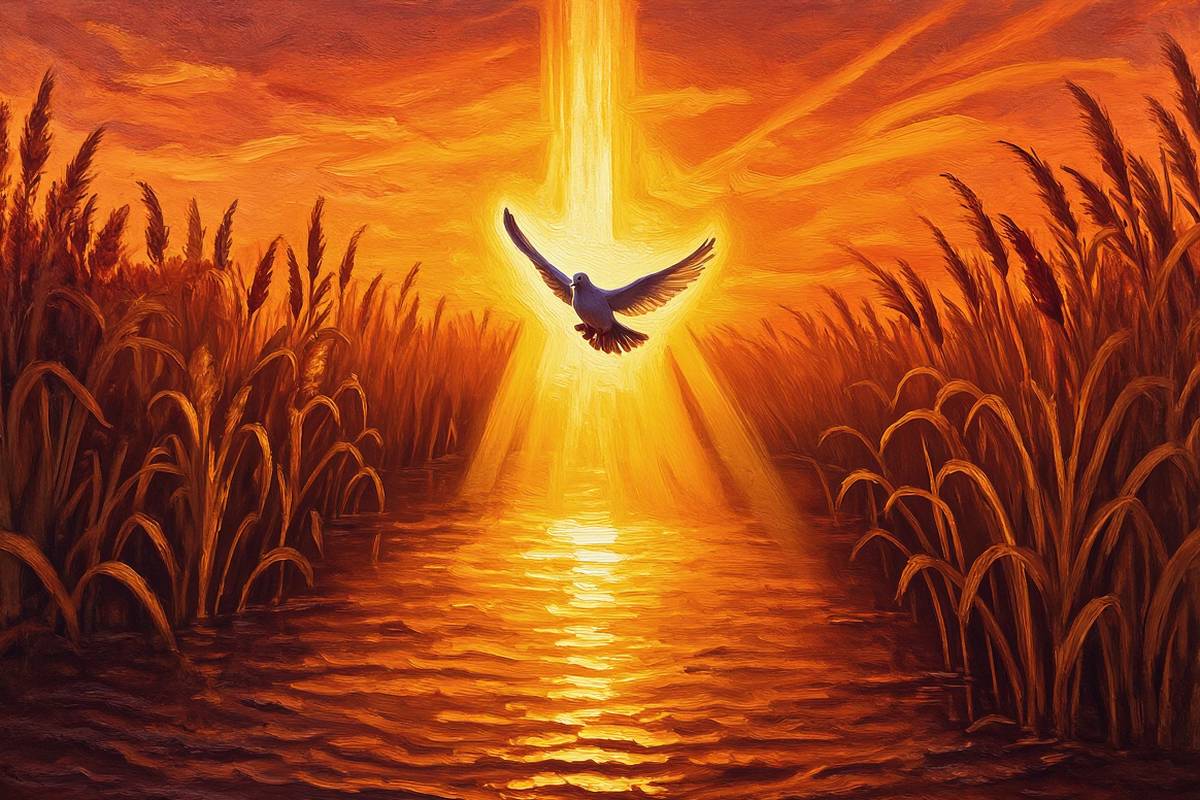
When He came up from the water, the heavens opened, the Spirit descended like a dove, and the Father said, “This is My beloved Son, in whom I am well pleased.” Pastor Hohman’s point is direct: even Jesus, who was greater than John, came under John’s authority. He applies it to his own ministry. When he preaches elsewhere, even as a bishop, he builds the way that house is building and does not override its leaders.
1 Corinthians 10:1–2 says all Israel was baptized into Moses in the cloud and in the sea. Moses alone received the instructions to leave Egypt with its wealth and to cross a sea no one could see across. The people were baptized into Moses because that was what God was doing through him. In this dispensation, Pastor Hohman says, God has given apostles, prophets, evangelists, pastors, teachers, elders and deacons, man or woman, as He chooses.
Jesus’ final words on earth in Matthew 28:18–20 confirm it. All authority in heaven and earth is His, and He sends His people to make disciples, baptizing them and teaching them to observe all He commanded. Pastor Hohman teaches that we are not saved for heaven by water baptism or by submission, but we are saved from the corruption of the world through it.
Naaman, Noah and the Power of Water Baptism
For an Old Testament picture, Pastor Hohman turns to Naaman, a skilled Syrian general with leprosy. A young Israelite girl serving his wife told her that a prophet in Samaria could heal him. The king of Syria sent a letter to the king of Israel, who tore his clothes, fearing a trap. Then Elisha sent word to bring Naaman to him (2 Kings 5:8–14).
Elisha did not even come out. He sent a messenger telling Naaman to wash in the Jordan seven times. Naaman, a man used to authority who had forgotten how to submit to it, became furious. He expected the prophet to wave his hand over the spot, and he insisted the rivers of Damascus were better. His servant reasoned with him: if the prophet had asked something great, would he not have done it?
Naaman swallowed his pride, dipped seven times, and his flesh was restored like the flesh of a little child. Pastor Hohman calls this a type of water baptism. When we say, “I’m submitting to the government of heaven,” the power of God is released through the authority He has set in the earth, bringing healing, life, protection and guidance. He likens it to the river whose streams make glad the city of God (Psalm 46:4).
Noah is the second picture. 1 Peter 3:18–22 says Christ suffered once for sins to bring us to God, and that while Noah built the ark, only eight people were saved through water. People mocked Noah, but he kept doing what God told him. Peter calls that water an antitype of baptism, which now saves us, not by removing dirt from the body, but as the answer of a good conscience toward God.
Those who refused to submit were destroyed by corruption; those who submitted were saved from it. Romans 6:1–4 adds that we were buried with Christ through baptism into death so that we should walk in newness of life. Pastor Hohman testifies that he was an addict and was instantly free, with no desire left. He has seen others set free the same way.
That is why ministers at NTC prophesy over people at their water baptism, he explains: it seals them for the future. He has pastored in Merrill for nearly forty years, and many things tried to make him quit, but he knows he is sealed. Receiving one another carries a reward too (Matthew 10:40–42). Even a cup of cold water given to a disciple will not lose its reward.
He is clear that water baptism does not earn salvation. The thief on the cross in Luke 23:39–43 did nothing but trust Jesus, and Jesus told him, “Today you will be with Me in Paradise.” Baptism instead lets the power of heaven flow through God’s authority to keep us and empower us in a dark world. The kingdom, he reminds the church, is righteousness, peace and joy in the Holy Spirit (Romans 14:17).
Building Kingdom Life This Week
Pastor Hohman closes with communion, recalling how Jesus, after submitting in baptism, was empowered all the way to the cross and through the resurrection. He invites anyone never baptized as a believer to sign up, so they can enjoy life as overcomers instead of being burdened by what is happening in the world. Here are the practical steps for building kingdom life from this message:
- Get water baptized. If you have never been baptized as a believer, take the step Jesus modeled, even if it feels awkward or inconvenient.
- Find your foundation Scripture. Ask the Lord for the passages your marriage, family or work should stand on, as the church stands on Philippians 1:27–28.
- Live as a citizen, not a lone ranger. Look for one way to strengthen what your local church is building rather than starting your own thing.
- Honor God-given authority. Like Jesus with John and Naaman with Elisha, respond to instruction without demanding it be done your way.
- Stand fast without fear. When opposition comes, stay united and unshaken; it is a sign of their failure and your salvation.
- Occupy until He comes. Treat your days as kingdom business: build, increase and keep going.
Timestamped Outline
- 0:00 Baptized into heaven’s rule
- 1:08 The call to plant the church in Merrill
- 3:02 “You’re going to pastor here”
- 6:04 The foundation Scripture: Philippians 1:27–30
- 9:08 Philippi as a Roman colony: Acts 16:12
- 11:23 Members of a citizen body
- 14:57 A kingdom, not a religion
- 16:21 Enemies of the cross: Philippians 3:17–20
- 18:49 Hebrews 6: the doctrine of baptisms
- 25:19 The seven baptisms
- 27:33 Submission means under a mission
- 30:09 The dispensations and covenant heads
- 36:05 Occupy till I come
- 38:18 Jesus modeled water baptism
- 41:37 Matthew 3: to fulfill all righteousness
- 45:44 Baptized into Moses: 1 Corinthians 10
- 49:28 Authority in the kingdom: Matthew 28
- 52:19 Naaman and the Jordan
- 58:38 Noah and 1 Peter 3
- 1:02:36 Romans 6: walking in newness of life
- 1:05:09 Sealed and empowered: Matthew 10
- 1:06:21 The thief on the cross
- 1:08:39 Communion and invitation
Building Kingdom Series
This message is part of the Building Kingdom series at NTC Ministries. Start from the beginning or go back one message:
- First message: Building Kingdom #2: A King, a Kingdom and a Royal Family
- Previous: Building Kingdom #6: Mother’s Day — Women’s Full Place in the Kingdom of Heaven
- You are here: Building Kingdom #10: Baptized Into Heaven’s Rule — Water Baptism, Authority and the Seven Baptisms
Frequently Asked Questions
Does water baptism save you?
Not in the sense of getting you into heaven. Pastor Hohman says plainly that we are not saved by water baptism or by works, otherwise we would boast. The thief on the cross never did anything, yet Jesus promised him Paradise. What baptism does, he teaches, is save us from the corruption of this world, the way the flood waters carried Noah’s family through while the mockers perished, and the way the Jordan cleansed Naaman.
What about people who were baptized as babies?
Pastor Hohman teaches that infant baptism is not the baptism Scripture describes, because a baby cannot make the decision. He sees what happens with a baby as a dedication: the parents commit to raise the child in the way he should go, so that one day the child will know the truth and choose baptism for himself. He encourages anyone baptized only as an infant to be baptized as a believer.
Can a person be water baptized more than once?
Pastor Hohman says he has been water baptized twice, once locally and once in the Jordan River. He also knows believers who were struggling and chose to be baptized again as a way of refreshing their commitment to heaven’s authority. His emphasis is not on the number of times but on what baptism represents: a heart that says, “I’m submitting to the government of heaven,” which opens the way for God’s power.
Scripture References
All passages open in the New King James Version on Bible Gateway:
- Philippians 1:27–30 — conduct worthy of the gospel
- Matthew 16:18 — I will build My church
- Philippians 3:17–20 — citizens of heaven
- Hebrews 6:1–3 — the doctrine of baptisms
- Matthew 3:13–17 — Jesus baptized by John
- 1 Corinthians 10:1–2 — baptized into Moses
- Matthew 28:18–20 — all authority
- 2 Kings 5:8–14 — Naaman in the Jordan
- 1 Peter 3:18–22 — Noah and baptism
- Romans 6:1–4 — newness of life
How this summary was made: written with AI assistance from the sermon’s own transcript and checked against the Scriptures listed above.
Watch More Messages
If this message stirred you to take your place in God’s kingdom, there are hundreds more teachings from NTC Ministries waiting for you. Browse the full sermon archive and keep building with Jesus.