Greater is He that is in me than he that is in the world is the truth this message builds on, and its second part turns from David to Joshua and Caleb. The pastor shows how Israel saw God’s miracles in Egypt and at the Red Sea yet kept complaining, and how ten leaders came back from the Promised Land seeing giants while Caleb said, “We are well able to overcome it.” The difference, he teaches, is pressing into God through His Word, prayer and fellowship. This message continues from Greater Is He That Is in Me Than He That Is in the World — Keeping Your Eyes on Your Source.
Below are the full video, a structured summary, the Scriptures linked to the New King James Version on Bible Gateway, a timestamped outline and practical steps.
Sermon at a Glance
This message was preached at NTC Ministries in Merrill, Wisconsin, and posted on July 11, 2023. It runs about 50 minutes and closes with communion. The pastor explains that it has been a couple of months since he last taught on this theme, so he reviews the story of David before moving forward into Numbers 13 and 14.
His central point is that faith does not deny the reality of difficulty. It declares the power of God in the face of the problem, and that kind of faith grows only as we keep pressing into who God is.
| Detail | Information |
|---|---|
| Speaker | The pastor (not named in the recording) |
| Series | Greater Is He That Is in Me, part 2 |
| Main text | 1 John 4:4, Numbers 13:1–33 and Numbers 14:6–24 |
| Key theme | Pressing into God gives us Caleb’s perspective: we are well able to overcome |
| Length | About 50 minutes, ending in communion |
David Knew Who His God Was
The pastor opens with the Word itself. It is rich, vibrant and alive, and like a two-edged sword it deals with issues in our hearts (Hebrews 4:12). On Christ the solid rock we stand; all other ground is sinking sand. When we try to do things on our own we stumble and make mistakes, but greater is He who is in us than he who is in the world (1 John 4:4).
He reviews the previous message. David was a young shepherd who spent time with the Father and came to know who He was. So when trouble came, David did not panic. He went after the lion and the bear that came for his flock (1 Samuel 17:34–37). That is what Satan does, the pastor says: he comes to steal, kill and destroy (John 10:10), trying to rob us of the blessings God has given.
When we start questioning God’s promise, it is because Satan is lying and manipulating. But God always leads us in triumph (2 Corinthians 2:14).
When David visited his brothers and found Israel hiding from Goliath, he did not head home to the sheep. “Greater is he rolls up on the inside of him,” the pastor says. Perfect love casts out fear (1 John 4:18). David refused the king’s armor because it was not made for him (1 Samuel 17:38–39), and he faced a fully armed giant with a sling and a stone, declaring that Goliath had defied the armies of the living God (1 Samuel 17:45–46).
David won, the pastor says, not because of his big words or his skill with a sling, though he surely practiced, but because he knew greater is He that is within him. If God is for us, who can be against us (Romans 8:31)? Though problems rise like giants or mountains, we can tell the mountain to move (Mark 11:23).
Pressure Builds Faith When You Press In
All of us go through hard times, the pastor says, from mortgages to taxes. But stretching is okay; God uses it to grow strength and faith. The danger is that under stress our devotion dwindles and we decide we are too busy for the Word, church or prayer.
His answer is to start each day with God: “This is the day the Lord has made; we will rejoice and be glad in it” (Psalm 118:24). Sometimes he reads the same chapter every day for weeks, telling God he is not sure what is going on yet, and reads it again, because faith comes by hearing, and hearing by the word of God (Romans 10:17).
Believers are not exempt from tribulation. In fact, he says, giving your life to Christ is like walking around with a bullseye on your T-shirt, because you now pose a threat to Satan’s kingdom. We are called to be fishers of men (Matthew 4:19) and lights in the world. So when pressure comes, he presses in all the more: standing on the Word, praying in the Spirit, getting to church and building himself up. Breakthrough, he says, is right on the other side.
Jesus invites the weary and burdened to come to Him for rest, because His yoke is easy and His burden is light (Matthew 11:28–30). And he who comes to God must believe that He is, and that He rewards those who diligently seek Him (Hebrews 11:6). That part is on each of us.
Time with Jesus is something you never regret. Whether you give Him ten minutes or a couple of hours, you come away filled with His presence, strength, peace and joy. When we stop pressing in, fear creeps back. His answer is to keep declaring, “greater is he that’s in me than he that’s in the world.”

Israel Saw Miracles and Still Complained
Turning to Numbers 13, the pastor gives the background. God called Moses to tell Pharaoh, “Let My people go,” and even Moses protested that he could not speak well (Exodus 4:10–12). God sent plagues on Egypt, from rivers of blood and frogs to locusts and finally the death of the firstborn. Israel cried out, God heard, and Pharaoh let them go.
Then Pharaoh changed his mind and chased them. With their backs against the Red Sea, the people panicked, complaining that they had been brought out to die. Moses kept his eyes on the One who could deliver them. He stretched out his rod, the sea parted, and Israel crossed on dry ground (Exodus 14:21–22). “It wasn’t even mushy,” the pastor says. When Pharaoh’s army followed, the sea closed over them.
Did that change Israel’s perspective? No. Instead of saying they wanted to know this God of signs and wonders, they kept grumbling about food and wanting to go back to Egypt. God sent quail and manna from heaven (Exodus 16:12–15). It was raining breakfast and dinner, he says, and they were still complaining.
He wants to know that God, not just come to church to have his ears tickled. In His presence is fullness of joy (Psalm 16:11), so we cannot get too busy and let Satan rob us of what Christ has done.
He quotes Dr. Hohman: change isn’t change unless there’s change. You can pray a prayer and say you are a Christian, but if you stay in the same boat of complaining, arguing and negativity, you are only deceiving yourself. Believers are called to come out from the world and be separate (2 Corinthians 6:17) and to look for the good.
The Twelve Spies and the Promised Gift
In Numbers 13:1–3, the Lord tells Moses to send men to spy out the land of Canaan, “which I am giving to the children of Israel.” The pastor wants that phrase to sink in. It is like Christmas morning: he wraps presents for his children, and when they tear into them, he does not tell them to give the gifts back. God does not renege on His gifts either.
The spies were not random men; each was a leader of his tribe, so the pastor urges the church to pray daily for bosses, supervisors, pastors and elders, who carry more pressure than people realize.
He illustrates with Dr. Hohman, whom he calls a hayseed from the U.P. God sent him to Merrill with a vision for a school, a radio station, a college, a food pantry and a worldwide ministry. He did not question how; he pressed into who his God was, and almost 40 years later the ministry stands. God stretches us to grow us, the way muscle must tear before it grows.
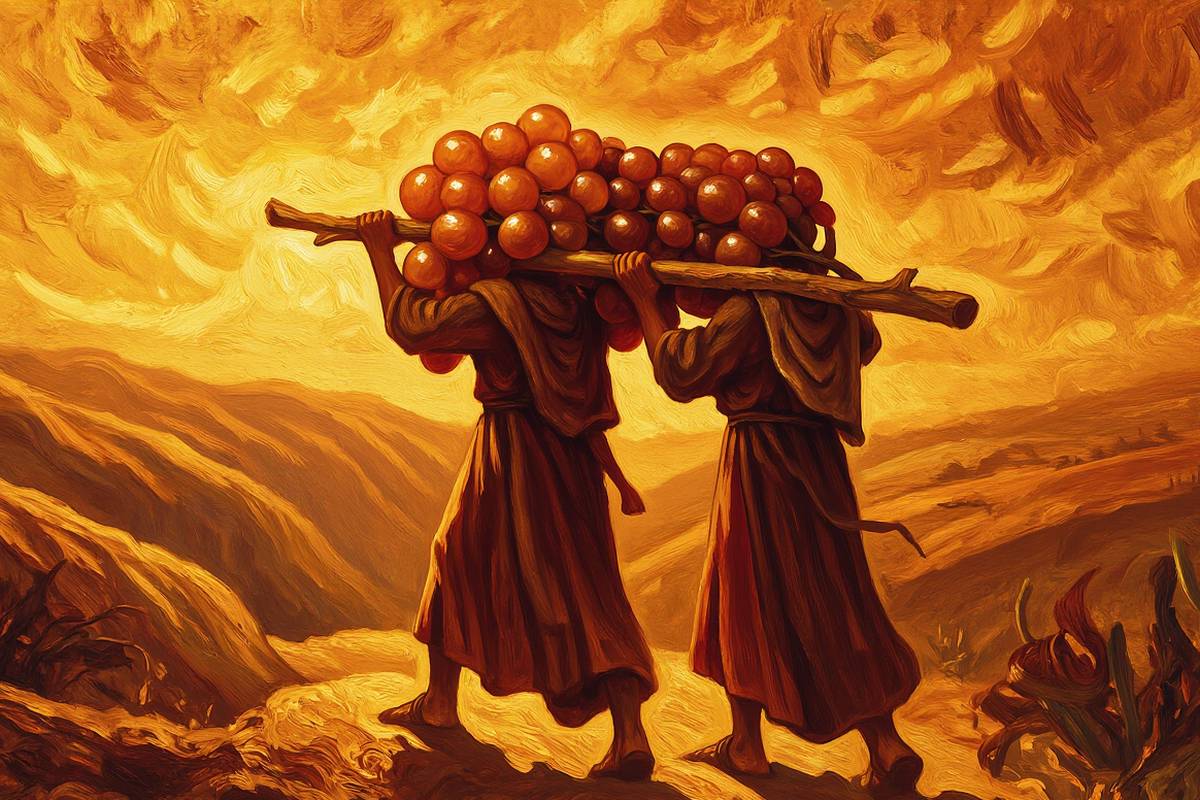
In Numbers 13:17–20 Moses sends them to see whether the people are strong or weak, the cities camps or strongholds, the land rich or poor, and tells them to be of good courage and bring back fruit. The spies were thorough. In Numbers 13:21–25 they cut down a single cluster of grapes so large that two men carried it on a pole, along with pomegranates and figs, and returned after forty days.
The steps of faith God asks of us deserve the same diligence. Some miracles are instant, he says; other times we step out and wait for the promise, letting patience have its perfect work (James 1:4).
Caleb: Greater Is He That Is in Me Than He That Is in the World
The report began well. In Numbers 13:26–29 the spies said the land truly flows with milk and honey, “nevertheless” the people are strong, the cities fortified, and Amalekites, Hittites, Jebusites, Amorites and Canaanites live everywhere, from the mountains to the sea. The people got worked up, the pastor says, because they had built a habit of complaining and letting emotions run their lives.
Then Numbers 13:30–33: “Caleb quieted the people before Moses, and said, ‘Let us go up at once and take possession, for we are well able to overcome it.'” Same land, different perspective. Caleb pressed in to receive the blessing God had already given. If God says He is giving it, will He take it back? Not a chance, the pastor says; God does not make mistakes, and He is in the blessing business.
The other men gave a bad report: the land devours its inhabitants, the people are giants, “and we were like grasshoppers in our own sight, and so we were in their sight.” Lift your vision higher, the pastor urges. Greater is He that is in me than he that is in the world, and greater than your circumstance or your situation at work.
When you know who your God is, you do not care what Satan tries. By my God I can run against a troop and leap over a wall (Psalm 18:29). Caleb used a confession of faith. “Faith isn’t blind,” the pastor says. “Faith does not deny the reality of difficulty,” but it declares the power of God in the face of the problem.
Israel did take the land at a later date, which shows that even when delays come, faith’s confession brings victory. He gives an example close to home: Dr. Hohman received the word for Merrill in 1980 but did not move there until 1986, and the speaker’s family moved in 1987. Steps of faith, he says, and let patience have its perfect work.
The table below sets the two reports side by side, as the pastor reads them.
| Question | The ten leaders | Joshua and Caleb |
|---|---|---|
| What did they see? | Fortified cities and giants everywhere | An exceedingly good land God was giving them |
| How did they see themselves? | Like grasshoppers | Well able to overcome it |
| What did they focus on? | The strength of the enemy | The promise of God |
| What did they speak? | A bad report | A confession of faith |
| What happened? | They did not see the land | They entered and their descendants inherited it |
A Different Spirit and the Power at Work in Us
When the people rose up against Moses and wanted new leaders, Joshua and Caleb tore their clothes. In Numbers 14:6–9 they said the land is exceedingly good, and if the Lord delights in us, He will bring us in and give it to us. “Only do not rebel against the Lord, nor fear the people of the land, for they are our bread; their protection has departed from them, and the Lord is with us.”
God took Israel out of Egypt physically, the pastor notes, yet they could not change their ways. We need Joshua and Caleb’s perspective on God’s promises: healed by His stripes (Isaiah 53:5), no weapon formed against us prospering (Isaiah 54:17). He names God as Jehovah Rapha who heals, Jehovah Jireh who provides, and Jehovah Sabaoth leading us triumphantly into battle.
In Numbers 14:20–24, God says, “I have pardoned, according to your word,” declares that all the earth shall be filled with His glory, and says those who tested Him ten times will not see the land. “But My servant Caleb, because he has a different spirit in him and has followed Me fully, I will bring into the land.” God has put a new spirit in us too, the pastor says. When the world says there is no hope, it is Christ in us, the hope of glory (Colossians 1:27).
That is why strong prayer lives and devotion to the Word matter. He wants to abide in the vine (John 15:5) and see God do the impossible through him, not because he is somebody great, but because it is a promise he chooses to take. As for God, His way is perfect and His word is proven; He is a shield to all who trust in Him (Psalm 18:30). Like Joshua, “as for me and my house, we will serve the Lord” (Joshua 24:15).
Joshua and Caleb both brought a good report, and the pastor guesses they were friends who built each other up. A steady diet of friends who do not know Christ, he says, weakens faith when giants rise up.
When the enemy says you are nothing, remember that you are fearfully and wonderfully made (Psalm 139:14), placed here for such a time as this. God is not a genie who fixes everything while we wait. He has given us the measure of faith, and believers will lay hands on the sick and see them recover (Mark 16:18). We need to be faith-filled leaders when someone comes to us in need.
He ends with Ephesians 3:20–21: God is able to do exceedingly abundantly above all that we ask or think, according to the power that works in us. You may not feel it or see it, he says, but God never stops working. His promises are still yours, through all ages, for you, your children and your children’s children.
Living It Out This Week
The service closes with communion from 1 Corinthians 11:24–25, a reminder of the body broken and the new covenant in His blood. Here are practical steps from this message:
- Greet God before the day starts. The pastor suggests saying good morning to the Father, the Holy Spirit and King Jesus and welcoming Him into your day.
- Stay with one chapter. Reread the same passage until faith comes by hearing, even if it takes weeks.
- Press in under pressure. When stress rises, add time in the Word, prayer and church instead of cutting it.
- Change your report. Catch yourself complaining and replace it with what God has promised, as Caleb did.
- Pray for your leaders. Lift up your boss, supervisors, pastors and elders by name each day.
- Choose faith-building friends. Spend time with people who strengthen your faith, like Joshua and Caleb did for each other.
Timestamped Outline
- 0:00 The Word of God and greater is He
- 0:57 David, the lion and the bear
- 2:53 David faces Goliath
- 3:48 Opening prayer
- 5:43 Stretching builds faith
- 8:05 A bullseye on believers
- 9:06 Matthew 11:28–30: come to Me
- 10:07 Time with Jesus is never wasted
- 12:07 Moses, Pharaoh and the plagues
- 14:14 The Red Sea parts
- 16:28 Manna, quail and complaining
- 17:44 Numbers 13: the land I am giving you
- 19:50 Pray for your leaders
- 21:53 Spying out the land
- 23:31 Patience and the report of fruit
- 24:32 Caleb: we are well able
- 26:49 Like grasshoppers in our own sight
- 28:55 A confession of faith
- 30:12 Numbers 14: Joshua and Caleb
- 33:37 I have pardoned according to your word
- 38:08 Psalm 18:30: His way is perfect
- 42:24 Ephesians 3:20–21
- 44:45 Communion and closing prayer
Greater Is He Series
This message is part of a short series at NTC Ministries. Go back to the previous message or continue with the next:
- Previous: Greater Is He That Is in Me Than He That Is in the World — Keeping Your Eyes on Your Source
- You are here: Greater Is He That Is in Me Than He That Is in the World, Part 2: Joshua, Caleb and the Twelve Spies
- Next: Greater Is He That Is in Me Than He That Is in the World #3 — What Is Your Story?
Frequently Asked Questions
Why did God tell Moses to send spies if He was already giving them the land?
The pastor stresses that God was not asking for their opinion on whether the land could be taken. He said plainly that He was giving it to them, so the spies were sent to see what God was providing and to bring back its fruit. The test was not of the land but of their perspective: whether they would focus on the giants or on the promise.
Does faith mean ignoring hard facts?
No. The pastor says faith is not blind and does not deny the reality of difficulty. Caleb saw the same fortified cities and the same descendants of Anak as the other spies. The difference was that he declared the power of God in the face of the problem. Faith acknowledges the giant and then speaks what God has promised about it.
What if the promise takes a long time?
He points out that Israel did take the land, but at a later date, and that delays do not cancel faith’s confession. His own example is the vision for the Merrill church, which came years before the move actually happened. Keep taking steps of faith and let patience have its perfect work, he says, so that you are complete and lacking nothing when the promise arrives.
Scripture References
All passages open in the New King James Version on Bible Gateway:
- 1 John 4:4 — greater is He who is in you
- 1 Samuel 17:34–37 — David, the lion and the bear
- Matthew 11:28–30 — rest for the weary
- Exodus 14:21–22 — the Red Sea parted
- Numbers 13:1–3 — the land I am giving
- Numbers 13:30–33 — Caleb and the bad report
- Numbers 14:6–9 — the Lord is with us
- Numbers 14:20–24 — a different spirit
- Ephesians 3:20–21 — the power that works in us
How this summary was made: written with AI assistance from the sermon’s own transcript and checked against the Scriptures listed above.
Watch More Messages
If this message helped you see your giants differently, there are hundreds more teachings from NTC Ministries waiting for you. Browse the full sermon archive and keep pressing into the God who is greater.