The motivational gifts are the gifts God the Father places in every believer at the new birth, and in this eighth session Dr. William P. Hohman turns to one of the hardest to recognize: the gift of giving. He teaches that every gift God gives is meant to serve other people, that your purpose comes into view as you start serving, and that a giver who matures in this gift becomes the arms of the body of Christ. This message continues from Motivational Gifts #7: The Gift of Exhortation and Why We Need Each Other.
Below you will find the full video, a structured summary of the sermon, the Scripture behind each point (linked to the New King James Version on Bible Gateway), a timestamped outline, and practical steps for using your own gift this week.
Sermon at a Glance
This message was posted on August 15, 2023, as the eighth session in the motivational gifts series at NTC Ministries. It runs about 75 minutes and closes with communion and a prayer of commitment. Pastor Hohman opens by noting how differently two other ministers preach: one is an exhorter, the other more motivated by teaching and prophecy. Not better, he says, just different.
From there he recaps where the gifts come from, reviews prophecy, serving, teaching and exhortation, and then spends most of the hour on the giver: who they are, how Matthew shows the gift at work, and where an immature giver can go wrong.
| Detail | Information |
|---|---|
| Speaker | Dr. William P. Hohman |
| Series | Motivational Gifts (session 8 of the series) |
| Main text | Romans 12:3–8 and Matthew 6 |
| Key theme | The gift of giving, the arms of the body of Christ |
| Length | About 75 minutes, ending in communion |
Every Gift Is Given to Serve Others
Pastor Hohman starts with a simple question: who has ever received a gift they did not like, and who has received one that blessed them for years? The whole kingdom of God, he says, is about giving gifts. Jesus said freely you have received, freely give (Matthew 10:8), so every gift God gives is meant to be given out, even when it also blesses us personally.
He reads 1 Peter 4:10: each one should use whatever gift he has received to serve others, as a good steward of God’s grace. It does not matter which gifts we have; we are to use them to serve people. The more we use them, the more they develop and the more they produce.
That is also how purpose is found. People who keep asking what their purpose is often never do anything for God. Start serving, be a people person, look for ways to help and bless, and you will watch your gifts come out and your purpose come into view. Pastor Hohman is blunt that people who sit at home and never come to church will not fulfill their purpose.
He ties this to creation itself, which waits in futility for the revealing of the sons of God (Romans 8:19–21). Creation cannot fulfill its purpose until we fulfill ours. The church, he says, is not a luxury cruise liner where everyone waits on you; it is a battleship where all hands are on deck to take territory. Jesus came to build His church, and the gates of Hades will not prevail against it (Matthew 16:18).
Without faith it is impossible to please God (Hebrews 11:6), so believers have to step out and watch God’s grace and gifts manifest in their lives. Like a farmer who plants no seed and expects no crop, nothing grows until we do something. The kingdom, he says, runs on the law of reciprocity.
Three Sources of Spiritual Gifts
The Old Testament foundation for the series is Psalm 46:1–5. God is our refuge and strength, and there is a river whose streams make glad the city of God. Pastor Hohman notes that “streams” is plural: the gifts are streams flowing into the church through ordinary believers. Because of them, the city of God shall not be moved. God has gifted His people to bear up under pressure and soar over obstacles, but every gift needs to be in operation.
He then explains that each Person of the Godhead gives gifts, which is why denying certain gifts amounts to denying part of the Godhead. The Holy Spirit gives the manifestation of the Spirit to each one for the profit of all (1 Corinthians 12:7). Jesus, who descended and ascended far above the heavens, gave apostles, prophets, evangelists, pastors and teachers (Ephesians 4:10–11), which is why they are also called ascension gifts.
The Father gives the motivational gifts. In Romans 12:3, God has dealt to each one a measure of faith, and Pastor Hohman teaches that in the New Testament “God” refers to the Father unless Jesus or the Holy Spirit is named. These gifts are given at the new birth. The gifts of the Spirit, by contrast, come when a believer asks for and receives the Holy Spirit, and then they have to be exercised.
One passage holds all three together. 1 Corinthians 12:4–6 speaks of diversities of gifts but the same Spirit, differences of ministries but the same Lord, and diversities of activities but the same God who works all in all. Pastor Hohman reads these as the spiritual gifts, the fivefold ministries and the motivational gifts.

The Seven Motivational Gifts of Romans 12
Romans 12:4–8 lists the seven motivational gifts: prophecy, serving, teaching, exhortation, giving, organization (leading) and mercy. All the members of the body do not have the same function. Most people have one or two that are dominant, and that dominant gift is the lens through which they see life once they are born again. Using it bolsters faith, he says, but our faith must stay in God, who gave it.
Pastor Hohman explains why the church teaches this at all. Misunderstanding these gifts is one of the greatest sources of division, because we expect others to be like us. When two differently gifted people learn to work together, both end up right. The Message Bible’s wording of this passage, he notes, warns against enviously or pridefully comparing ourselves with each other. Paul says those who measure themselves by themselves are not wise (2 Corinthians 10:12).
He adds that the New American Standard renders Romans 12:6 as each of us exercising our gifts. Like muscles, gifts grow when they are used. Waiting for God to reveal your purpose while doing nothing will not work. The fivefold ministry exists to equip the saints for the work of ministry (Ephesians 4:11–12), not to run infomercials and fund a business.
Before reaching giving, he reviews the first four gifts and the part of the body each one represents:
| Motivational gift | Part of the body (as taught) | What drives this person |
|---|---|---|
| Prophecy (perceiving) | The eyes | Discerning good and evil and revealing truth; the watchdogs of the church |
| Serving | The hands | Meeting practical needs in the church |
| Teaching | The mind | Accuracy of information; instructing, clarifying, simplifying and illustrating |
| Exhortation | The mouth | Encouraging others; encouragers need encouraging too |
| Giving | The arms | Always reaching out to help and meet needs, usually quietly |
On teaching, he adds a principle of interpretation: a Scripture has one interpretation but can have twenty thousand applications. On exhortation, he points to David, who recalled the lion and the bear before facing Goliath (1 Samuel 17:34–37). Encouragers need encouraging too.
The Gift of Giving: The Arms of the Body
Romans 12:8 says he who gives should give generously. Pastor Hohman reads the Amplified Bible’s sense of giving with zeal and singleness of mind and applies it plainly: never have giver’s remorse. If the Lord tells you to give a thousand dollars and the next day you need a tire, God already knew. He wants you in faith toward Him for that tire, not toward a job, the government or a crowdfunding page. As he puts it, “our apron strings are from heaven, not this world.”
Those motivated by giving are the arms of the body, always reaching out. They usually want to give quietly and care nothing for plaques or trinkets. They also stir others to give. He quotes Oral Roberts: if what you have in your hand is not enough to meet your need, “then it automatically becomes your seed.” Pastor Hohman shares that twice they have given away everything they owned, and he warns not to copy that unless God is speaking to you.
Givers are alert to needs others overlook, look for the best buys and want to keep a good budget, though some never learn how and end up squandering what they have. When the enemy tries to make a giver stop after being taken advantage of, Pastor Hohman says to overcome by the blood of the Lamb and the word of your testimony (Revelation 12:11) and keep doing what God called you to do.
He explains that the Greek word for giving in Romans 12:8 means to give over. Once you give something, it belongs to the other person. He illustrates with his 1969 Ford Mustang, which he describes as a car that never saw a rainy day. At a men’s conference the Lord told him to give it away. He and Pam paid over a thousand dollars to fix it first, because a giver does not give junk. The young pastor who received it later sold it for a practical car, and that was his right.
He also teaches a principle of ownership. Many people do not realize the money they have is actually theirs, so it comes in one hand and goes out the other, like wages put into a bag with holes (Haggai 1:6). Living for today is immaturity, because foolishness is bound up in the heart of a child (Proverbs 22:15). Learn to grow what you have, in part by giving.
Matthew the Giver and What He Wrote About Money
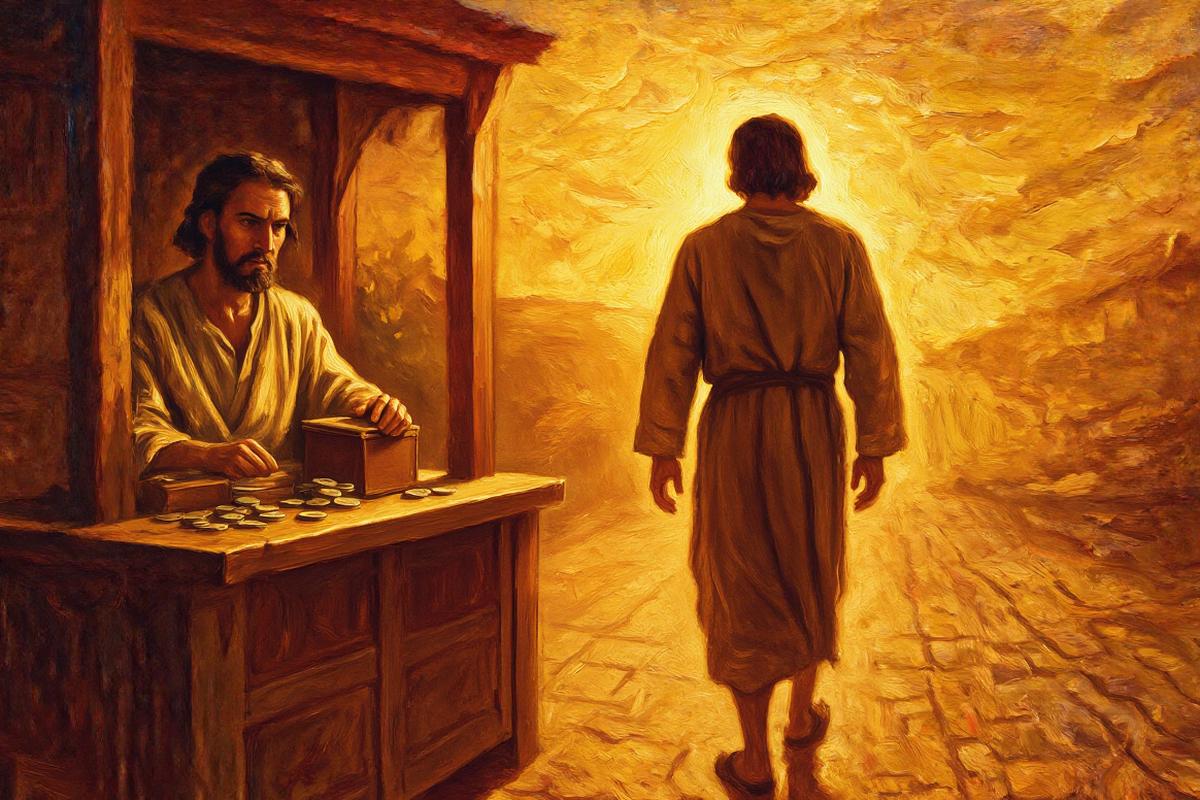
Pastor Hohman’s Bible example of the gift of giving is Matthew. When Jesus called him, Matthew walked away from a well-paid job as a tax collector for the Romans (Matthew 9:9–10). You might think of a tax collector as a taker, he says, but once Matthew received the Lord, the motivation of a giver came alive. He opened his home to Jesus, the disciples and many tax collectors and sinners, using his money to meet a need and to bring people to Jesus.
Givers often avoid the limelight, and it fits that Matthew wrote almost nothing about himself. Much of what he did write concerns money, and much of that warns about its pitfalls. Pastor Hohman compares money to a wrench for a mechanic or a hammer for a carpenter. It is a tool. It is the love of money that is the root of evil (1 Timothy 6:10), and he points to people who win the lottery and destroy themselves because they never learned how to handle it.
In Matthew 6:1–4, Matthew records Jesus warning against doing charitable deeds to be seen. Those who give to be praised by people already have their reward. Give in secret, and your Father who sees in secret will reward you openly. One motivated by giving, he says, wants the reward from God, because then he will have more to give.
Matthew 6:19–21 calls believers to lay up treasure in heaven, where moth and rust do not destroy, because where your treasure is, there your heart will be also. Pastor Hohman links this with Colossians 3:1–3: set your affections on things above.
He then reads Matthew 6:25–34 as Jesus’ cure for giver’s remorse. Do not worry about what you will eat, drink or wear. Your Father feeds the birds and clothes the lilies, and He knows what you need. Seek first the kingdom of God and His righteousness, and all these things will be added. Luke states the same principle in one line (Luke 6:38), but Matthew, motivated by giving, spells out both the blessing and the pitfalls.
Traits and Pitfalls of the Giver
Pastor Hohman lists characteristics of a mature giver. They are joyful in giving and receiving and testify about being blessed. They count time, talent, knowledge, skills and affection as part of what they give. He remembers one of his children, he thinks Jennifer, wanting to hug strangers who looked down. Givers also encourage tithes and offerings, give humbly, look for people who cannot help themselves, and give gifts of high quality rather than junk.
They will not be manipulated. He recalls a woman who told a man in the church that the Lord said he should pay for her trip. The man answered that if God wanted him to do it, God would have told him. Givers also take time to learn how to invest, save and make wise purchases, and they will sacrifice comforts to give. They must still show hospitality (Romans 12:13), so let givers enjoy church without being hounded for help, as he once had to tell the congregation about a physician who had stopped attending.
Then come the pitfalls of an immature giver:
- Becoming stingy with their own family, which is a person’s first ministry.
- Controlling people through gifts and expecting something back.
- Wanting people to rely on them rather than on God, like spoiling children.
- Judging who deserves to receive instead of simply obeying God.
- Putting financial advice ahead of what God says, and drifting toward greed.
- Pressuring others to give and judging how they give.
On the family pitfall, Pastor Hohman tells what he learned through the apostolic organization he was ordained in, connected to John G. Lake. As he recounts it, Lake gave food away to people in worse shape, his wife died of malnutrition, and only his daughter Gertrude still talked to him and liked him. His point: the gift of giving is meant to bless your family too.
He closes by saying this is one of the hardest gifts to recognize, because an immature giver’s actions can look like the opposite of generosity. That is why believers should be slow to judge one another by outward things.
Living It Out This Week
Pastor Hohman ends with communion and asks the church to pray, “Father, how do You need me to fit here? What’s my role, what’s my function?” Here are practical steps drawn from the message:
- Serve before you know your purpose. Look for one practical way to help someone this week and watch which gifts surface.
- Stop comparing. When someone handles a need differently than you would, remember they may see it through a different gift.
- Give without remorse. When God prompts a gift, trust Him with tomorrow’s needs, as Matthew 6 teaches.
- Give quietly and give quality. Let your left hand not know what your right hand does, and never give away junk.
- Learn to handle money. Seek wise counsel on budgeting and saving now, so you are ready for more later.
- Bless your family first. Do not let generosity toward others make you stingy at home.
His closing prayer of commitment says it simply: by Your grace, all the gifts You have given, I will use to bless and serve those around me.
Timestamped Outline
- 0:00 Session eight: not better, just different
- 1:10 Every gift is given to serve others: 1 Peter 4:10
- 2:21 Serving reveals your purpose
- 3:31 A battleship, not a cruise liner
- 4:42 Psalm 46: streams that make glad the city of God
- 8:07 Gifts from the Father, the Son and the Spirit
- 11:25 1 Corinthians 12:4–6: all three in one passage
- 12:39 The seven motivational gifts in Romans 12
- 16:09 Exercise your gifts like muscles
- 17:22 Do not compare yourselves
- 23:08 Review: prophecy and serving
- 26:33 Review: teaching and one interpretation
- 28:48 Review: the exhorter
- 31:05 The gift of giving and giver’s remorse
- 33:08 Givers are the arms of the body
- 39:20 Matthew leaves his tax booth
- 42:47 Money is a tool
- 46:04 The principle of ownership
- 48:41 Giving over, and the Mustang story
- 53:04 Matthew 6: give in secret
- 56:28 Do not worry: Matthew 6:25–34
- 1:00:14 Characteristics of a giver
- 1:06:46 Pitfalls of an immature giver
Motivational Gifts Series
This message is part of a ten-part teaching series at NTC Ministries. Start from the beginning or continue where this one leaves off:
- First message: Motivational Gifts #1: The River, the Streams and the 21 Gifts of God
- Previous: Motivational Gifts #7: The Gift of Exhortation and Why We Need Each Other
- You are here: Motivational Gifts #8: The Gift of Giving, the Arms of the Body of Christ
- Next: Motivational Gifts #9: God Expects a Return and the Gift of Leadership
Frequently Asked Questions
How do I know if giving is one of my motivational gifts?
Pastor Hohman describes givers as people who notice overlooked needs, enjoy finding the best buys, want to keep a good budget, give quietly without wanting recognition, and resist being pressured into giving. At the end of the service he asked who sensed giving was a dominant gift, and noted that many hands will go up for more than one gift. Most believers have one or two dominant motivations.
Should I give everything away like the pastor did?
No, not unless God is speaking to you. Pastor Hohman says he and his wife twice gave away everything they owned because the Lord told them to, and even his own pastor tried to talk him out of it for two months. He tells people not to copy that just because they see how blessed he is. Start giving, he says, but you do not have to give everything away.
Is it wrong to ask for help through a fundraiser?
He does not forbid it. He acknowledges there is a time and purpose to help people out that way. His concern is that people are quick to turn to crowdfunding for small things, when their trust should be in God. In his view, believers whose apron strings are tied to heaven look to God first rather than to a job, the government or the crowd.
Scripture References
All passages open in the New King James Version on Bible Gateway:
- Romans 12:3–8 — the seven motivational gifts
- 1 Peter 4:10 — use your gift to serve others
- Psalm 46:1–5 — streams that make glad the city of God
- 1 Corinthians 12:4–6 — gifts, ministries and activities
- Ephesians 4:10–11 — the ascension gifts
- Matthew 9:9–10 — Matthew follows Jesus
- Matthew 6:1–4 — give in secret
- Matthew 6:19–21 — treasure in heaven
- Matthew 6:25–34 — seek first the kingdom
How this summary was made: written with AI assistance from the sermon’s own transcript and checked against the Scriptures listed above.
Watch More Messages
If this message helped you see your own gift more clearly, there are hundreds more teachings from NTC Ministries waiting for you. Browse the full sermon archive and keep growing in the gifts God has placed in you.