What is God asking of you today? Pastor Paul answers that salvation is not a ticket you pocket while you wait for heaven. Believers are the army of the living God and the hands and feet of Christ, and God gives clear instructions in His Word: believe, put Him first, read the Bible, gather with the church, forgive, give thanks, pray, love and care for others. Then He asks for steps of faith that put those beliefs into action.
Below you will find the full video, a structured summary of the sermon, the Scripture behind each point (linked to the New King James Version on Bible Gateway), a timestamped outline, and practical steps you can take this week.
Sermon at a Glance
This message was preached at NTC Ministries in Merrill, Wisconsin, while Dr. Hohman was ministering at the church’s French-speaking African congregations in Illinois, and was posted on December 7, 2022. It runs about 53 minutes and ends in prayer. Pastor Paul opens by noting that the ministry’s reach, from Russian-speaking churches in Minnesota to French-speaking churches in Illinois, did not happen by accident. It happened because people took steps of faith when God asked.
His aim, he says, is not to beat anyone up but to encourage. Your time is not over and you have not missed your moment. God created you on purpose, for such a time as this, to do great things on this earth and not only in the sweet by and by.
| Detail | Information |
|---|---|
| Speaker | Pastor Paul |
| Series | Single message |
| Main texts | Ephesians 2:8–10, Luke 19:11–26, James 2:14–26 |
| Key theme | Active faith: hearing what God asks and taking steps to do it |
| Length | About 53 minutes, closing in prayer |
The Army of the Living God
Many people, Pastor Paul says, believe that once they pray a prayer they have their ticket to heaven and can sit back and wait. Scripture describes something else. Believers are the body of Christ, His hands and feet, and the army of the living God (1 Samuel 17:26).
He draws the comparison with signing up for the military. Within weeks you are sent to a base you did not choose, and once there you are told when to sleep, when to wake, how to make your bed and how to march. It is a life of discipline. If God calls us His army, he asks, should there not be a similar discipline in how we respond to what He has asked of us?
Going to church once a week and hoping it gets you into heaven is not that discipline. The Bible, he says, is full of instructions. If you think God has never asked you to do anything, he says, the first question is whether you are reading your Bible.
He also tackles the excuses we make. I am not good at that. I am an introvert. I cannot talk the way you do. Pastor Paul says he never dreamed of becoming a pastor himself. God has placed you here for such a time as this (Esther 4:14), and He created you with purpose.
From Reluctant Guitarist to Pastor
At fourteen, someone asked Pastor Paul whether he had ever thought about learning the guitar. It had never crossed his mind. He talked it over with his parents, took six months of lessons, and fell in love with playing alone in his room, so much that his mother would come in and tell him it was time to stop. God gives gifts, he says, and opens our eyes to see that something is a good fit.
Then his father told him he would lead praise and worship in the school chapel. He refused, and they went back and forth. Finally his father suggested that the next time he had to share in chapel, he share on praise and worship and then lead it. He said fine, and immediately wondered what he had got himself into. His hands were buckets of sweat and his mouth was full of cotton.
What helped was a simple revelation. If the Bible says to clap, to dance and to make a joyful noise to the Lord, then it is not him people are refusing; it is the Bible. That was a kind of preaching. From there a chapel worship team formed, the youth took over Wednesday night worship, and he served on the Sunday team, the sound team and the cameras.
The lesson is that steps of faith make room for growth, as God takes us from faith to faith, strength to strength and glory to glory. Pastor Paul then asks what would have happened if Dr. Hohman had not listened when the Lord sent him to Merrill in 1986 to lead a handful of people to Christ and start a church. One person listened, and today the ministry reaches 37 nations. He mentions a church just built in Afghanistan whose pastor the ministry supports, as well as medical clinics, colleges, schools and orphanages.
What Is God Asking of You? Nine Basics
Before going deeper, Pastor Paul runs through some basic things the Word of God tells every believer to do, backing each with Scripture so that, as he puts it, it is not just what he thinks. Afterwards he counts them up as nine, covering life physically, spiritually, emotionally and mentally. The table gathers them in his order.
| What God asks | Scripture he gives | His comment |
|---|---|---|
| Believe in Jesus | Acts 16:31 | Confess with your mouth and believe in your heart |
| Prioritize Him | Matthew 6:33 | When priorities get out of order, we feel it |
| Read His Word | 2 Timothy 3:16–17 | The Bible is not meant to collect dust on a shelf |
| Get involved in church | Hebrews 10:25 | Gather more as the day approaches, not less |
| Forgive others | Luke 6:37 | Unforgiveness opens the door to bitterness |
| Give thanks | Philippians 2:14 | Do all things without complaining; zip the lip |
| Pray | 1 Thessalonians 5:17 | Thank Him before your feet hit the ground |
| Love | 1 Corinthians 13 | Without love we are only a clanging cymbal |
| Care for others | James 1:27 | Visit orphans and widows in their trouble |
Believe on the Lord Jesus Christ, and you will be saved, you and your household (Acts 16:31); if you confess with your mouth and believe in your heart, you will be saved (Romans 10:9). Then seek first the kingdom of God and His righteousness (Matthew 6:33).
The Word is quick and powerful, sharper than any two-edged sword (Hebrews 4:12), and a soldier needs a sword because the devil prowls like a roaring lion (1 Peter 5:8). He does not bother people who are doing nothing, Pastor Paul says, but that is no reason to do nothing. All Scripture is profitable for doctrine, reproof, correction and instruction in righteousness (2 Timothy 3:16–17). Nobody likes correction, he admits, but God corrects in love.
We are not to forsake assembling together, and even more so as we see the Day approaching (Hebrews 10:25). Forgive, and you will be forgiven (Luke 6:37). Everyone has a story, but Jesus said to be of good cheer because He has overcome the world (John 16:33). Bitterness, he warns, will eat you alive.
Do all things without complaining and disputing (Philippians 2:14). Sometimes, he says, you just have to zip the lip. Pray without ceasing (1 Thessalonians 5:17): thank God before your feet hit the floor, through the workday and even after you have made a mess of things.
Without love, even the tongues of men and of angels are only sounding brass or a clanging cymbal (1 Corinthians 13:1). You cannot make people believe what you believe, he says, but you can show them through kindness and goodness. And pure religion is to visit orphans and widows in their trouble and keep yourself unspotted from the world (James 1:27).
Salt, Light and His Masterpiece
Church, Pastor Paul says, is where we practice. It is easy to shout hallelujah inside the building. The test comes outside, where believers are called to be the salt and light of the world (Matthew 5:13–14). Whether we think so or not, we are leaders, and the world is watching how we live, not just what we say.
As a teenager skating at a local park, a boy once asked him if he was high on life, because he was the happiest person the boy had ever met. Nothing special was happening; it was simply his lifestyle. When people see Christ in you, the hope of glory (Colossians 1:27), they are drawn to it. And when we stumble in word or action, we ask forgiveness, because of the standard Christ sets in us.
He returns to priorities. Jesus said the greatest commandment is to love the Lord your God with all your heart, soul, mind and strength, and the second is to love your neighbor as yourself (Mark 12:30–31). A symbol of being a Christian, he says, is not doing all you can to take care of yourself, but doing all you can to take care of others. When you think you cannot do it, remember that you can do all things through Christ who strengthens you (Philippians 4:13).
The main text is Ephesians 2:8–10. We are saved by grace through faith, not of works, lest anyone should boast. Yet verse 10 says we are His workmanship, created in Christ Jesus for good works, which God prepared beforehand that we should walk in them. Not sit idly by. Pastor Paul wants to hear “well done, good and faithful servant,” not a question about why he ignored the opportunities God gave.
Another word for workmanship, he says, is masterpiece. An artist may paint hundreds of canvases, yet one or two stand out. When God made the sun, moon, stars and every creature, He called it good, but after making humanity He saw everything and called it very good (Genesis 1:31). David asks what man is, that God is mindful of him (Psalm 8:4). God is thinking about you all the time, and you are not the forgotten pillow on the couch.
Fear tries to make us back away from steps of faith. But you can reach people Pastor Paul cannot, and he can reach people you cannot. Without Christ, he says, even the richest person on earth finds no fulfillment, while there is rich fulfillment in doing the things of God.
Occupy Till I Come: The Parable of the Minas
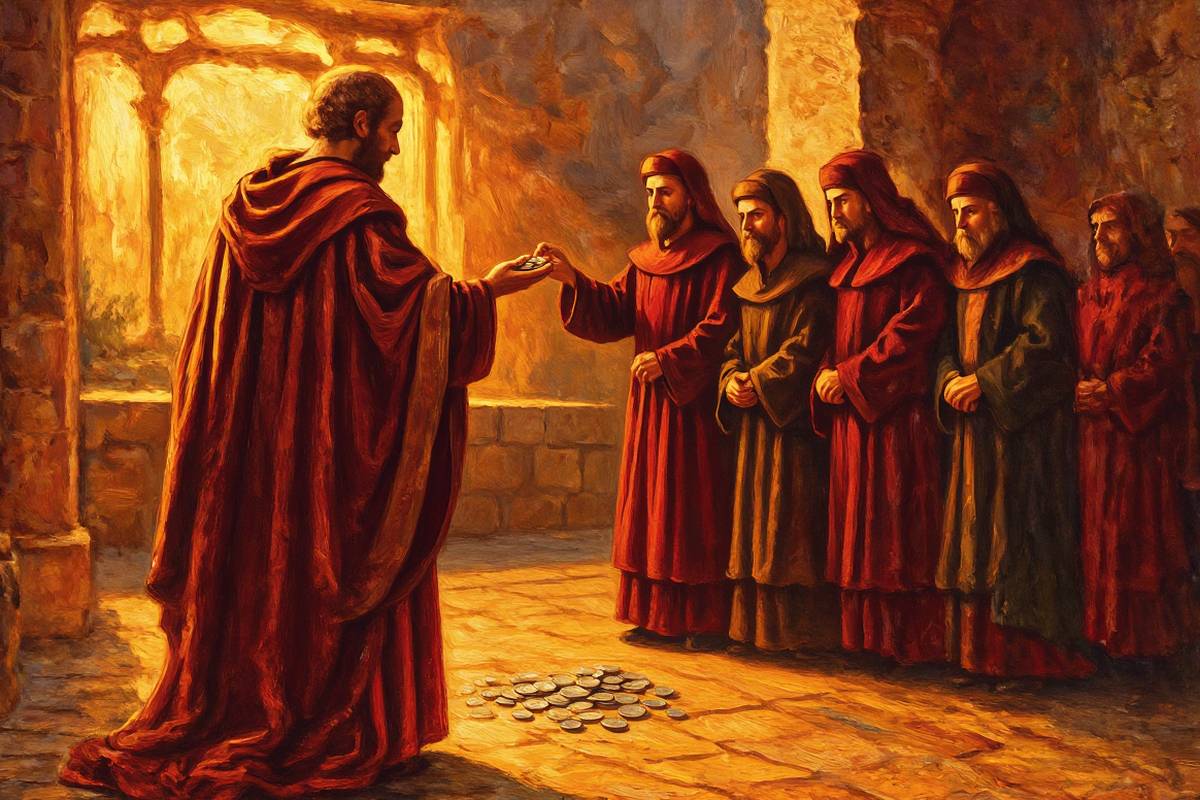
In Luke 19:11–26, Jesus told a parable because His hearers thought the kingdom of God would appear immediately. A nobleman went to a far country to receive a kingdom, gave ten servants a mina each, and said, “Do business till I come.” Pastor Paul reads this as a picture of Jesus telling His army to occupy until He returns.
When the nobleman came back, the servant who earned ten minas received authority over ten cities, and the one who earned five was set over five. The servant who hid his mina in a handkerchief out of fear lost even that. God is about giving gifts, Pastor Paul says. Some play instruments and sing, some run technology, some have hospitality and remember every detail of people’s lives, and some are able to give financially.
We need one another; the hand cannot say to the foot that it has no need of it (1 Corinthians 12:21). God wants us faithful in the little things, even saying hello to someone we would rather avoid. He recalls the parable of the great supper, where invited guests made excuses about land and family, and the host filled his house with others instead (Luke 14:16–24).
Jesus asked why people call Him Lord and do not do what He says (Luke 6:46). Following Him means forsaking all, and God never takes something away unless He has something better. Salt does not dance on your steak; it just sits there and adds flavor. Faithfulness looks like doing what He asked, day in and day out.
Sometimes, though, what God asks feels like building an ark before it has ever rained. Noah still had to take the first step. Faith is the substance of things hoped for, and without faith it is impossible to please God (Hebrews 11:1–6). He adds that the righteous are bold as a lion (Proverbs 28:1), and that by His stripes we are healed (Isaiah 53:5).
Faith and Works Row Together
The final passage is James 2:14–26. What does it profit if someone says he has faith but has no works? Telling a hungry brother or sister to depart in peace, be warmed and filled, without giving what the body needs, profits nothing. Faith by itself, if it does not have works, is dead. Faith and works together, he says, create a kind of synergy.
Pastor Paul applies it from the church’s food pantry. He was nervous at first, but he learned that people come because they need help, and many open up about health, family and relationships. So he stops and tells them that above the food, he believes God wants to give them something spiritual, and asks if he can pray with them. He reports seeing people healed, finding jobs and reconciled with family, not because of special words but because he stopped and stepped out.
James points to Abraham, whose faith worked together with his works when he offered Isaac, and who was called the friend of God. God needed to see his willingness. Rahab, an ordinary person, hid the spies at the risk of her life, and she and her household were spared at Jericho. If you are willing and obedient, you shall eat the good of the land (Isaiah 1:19).
Jesus said, “You are My friends if you do whatever I command you” (John 15:12–14). Pastor Paul shares an illustration of a rowboat with one oar named faith and the other named works. Row with only one and you go in circles; use both and you go where God needs you to go.
He closes with encouragement that He who has begun a good work in you will complete it (Philippians 1:6), and that whatever you do, you do all to the glory of God, seeking the good of many that they may be saved (1 Corinthians 10:31–33). Then he prays for those who have been resisting God to surrender and take their next step of faith.
Answering God’s Ask This Week
Here are practical ways to answer the question of what God is asking of you, drawn from this message:
- Check the nine basics. Go through the table above and pick the one you have been neglecting, whether prayer, forgiveness or reading the Word.
- Thank God before your feet hit the floor. Start each morning by thanking Him for the day and asking for His help with what is ahead.
- Use your mina. Name one gift you have, such as music, hospitality, technology or giving, and put it to work in your church this month.
- Offer to pray. When someone shares a struggle, stop and ask if you can pray with them right there.
- Be faithful in the little. Say hello to the person you would rather avoid and go out of your way to be a friend.
- Take the step of faith you have been resisting. If God has been asking you to do something for a while, today is the day to start.
Timestamped Outline
- 0:00 Churches worldwide and steps of faith
- 0:53 More than a ticket to heaven: the army of God
- 1:35 Military discipline
- 3:24 For such a time as this; learning guitar at 14
- 4:59 Leading worship in school chapel
- 7:12 One person listened: a church in 37 nations
- 8:08 Believe in Jesus: Acts 16:31
- 8:58 Seek first the kingdom
- 10:42 All Scripture is profitable
- 11:35 Church involvement and forgiveness
- 13:39 Pray without ceasing
- 14:39 Love and care for widows and orphans
- 16:29 The world is watching: high on life
- 21:20 Fear tries to make us back down
- 24:18 Ephesians 2:8–10: saved for good works
- 27:21 You are His masterpiece
- 29:24 Luke 19: the parable of the minas
- 32:09 Using the gifts God gives
- 34:51 Why call Me Lord and not obey?
- 35:52 Salt and Noah’s ark
- 39:44 James 2: faith without works is dead
- 40:44 Praying at the food pantry
- 43:53 Abraham and Rahab
- 48:42 Two oars named faith and works
- 50:38 Closing prayer
Frequently Asked Questions
Does this message teach that we are saved by works?
No. Pastor Paul reads Ephesians 2:8–9 and says plainly that we cannot earn salvation; we receive it by faith as the gift of God. His point comes from verse 10: once saved, we are created for good works that God prepared for us to walk in. Works do not save us, but saving faith shows itself in action, which is why James says faith without works is dead.
How do I know what God is asking me personally?
Start with what He has already said. Pastor Paul says many people who think God has never asked them anything are not reading their Bibles. The basics apply to everyone. Beyond them, he describes a small inner prompting, such as the sense that he could pray with someone at the food pantry. He did not need God to shout; he simply acted on that inkling.
What if I am afraid of what people will think?
Pastor Paul admits the thoughts come: what will they think, what if they do not believe what I believe, what if they tell someone? His answer is that he does not care what they think of him, because he is prioritizing what God has asked him to do. He also tells of his own sweaty hands the first time he led worship. Fear did not disappear first; he took the step anyway.
Scripture References
All passages open in the New King James Version on Bible Gateway:
- Ephesians 2:8–10 — created for good works
- Luke 19:11–26 — the parable of the minas
- James 2:14–26 — faith without works is dead
- Matthew 6:33 — seek first the kingdom
- 2 Timothy 3:16–17 — all Scripture is profitable
- Hebrews 10:25 — assembling together
- Hebrews 11:1–6 — without faith it is impossible to please God
- John 15:12–14 — you are My friends
- Philippians 1:6 — He will complete the good work
How this summary was made: written with AI assistance from the sermon’s own transcript and checked against the Scriptures listed above.
Watch More Messages
If this message stirred you to take a step of faith, there are hundreds more teachings from NTC Ministries waiting for you. Browse the full sermon archive and keep growing in what God has called you to do.