Seeing God as He really is means letting His Word, not our hurts, define words like love, wrath and chastening. In this fourth message of the series, the pastor teaches that God’s chastening is correction, not punishment. Like a loving father with a son he delights in, God trains and teaches us. He does not break our legs, hurt our children or make us poor.
The message builds on the earlier teaching on love and wrath in Seeing God As He Really Is #3: What the Wrath of God Really Means. Below you will find the full video, a structured summary, the Scriptures he uses (linked to the New King James Version on Bible Gateway), a timestamped outline, and practical steps for receiving God’s correction with joy.
Sermon at a Glance
This message was posted on April 1, 2026, at NTC Ministries. The pastor opens by reviewing the series so far: many of our words about God have been distorted by experience, so we stop seeing Him as He really is. After recapping love and wrath, he turns to the day’s subject, chastisement, and the power God has given us to make choices.
His central passages are Proverbs 3:11–12 and Hebrews 12:3–11, with Nehemiah 8 showing how the joy of the Lord becomes our strength. He closes with a prayer asking God to cleanse anything that keeps us from intimacy with Him.
| Detail | Information |
|---|---|
| Speaker | The pastor (not named in the recording) |
| Series | Seeing God As He Really Is, #4 of 6 |
| Main text | Hebrews 12:3–11 and Proverbs 3:11–12 |
| Key theme | Chastening is loving correction and training, not punishment |
| Length | About 60 minutes, ending with a prayer of cleansing |
When Words Get Distorted
The pastor begins with a simple observation. Words get distorted over the years, and their meanings shift because of people’s experiences. You can say something to someone and they take offense at a meaning the word never carried, because of what it says to them.
His example is marriage. Ask what a perfect marriage is, and a husband and wife may give two different answers. They say “I do” at the altar, and then each walks off toward a different picture of the perfect marriage. Then they wonder why they argue. They are not seeing the same thing.
Much of what goes wrong in churches, he says, comes from the same problem. Organized church is not bad; God is a God of decency and order. But definitions have changed, and we have stopped seeing words for the truth. “That’s what this series is about, seeing God as he really is.”
A dictionary, he explains, is really full of pictures. When you read the word snow, you do not see four letters; you see flakes falling, banks piling up and your aching back from shoveling. When our pictures come from bad experiences instead of truth, we get God wrong. Seasons are a gift from God (Genesis 8:22), and so are jobs and churches, yet one bad experience can make someone decide that all jobs or all churches are bad.
That is why we need truth. Jesus told those who believed Him that if they abide in His word, they will know the truth, and the truth will make them free (John 8:31–32). Love, he says, “has to be defined by God’s word, not people’s experiences.”
Love That Is Returned
Reviewing the first part of the series, the pastor compares two verses. “For God so loved the world that He gave His only begotten Son” (John 3:16). And Peter, turning around, saw the disciple whom Jesus loved following (John 21:20).
In English Bibles both are simply “love,” but he teaches that they are two different words. God loves the whole world with immense love. The love between Jesus and John was a reciprocal affection: John received Jesus’ love and loved Him back, and that is why he was following. Knowing the stories and memorizing Scripture is not the same as a relationship. “Unless they accept his love and love him back,” he says, they do not have a relationship with God.
Jesus put it plainly in John 14:21: he who has My commandments and keeps them is the one who loves Me, and he will be loved by My Father, and I will manifest Myself to him. That, the pastor says, is where signs, wonders and miracles come in.
He compares it to an electrical circuit. Reading the Bible is one line going out; doing it brings a line coming back, and the light comes on. People who say miracles are not for today have often read the Word without applying it. A young man cleanses his way by taking heed according to God’s Word (Psalm 119:9), not just by knowing it.
Wrath That Protects
Next he reviews the teaching on wrath. Many Christians think God’s wrath is His anger, as if He is waiting to strike people down. The pastor teaches that the word he traces for wrath pictures a river overflowing its banks: water going where it was never channeled to go. God’s wrath is Him doing something He does not want to do, in order to protect the innocent.
He compares it to a police officer. Most officers never draw their gun in their whole career, and when they do, it is not because they are angry, but to protect innocent people from harm. In the same way, a church may ask someone to leave when they are harming others and will not listen. A church, he notes, is not a public place but one people enter by invitation, a hall of kings where believers come to be healed and get their marching orders.
Isaiah 5:20–21 warns against those who call evil good and good evil. Justice and mercy, he says, cannot be applied independently. Justice alone becomes hard and ever more legalistic; mercy alone means anything goes. A child left to himself brings his mother shame (Proverbs 29:15). God’s wrath only overflows to bring a proper balance of justice and mercy. The law came through Moses, but grace and truth came through Jesus Christ (John 1:17).
All the law and the prophets hang on loving God and loving your neighbor (Matthew 22:36–40). Nowhere did God’s love overflow as greatly as at the cross, where all the wrath of God came upon Jesus. “Having now been justified by His blood, we shall be saved from wrath through Him” (Romans 5:9–10). Will a believer ever experience the wrath of God? “Never,” he says. Just as the blood on the doorposts caused the death angel to pass over in Egypt, God did not appoint us to wrath but to obtain salvation (1 Thessalonians 5:9–11). So comfort one another: God is on your side.

Choose Life: The Earth Is Leased to Us
That brings him to the day’s message. God has given us the power to make choices. When He created mankind, He gave them dominion over the works of His hands. The heavens are the Lord’s, but the earth He has given to the children of men (Psalm 115:16).
He explains this as a lease. A friend of his in California needed a building and found one on a closed military base. The base would not sell or rent, but offered to lease it for a dollar for a hundred years. For the length of that lease, his friend could do what he wanted with it. “That’s us with this earth,” the pastor says. When this age is over, God takes it back.
So God says in Deuteronomy 30:19–20, “I have set before you life and death, blessing and cursing; therefore choose life.” Many people do not choose life, because they see God as the one who breaks their leg, hurts their kids and makes their animals die.
He relays a family testimony Paul had shared. The family’s dog had a tumor and was scheduled for an ultrasound before possible surgery. Standing on the truth that a righteous man regards the life of his animal (Proverbs 12:10), Paul commanded the tumor to leave in Jesus’ name. That night, as Paul told it, the dog vomited and the tumor was lying on the ground. The ultrasound later showed nothing there.
God made us kings and priests (Revelation 1:6), and where the word of a king is, there is power (Ecclesiastes 8:4). We do not beg God to do what He commanded us to do. If we love Him and do what He says, He and the Father will come and make their home with us (John 14:23). Sovereign, he adds, does not mean God does whatever He wants at any moment. It means He is self-sufficient and needs no aid, yet He chose to include us as workers together with Him.
The Joy of the Lord Is Your Strength
“He’s not mad at you. He doesn’t hate you, but he’ll chastise you,” the pastor says. Proverbs 3:11–12 says, “My son, do not despise the chastening of the Lord, nor detest His correction; for whom the Lord loves He corrects, just as a father the son in whom he delights.” Not a son He is angry at, but one He delights in.
He describes how he corrected his own son: “let’s go for a car ride,” and they would talk through what happened and pray. That, he says, is what God wants to do with you. He is not an abuser. People attribute things to God that we would put a human father in jail for.
He reads Isaiah 51:4, where God says He will make His justice rest as a light of the peoples. He explains that the ancient rabbis taught that light is God’s connection with man’s spirit, and that when we reunite with God, His light shines brighter for us. It is not that His power increases, but that His joy increases, and His joy becomes our strength.
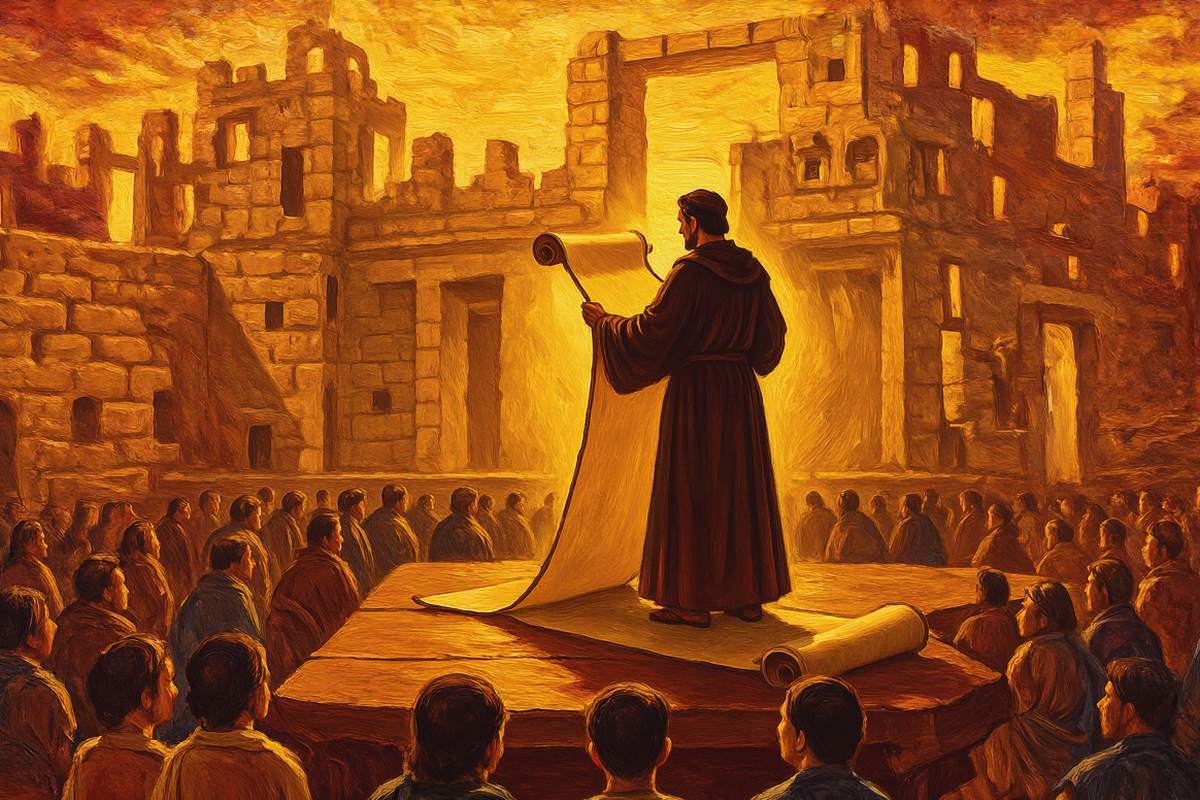
Nehemiah shows it. While rebuilding the walls of Jerusalem, the workers held a tool in one hand and a weapon in the other, and Sanballat tried to discourage them with lies. Then Ezra read the Law, and the people wept, thinking God must hate them. But Nehemiah, Ezra and the Levites said, “This day is holy to the Lord your God; do not mourn nor weep… for the joy of the Lord is your strength” (Nehemiah 8:9–12).
When you press in to hear His Word and do it, imperfect as you are, you put joy in God’s heart, and that becomes strength for you. You did not choose Him; He chose you to bear much fruit (John 15:16). The thief comes to steal, kill and destroy, but Jesus came that we might have life more abundantly (John 10:10). “God doesn’t ever deal with us in a negative way,” he says.
Seeing God as He Really Is in Chastening
Attributing the works of the devil to God, the pastor says, is a perfect example of calling good evil. People say a child broke an arm because God wanted to teach them something, yet no one ever comes back later to say what the lesson was. Jesus said that whoever has seen Him has seen the Father (John 14:9), and Jesus never made anyone sick or poor. Chastisement is a demonstration of God’s love, not injury.
He has taught a college class for years on the fellowship of Christ’s sufferings. Paul wrote that he wanted to know the power of Christ’s resurrection and the fellowship of His sufferings (Philippians 3:10). After studying every passage on suffering, he says, not one means God making you sick, poor or crushed beyond what you can bear. The suffering is living in a corrupted world where a born-again person no longer fits, because heaven is home.
Then comes Hebrews 12:3–11: whom the Lord loves He chastens, and He scourges every son whom He receives. No chastening seems joyful at the time, but afterward it yields the peaceable fruit of righteousness to those trained by it. “Chastening is correction not punishment,” he says.
His picture is a GPS. Miss a turn and it says you are off course and recalculates. Imagine if a GPS worked the way many Christians think God chastens: a jolt through the seat, a crash into a storefront, people hurt and you led away in handcuffs. Real correction simply says to turn around. That is repentance.
Correction can still be unpleasant, he admits, because it is an affront to our egos. But if we confess what is wrong, God is faithful and just to forgive and cleanse us (1 John 1:9). He argues that the idea of holiness through suffering came centuries after Jesus, tracing it to Augustine, and quotes Archbishop Trench, who wrote that Augustine redefined the word from God lovingly redirecting His children into making them pay for their sins.
The table below follows how he restores the meaning of the words in this series.
| Word | Distorted picture | Meaning as he teaches it |
|---|---|---|
| Love | God loves everyone the same, so relationship is automatic | God loves all, but relationship comes when we love Him back |
| Wrath | God’s anger, waiting to strike | An overflow to protect the innocent; Jesus bore it for us |
| Sovereign | God does whatever He wants, whenever He wants | Self-sufficient, needing no aid, yet choosing to include us |
| Chasten | Punishment, sickness or loss | To train up and educate a child |
| Scourge | To severely punish | A word that can also mean to attract, drawing us to Himself |
Good and upright is the Lord; therefore He teaches sinners in the way (Psalm 25:8–10). The goodness of God leads us to repentance (Romans 2:4–6). Reading the passage in the Passion Translation, he highlights that when God draws you to Himself, it proves you are His delightful child.
Receiving God’s Correction This Week
The pastor closes by asking everyone to pray: God, forgive me for the quirks and idiosyncrasies that keep me from intimacy with You; I call them sin, cleanse them by Your blood. Here are practical steps from this message on seeing God as He really is:
- Check your definitions. When you think of God’s love, wrath or chastening, ask whether the picture came from Scripture or from a bad experience.
- Love Him back. Do what His Word says, not just read it, and expect Him to manifest Himself to you.
- Choose life. Take your authority as a king and priest, and speak His Word over the situations entrusted to you.
- Treat correction as a GPS. When the Holy Spirit says “off course,” turn around without fear of punishment.
- Stop blaming God for the thief’s work. Sickness, poverty and destruction come from the thief, not the Father.
- Bring Him joy. Press in to His Word and obey it, and let His joy become your strength.
Timestamped Outline
- 0:00 Words that get distorted: the marriage example
- 1:12 Review: love in John 3:16 and John 21:20
- 3:27 John 14:21: love Him back and He manifests Himself
- 5:38 Review: wrath as an overflowing river
- 8:07 Protecting the innocent and the hall of kings
- 10:41 Justice and mercy belong together
- 13:31 A dictionary is full of pictures
- 15:55 John 8:32: the truth makes you free
- 18:07 Matthew 22: the greatest commandments
- 20:38 Romans 5:9–10 and 1 Thessalonians 5:9–11
- 23:07 The earth leased to man
- 25:13 Deuteronomy 30:19–20: choose life
- 28:42 What sovereign really means
- 29:54 Proverbs 3:11–12: correction from a delighted father
- 34:16 Light and joy: the rabbis’ teaching
- 36:30 Nehemiah 8: the joy of the Lord is your strength
- 38:37 John 10:10: the thief and abundant life
- 41:08 Calling good evil: blaming God
- 43:48 The fellowship of Christ’s sufferings
- 46:16 Hebrews 12: whom the Lord loves He chastens
- 47:23 Correction is a GPS
- 51:09 Where the idea of suffering for holiness came from
- 53:52 Psalm 25 and Romans 2:4
- 55:04 Chasten means to train; scourge means to attract
Seeing God As He Really Is Series
This message is part of a six-part teaching at NTC Ministries. Start from the beginning or continue where this one leaves off:
- First message: Seeing God As He Really Is #1 — Completing the Love of God
- Previous: Seeing God As He Really Is #3: What the Wrath of God Really Means
- You are here: Seeing God As He Really Is #4: Chastening Is Correction, Not Punishment
- Next: Seeing God As He Really Is #5: Connection — God’s Hugs and Kisses
Frequently Asked Questions
Does God send hardship to teach me a lesson?
The pastor says no. He calls the idea that God broke a child’s arm to teach a parent something an example of calling good evil, and he notes that no one ever comes back later able to say what the lesson was. Jesus revealed the Father and never made anyone sick or poor. The thief comes to steal, kill and destroy; Jesus came to give abundant life. God corrects through His Word and His Spirit, like a father talking things through with a son.
Why do born-again believers sometimes feel they do not belong?
He connects this to the fellowship of Christ’s sufferings. Once you are born again, you are not the same person, so you do not fit comfortably into a corrupted world. Heaven is your home and you are sojourning here. Any attempt to simply blend in will not work, he says, because you have changed. That discomfort, not sickness or poverty, is what he teaches the suffering of Christ’s fellowship really means.
Do I need to weep and suffer to prove I have repented?
No. The pastor says some churches do not believe a person has repented unless they see crying and anguish, but that is not in the Word. Repentance is a change of direction, like turning around when a GPS says you are off course. When we confess our sin, God is faithful and just to forgive and cleanse us, and that brings us close to Him, where His joy becomes our strength.
Scripture References
All passages open in the New King James Version on Bible Gateway:
- Hebrews 12:3–11 — whom the Lord loves He chastens
- Proverbs 3:11–12 — as a father the son in whom he delights
- Nehemiah 8:9–12 — the joy of the Lord is your strength
- John 14:21 — I will manifest Myself to him
- Romans 5:9–10 — saved from wrath through Him
- Deuteronomy 30:19–20 — choose life
- John 10:10 — life more abundantly
- Psalm 25:8–10 — He teaches sinners in the way
How this summary was made: written with AI assistance from the sermon’s own transcript and checked against the Scriptures listed above.
Watch More Messages
If this message helped you see your Father more clearly, there are hundreds more teachings from NTC Ministries waiting for you. Browse the full sermon archive and keep growing in the truth that sets you free.